
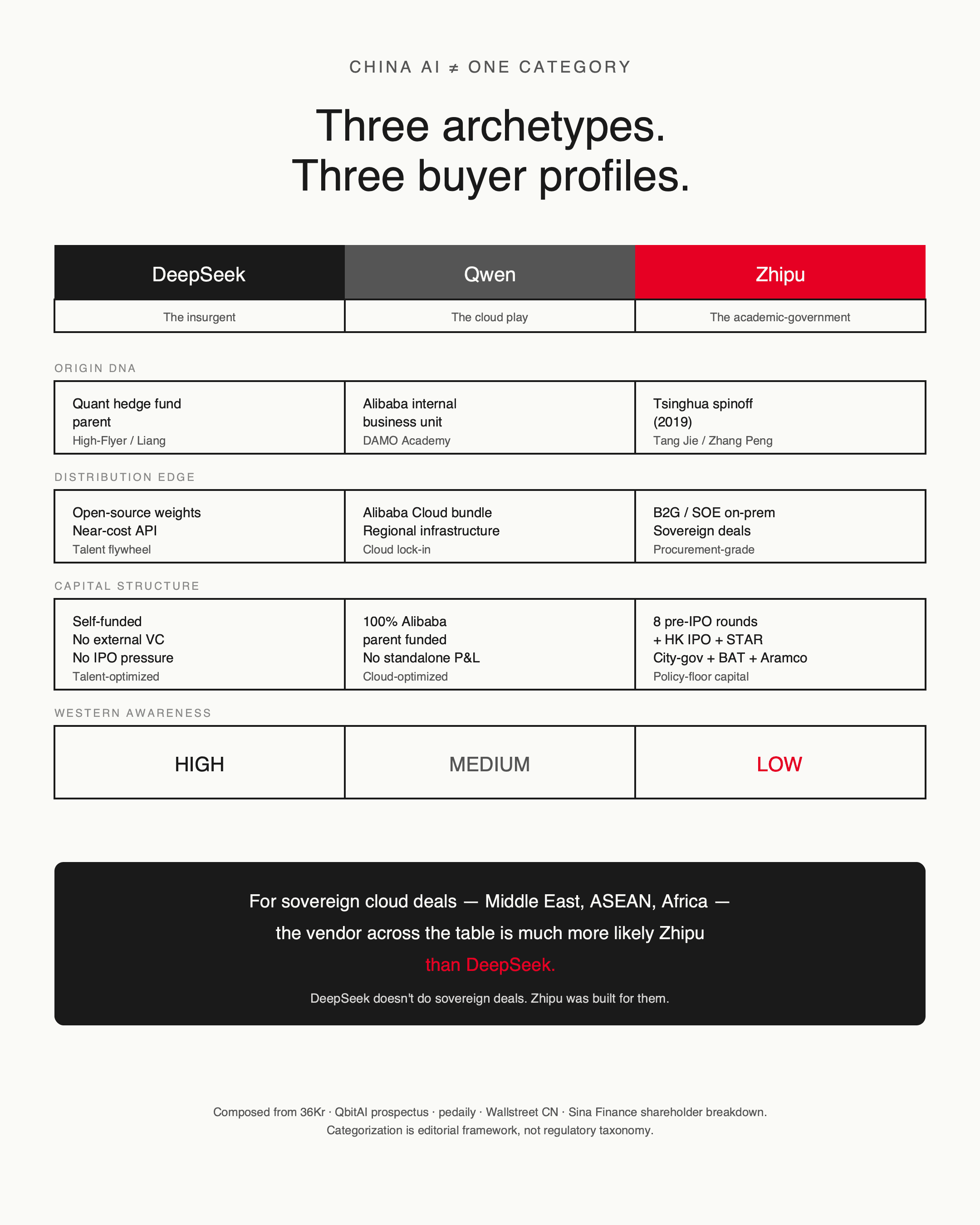
It isn't DeepSeek vs OpenAI. China has three AI lab archetypes, and most Western operators only know one. Here's the map that fixes your vendor evaluation framework.
On Monday June 22, 2026, Zhipu AI (HKEX: 2513) became the first pure-play Chinese LLM company to cross HK$1 trillion in market cap — roughly US$128 billion.
The stock has run about 2,467% year-to-date since its January 8, 2026 Hong Kong IPO. The proximate trigger: GLM-5.2 release, which JPMorgan flagged as ranked #2 globally on Code Arena front-end web dev — behind Anthropic's Claude Opus tier.
If you cover Chinese AI from English sources, this is probably the first time you're hearing the name. That's not an accident. Western media coverage has compressed Chinese AI into one company — DeepSeek — for 18 months. The other labs get filed mentally under "DeepSeek-like cheap inference."
That filing is wrong. China doesn't have one type of AI lab. It has three. You probably only know one in operator-relevant detail.
The 165-day rally Western analysts almost entirely missed
- January 8, 2026 — IPO on HKEX. Price HK$116.20. Day-one close: HK$57.89B market cap.
- February to May 2026 — Stock climbs from ~HK$200B to ~HK$600B. Almost no English coverage. Chinese-language coverage (36Kr, 量子位, 财联社) is steady but doesn't translate.
- June 9-10, 2026 — STAR Market dual-listing announced — targeting ¥15B (~US$2.2B) on Shanghai 科创板.
- June 22, 2026 — GLM-5.2 release + JPMorgan upgrade pushes the stock through HK$1T. Peak intraday: HK$2,980, +42% on the day.
The five-month gap between IPO and HK$1T, during which the stock 5x'd, is the gap where Western operators could have been getting smart. Most weren't. The discovery moment for English-speaking readers is essentially now — the day after.
That's the operator alpha. The companies sophisticated buyers will negotiate with in 12 months are the companies almost nobody is writing about in English today.
China's AI doesn't have six companies. It has three archetypes.
When Western coverage groups "Chinese AI" together, the implicit model is that all the major Chinese labs are interchangeable. They produce models, the models are cheaper than OpenAI, end of analysis.
That model is wrong in roughly the same way "Chinese tech" was a useless category in 2015. Treating Alibaba, Tencent, ByteDance, and Pinduoduo as a single bucket would have given you bad bets that whole decade.
Archetype 1 — The insurgent open-source flywheel (DeepSeek)
Self-funded by a quant hedge fund parent. Releases open weights aggressively. Monetizes inference at near-cost. Optimizes for talent flywheel and ecosystem capture, not API margin. Founder: Liang Wenfeng. Capital structure: zero external investors, zero IPO pressure. Western devs already use it. Coverage in English is extensive.
Archetype 2 — The cloud-bundled platform play (Qwen / Alibaba)
The model is a feature of Alibaba Cloud — bundled, distributed, and monetized through the cloud ecosystem rather than direct API margin. No founder in the traditional VC sense; Qwen is an Alibaba business unit. Strategic logic: lock-in to Alibaba Cloud's regional infrastructure. Western awareness: medium-high in the HuggingFace community, low in the boardroom.
Archetype 3 — The academic-government-industrial complex (Zhipu)
Spun out of Tsinghua University in 2019. Founders include Tang Jie, Zhang Peng, and Li Juanzi — all academic AI veterans. Capital structure includes city-level state funds (Beijing, Hangzhou, Chengdu, Zhuhai), strategic corporate investors (Ant Group, Meituan, Tencent, Alibaba, Saudi Aramco's Prosperity7), and top-tier domestic VCs (Legend Capital, Dachen, Qiming, Sequoia China, Hillhouse).
Customers are heavy on Chinese SOEs, financial institutions, and government tenders. Distribution edge: on-premises enterprise deployments and government procurement-grade compliance posture.
These three archetypes don't compete in the same way. They don't sell to the same buyers. They don't have the same exit dynamics. They don't react to the same regulatory signals.
Policy-funded runway changes your competitive modeling
Most competitive modeling of Chinese AI labs treats them like Silicon Valley startups: 18-30 month runway, VC discipline, hit profitability or die.
That mental model is wrong for Zhipu specifically. The HK$1T market cap is sitting on a true public float of less than 4%. Cornerstone investors at the January IPO included ~HK$30B from Beijing state vehicles. Pre-IPO rounds pulled city-government capital from Beijing, Hangzhou, Chengdu, Zhuhai. STAR Market dual-listing in June targets another ¥15B from A-share investors.
- Zhipu's spend is not constrained by market discipline.
- The implicit valuation floor is policy, not unit economics.
- The 18-30 month subsidy window I argued for DeepSeek doesn't apply here.
Zhipu's runway is policy-funded. Plan competitive responses accordingly — they can sustain below-market pricing substantially longer than your normal analysis suggests.
Code Arena #2 and the coding catch-up vector
GLM-5.2 was open-sourced June 17, 2026, and placed #2 globally on Code Arena front-end web dev. The model ahead is Anthropic's Claude Opus tier. On most synthetic-benchmark composites the gap to top overseas models compressed to a 1-4% band.
Coding agents are where the China-US gap closes fastest. Three structural reasons:
- Training data is fully public — GitHub, Stack Overflow, package source. Chinese labs don't have a data disadvantage on coding the way they might on English literary corpora.
- Evaluation is automatable. Compile, run, test, score. RL on coding tasks scales cleanly with compute. Chinese labs have strong reinforcement-learning fine-tuning chops.
- The use case is enterprise-procurement-friendly. Latency, security, price — not content moderation or brand voice. Chinese vendors compete cleanly on those axes.
12-month projection: GLM-5.2, DeepSeek V4/V5, and Qwen Coder will all be at near-parity with Cursor's current Claude/GPT defaults on coding tasks. The price will land at 20-40% of incumbent Western models.
The procurement debate inside Western engineering teams shifts from "should we use Chinese models" to "how do we vet which Chinese coding agent."
Three things Western coverage will keep getting wrong
Frame error #1: "Chinese OpenAI rival hits trillion-dollar valuation"
This treats Zhipu as a one-to-one OpenAI competitor. It isn't. OpenAI's revenue base is global consumer and enterprise API. Zhipu's revenue base is Chinese SOEs and financial institutions on private deployments. Different markets, different buyers, different regulatory regimes.
Frame error #2: "China AI stocks surge on benchmark wins"
This treats the rally as benchmark-driven. The benchmark was the trigger. The fuel was sovereign capital structure with sub-4% public float. Chinese AI stocks listed on HK or A-shares will keep behaving like this — large, abrupt repricings driven by float dynamics, lock-up calendars, and state capital flow.
Frame error #3: "Geopolitics is the main story"
Geopolitics is a slow-moving constraint. The fast-moving story is industrial. Chinese AI labs are now structured, capitalized, and benchmarked to compete with US labs in specific verticals (coding, enterprise deployment, sovereign cloud) — and the structures are increasingly distinct from each other.
The right unit of analysis is the archetype, not the geopolitical bloc.
The one question that should be on your roadmap by Friday
"Do I have a vendor evaluation framework that distinguishes Archetype 1, 2, and 3 Chinese AI providers — or am I still treating them as a single category?"
Most procurement teams I've seen don't even have language for the distinction. Their internal docs say "Chinese LLM vendor risk" as a single bullet. That's the framework debt.
Draft a one-page internal note that names the three archetypes, identifies the lead vendor in each, and writes a short decision tree for which one your team is likely to encounter. If you do this honestly, you'll find your team is preparing to negotiate with DeepSeek by default — when the actual vendor across the table in your specific category might be Zhipu, Qwen, or someone you haven't named yet.
The teams that read Zhipu's HK$1T milestone as a curious headline will keep underwriting Chinese AI as a single category through 2027. The teams that read it as a category bifurcation signal will have the procurement and competitive frameworks ready when their sales pipeline starts naming names other than DeepSeek.
"Pick by archetype, not by headline."
Weekly Newsletter · Free
One letter a week. No fluff.
Every Monday, one dispatch on what's actually working in China — and the cross-border arbitrage Western brands keep missing.
Subscribe free →About the author
Annie Chan
Ex-Transsion Global Digital Marketing Director · 60 countries operated · Bestselling Author · Writes Annie Chan Talk — your insider lens on China.
Read more about Annie →