
The geopolitics framing is wrong. The real story rewrites your M&A playbook — how to value agent SaaS, how to structure China-origin M&A, and which exits remain viable for the next wave of Chinese AI teams.
On April 27, 2026, China's NDRC did something no regulator had done before: it ordered a closed cross-border AI acquisition to be unwound.
The target was Manus. The buyer was Meta. The price tag was around $2 billion, announced on December 30, 2025. Xiao Hong, Manus's founder and CEO, joined Meta as a Vice President. The product was folded into Meta Super Intelligence Lab (MSL), the unit led by Alexandr Wang.
Western coverage has been reporting this as a US-China geopolitics story. That's the lazy frame. The real story is a product story, and it rewrites three things at once: how you value agent SaaS, how you structure China-origin M&A, and which exits remain viable for the next wave of Chinese AI teams.
This is the post for operators, M&A leads, and founders sitting on Singapore-flipped cap tables. You're going to want it the next time a deal memo lands on your desk with "founder originally from Beijing" in the bio line.
The $2B deal nobody is reading carefully enough
The headline math everyone's repeating:
- Acquisition price: ~$2 billion (range $2-3B per leaked reports; exact cash-stock split never disclosed)
- Manus revenue run-rate at close: $125M ARR
- Implied multiple: ~16× ARR
- Time from $0 to $100M ARR: 8 months
That's a defensible multiple for a 16× ARR agent company growing this fast. By itself, the deal would not be especially interesting. SaaS comps in 2026 trade in the 12-20× ARR range.
Here's the part the coverage skipped: Manus wasn't running its own frontier model.
The product was built on Anthropic's Claude 3.5 Sonnet at launch (March 6, 2025), upgraded to Claude 3.7 Sonnet through 2025, with a fine-tuned Qwen instance handling specific subtasks. The actual Manus IP is the agentic orchestration layer — multi-agent manager, sandbox infrastructure (browser + Python interpreter + filesystem + terminal), todo-planning subagent, context isolation, and filesystem-based memory.
Meta paid 16× ARR for a product whose intelligence layer was rented from a direct OpenAI competitor. Sixteen times ARR for a Claude wrapper.
You can read that as Meta overpaying. I think the right read is the opposite. Meta paid the going rate for an agentic product loop that scaled to 80 million virtual computer instances and 147 trillion processed tokens before its first birthday. The model was rented. The product moat was real.
The moat in agent SaaS is orchestration, distribution, and eval harness — not weights.
The Singapore loophole that just died
In mid-2025, Manus did what dozens of China-origin AI startups quietly did over 2024-25. They moved the parent company seat from Beijing/Wuhan to Singapore. Relocated 40 core engineers. Laid off about 80 China-based staff. The corporate structure on paper became Singapore-headquartered, Singapore-domiciled, Singapore-IP.
This was the standard playbook. The unstated assumption: a Singapore HQ severs Chinese regulatory jurisdiction, which makes Western M&A or VC exits viable.
That assumption is now dead.
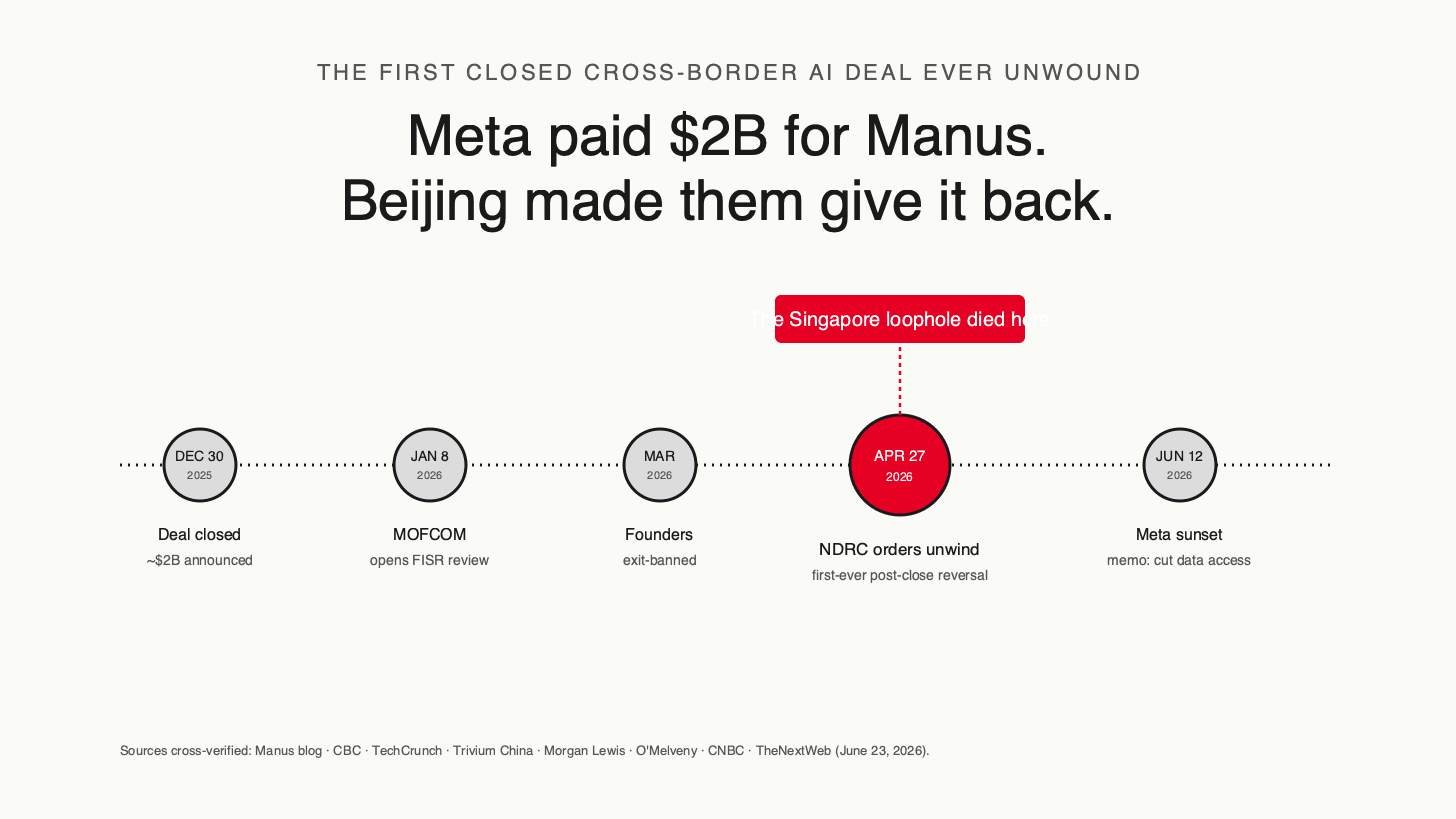
Timeline of how Beijing answered:
- Dec 30, 2025 — Meta-Manus deal announced
- Jan 8, 2026 — MOFCOM opens FISR (Foreign Investment Security Review)
- March 2026 — Beijing exit-bans Xiao Hong (CEO) and Ji Yichao (Chief Scientist)
- April 27, 2026 — NDRC orders deal reversed. First closed cross-border AI acquisition unwound.
Morgan Lewis and O'Melveny both published legal alerts within 10 days. Diplomatic language; identical conclusion: corporate seat flip does NOT sever Chinese regulatory jurisdiction if founders, core IP, or R&D originated in mainland China.
The Singapore wrapper is now legally cosmetic. The Delaware C-Corp wrapper too. The Cayman wrapper too.
What this means for M&A leads on China-origin pipeline
If you have China-touched targets on your active pipeline, your underwriting model needs a new line item: post-close reversal risk.
You can sign, close, integrate — and still be ordered to unwind 16 months later. Two billion dollars in writedowns.
Hard advice for hyperscaler M&A leads in 2026: scratch every China-origin AI target off the active pipeline. Not for two months. For at least 24 months.
Viable replacement targets
- Israeli (Tel Aviv-incorporated since Day 0)
- Indian (Bangalore/Delhi-incorporated since Day 0)
- European (Berlin/Paris/London-incorporated since Day 0)
- US-domiciled since Day 0 (not flipped from a China parent)
Talent flow changes too. Chinese founders looking for US-buyer exit math will need to incorporate as a US legal entity from Day 0, not after Series A.
Three product lessons that survive the unwind
Lesson 1: Sandbox economics is the agent SaaS cost line that matters
Manus had 80 million sandbox instances spun up in less than 12 months. 147 trillion processed tokens. $125M ARR.
Every single task got its own Linux VM with browser + Python interpreter + filesystem. That's not a model story. That's a sandbox cost-optimization story — and Meta paid 16× ARR for it.
If you're building agent products, the cost line that decides whether you ship at scale is not GPU spend on the model. It's the per-task sandbox compute.
Lesson 2: The eval harness is the moat
Your moat isn't the model. It's not even the orchestration layer (that's table stakes now).
It's the eval harness. The thing nobody talks about. How do you know your agent does X correctly across edge cases? Your competitor with worse architecture but a tighter eval loop will ship faster, iterate cleaner, and win enterprise contracts.
Manus built this. So did Cursor. So did Anthropic. If you're an agent product founder optimizing weights or even orchestration — switch your last 2 months of engineering to eval harness instead.
Lesson 3: Rented intelligence + owned product loop is a defensible architecture
Manus proved 16× ARR for a product built on rented frontier intelligence. As long as you have the orchestration loop, distribution, and eval moat — your model dependency is a feature, not a bug.
Renting Claude or GPT-4 means you ride the frontier without absorbing $100M+ training costs. The exit math still works.
What's next for the next wave of Chinese AI teams
If you're a Chinese AI founder with Western buyer exit math in your model, three things changed permanently:
- Corporate seat flip ≠ regulatory severance. Singapore/Delaware/Cayman wrappers are legally cosmetic if founders or core IP originated in mainland China.
- Hyperscaler M&A pipeline is closed for ~24 months. Plan for IPO (HKEX/STAR) or strategic acquisition by Chinese tech (Tencent/Alibaba/Bytedance) instead.
- If you genuinely want US-buyer exit, incorporate US legal entity from Day 0 — before Series A, before product launch.
The map of viable exits for Chinese AI is now: HK IPO, STAR IPO, or strategic acquisition by a Chinese tech major. Western M&A is off the table until Beijing publishes a clarifying rule that re-opens the path.
Xiao Hong is reportedly targeting an HK IPO with ~$1B in founder buyback. The next wave of Manus-equivalents will plan for this path from Day 0, not as a Plan B.
"The agent SaaS moat is orchestration, eval, and distribution. The model is rented. The product loop is owned. Pick that architecture before you pick your exit."
Weekly Newsletter · Free
One letter a week. No fluff.
Every Monday, one dispatch on what's actually working in China — and the cross-border arbitrage Western brands keep missing.
Subscribe free →About the author
Annie Chan
Ex-Transsion Global Digital Marketing Director · 60 countries operated · Bestselling Author · Writes Annie Chan Talk — your insider lens on China.
Read more about Annie →