China Market Entry Strategy: Why the Entry-Mode Question Is the Wrong One
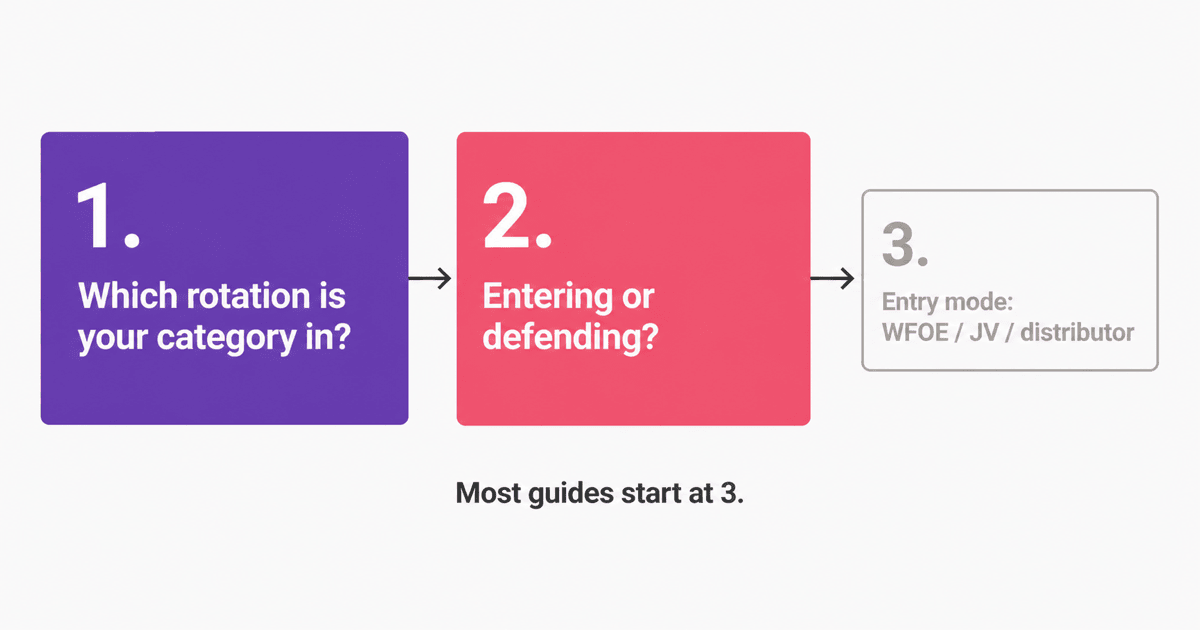
WFOE, joint venture, distributor, cross-border e-commerce — every guide starts here, and starting here is why so many entries fail. The prior question is which rotation your category is already in, and whether you are entering a market or defending against one.
Annie Chan··14 min read
Search "China market entry strategy" and you will get the same article about forty times. It lists the entry modes — representative office, wholly foreign-owned enterprise, joint venture, distributor, franchise, cross-border e-commerce — compares them on control and cost, and closes with a note about the importance of guanxi.
The information is not wrong. It is just answering a question that comes third, and the two questions ahead of it determine whether the entry works.
Question one: which rotation is my category already in? Question two: am I entering a market, or defending against one that is coming to me? Only then does entry mode matter.
Why entry mode became the default framing
The entry-mode framework was built for a market that existed between roughly 1995 and 2015 — one where foreign brands held the premium tier, domestic competitors competed on price, and the strategic question genuinely was how much control you wanted over your local operation.
In that market, entry mode was the decision. Get the legal structure right, find a competent partner, and the underlying assumption — that a Western brand carries a quality premium into a growing middle class — did its own work.
That assumption stopped holding somewhere around 2018. The evidence is now unambiguous in category after category. Domestic beauty (国货) crossed 57% market share while Estée Lauder posted a $1.13 billion loss. BYD holds 53.9% of its domestic segment. Mixue and Luckin together operate roughly 84,000 stores — about 2.7 times the combined footprint of Western chains in China. Pop Mart's Americas business grew 748% selling characters most Western retail buyers had never heard of.
"You can pick the perfect entry mode into a category where the premium tier is no longer yours to hold, and the structure will execute your strategy flawlessly into a wall."
Question one: which rotation is your category in?
Every category I have looked at closely sits somewhere on the same four-stage progression. Where yours sits determines almost everything downstream — timeline, budget, partner selection, and whether entry is even the right verb. For the same framework applied to five well-known exits — Uber, Samsung, Amazon, Walmart and Google — see why brands actually fail in China.
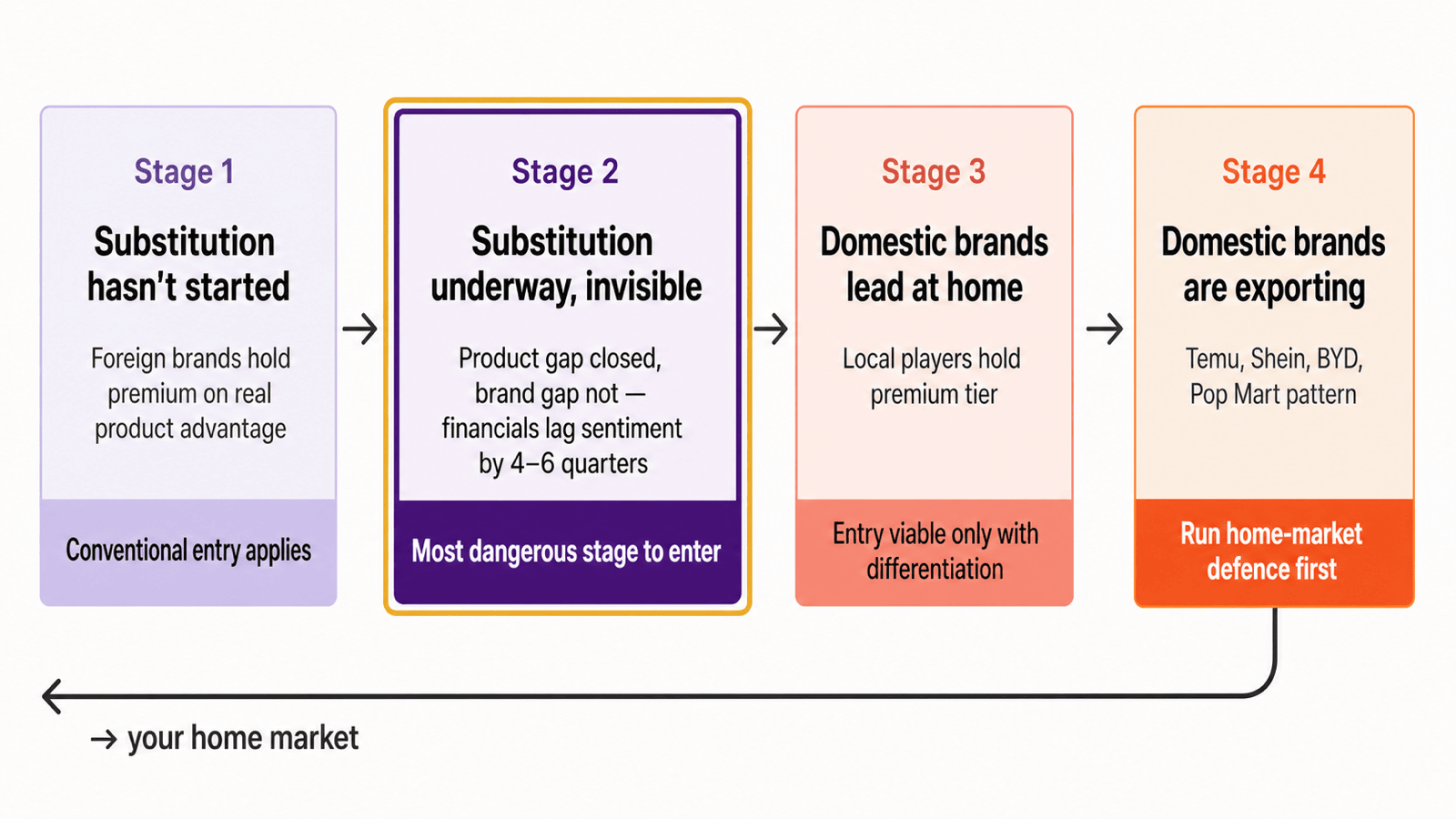
The four stages. Stage 2 is the one that catches entrants: the product gap has closed but the financials have not caught up yet.
Stage 1 — Domestic substitution has not started
Foreign brands still hold the premium tier on genuine product advantage. Local competitors compete on price and have not closed the quality gap. This is the market the classic playbook was written for, and it still exists in a shrinking number of categories — typically ones with hard technical moats or long regulatory approval cycles.
Entry here is relatively conventional. The classic guides apply.
Stage 2 — Substitution is underway and invisible from outside
Domestic players have closed the product gap but not yet the brand gap. Foreign share is still respectable, so the quarterly numbers look fine. Meanwhile the conversation on Chinese platforms has already shifted — dupe comparisons appear, price sensitivity rises, and the domestic alternative starts being described as the sensible choice rather than the cheap one. That shift has a name — guo chao — and it is not the patriotism story Western coverage sells.
This is the most dangerous stage to enter, because the financial data lags the sentiment data by four to six quarters. Teams enter on the basis of numbers that describe a market that no longer exists.
Stage 3 — Domestic brands lead at home
Local players hold the premium tier. Foreign brands compete as specialists or on heritage. Entry is possible but the positioning has to be genuinely differentiated — arriving as a generic Western premium option is arriving as a worse version of what the market already has.
Stage 4 — Domestic brands are exporting
The rotation has left China. Chinese players are now competing in your home market — the Temu, Shein, BYD, Pop Mart pattern. At this stage, "China market entry strategy" may be the wrong project entirely. The urgent question is your home-market defence.
I have watched teams commission a China entry study while the same company's domestic share was being taken by a Chinese entrant nobody in the room had named. Both projects were about China. Only one of them was urgent.
Question two: entering, or defending?
The second question follows from the first, and it is uncomfortable because it reframes a growth project as a risk project.
If your category is at Stage 4, the Chinese competitor coming for your home market has three advantages you should model explicitly: a manufacturing and iteration cycle measured in weeks rather than quarters, a domestic market that funded their fixed costs before they ever priced for export, and — in several sectors — capital that is not disciplined by the same return expectations as yours.
None of that is unbeatable. All of it is unbeatable if you are not modelling it.
If your category is Stage 1 or 2, entry is the live question and speed matters — the window narrows.
If Stage 3, entry is viable but only with differentiated positioning, and you should budget for a longer payback than your board expects.
If Stage 4, run the defence analysis first. Entry may still make sense — several brands have entered specifically to learn how their Chinese competitors operate — but it is a learning investment, not a growth one.
Now the entry-mode question
With the rotation stage established, entry mode becomes a genuinely useful decision rather than a substitute for strategy.
The structural options have not changed much: a representative office for presence without trading, a wholly foreign-owned enterprise for control, a joint venture where regulation requires it or where a partner brings something you cannot buy, a distributor for speed and low commitment, and cross-border e-commerce for testing demand without a local entity.
What has changed is the sequencing logic. Cross-border e-commerce has become the default first step for consumer categories, not because it is cheap but because it generates the thing you actually lack: real demand data from Chinese consumers, on your actual products, before you commit capital to a structure.
"Test demand before you build structure. Most of the expensive entry failures I have seen were structures built on assumptions that a $50,000 test would have falsified."
The regulatory detail here changes frequently and varies by category, and any guide — including this one — should be treated as directional. Confirm current requirements with counsel before committing.
The barriers that actually stop people
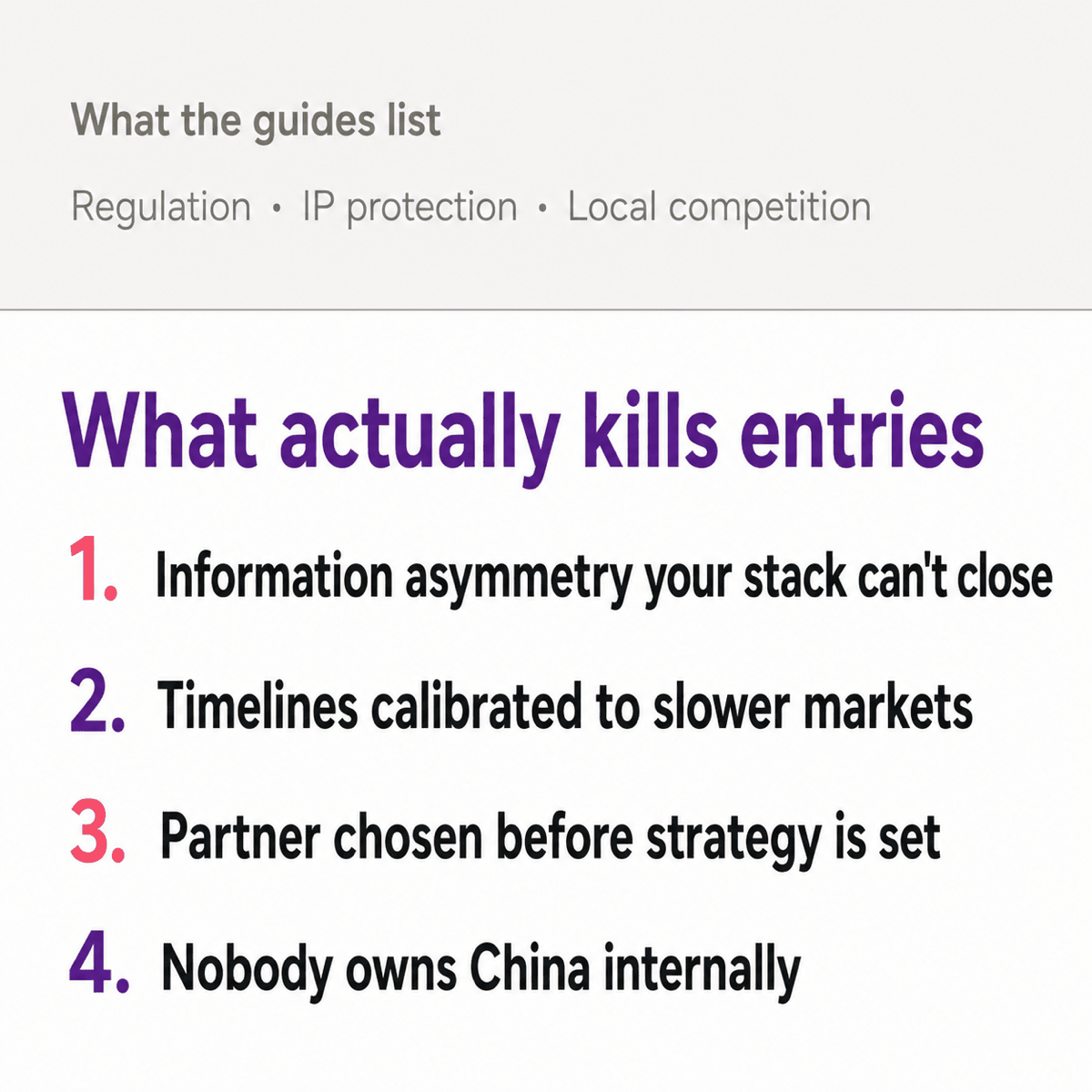
Standard lists of China market entry barriers name regulation, IP protection, and local competition. All real. But in my experience the barriers that actually kill entries are less discussed.
What the guides list, against what actually stops entries.
Barrier 1 — The information asymmetry is structural, not incidental
The decision-relevant conversation about your category happens on Chinese platforms your team cannot read. Western listening suites do index some of those platforms now, and that changes less than it sounds: what comes back is a volume line and a sentiment score generated by models trained on English text. Counting a conversation is not the same as understanding it, and this is not a gap you close by trying harder in English.
Barrier 2 — Your timeline expectations are calibrated to the wrong market
Boards that would happily fund a three-year payback in Germany routinely demand eighteen months in China, on the theory that the market is growing faster. Faster-growing markets have faster-moving competitors. The payback is usually longer, not shorter.
Barrier 3 — Partner selection happens before the strategy is set
Choosing a distributor or agency before you know your rotation stage means choosing a partner optimised for the wrong job. A partner brilliant at Stage 1 category-building is the wrong partner for a Stage 3 differentiated-niche play.
Barrier 4 — Nobody owns the China question internally
It sits across strategy, marketing, supply chain and legal, and belongs to none of them. The predictable outcome is a China project that generates documents rather than decisions.
What consulting costs, and when it is worth it
Market entry consulting for a mid-size brand generally runs into the tens of thousands for a scoped study, and considerably more for ongoing advisory. Enterprise data and monitoring add-ons for China coverage are frequently quoted in the $36,000 to $50,000 per year range.
That spend is justified when you are past the framing stage — when you know your rotation stage, you have a specific hypothesis, and you need local execution capability or primary research you genuinely cannot do yourself.
It is poorly spent when you are still at the framing stage, which is where most teams commissioning their first study actually are. A consultant paid to answer "should we enter China" will produce a competent document, and you will have paid five figures to acquire a frame you could have built for the price of a book.
That is the honest positioning of my own work. The [China Market Entry Playbook 2026](/book) runs 22 industry chapters through the same five questions — the anchor number that defines the category, the rotation underneath it, which layers of the global stack it has reached, what it means for your category, and what to do. It is $99, and it is designed to get you to the point where consulting spend is a good decision rather than a substitute for one.
Frequently asked questions
What are the main market entry strategies for China?
The structural options are a representative office (presence without trading), a wholly foreign-owned enterprise (full control, higher cost and complexity), a joint venture (required in some regulated sectors, or chosen for partner capability), a distributor arrangement (fastest, least control), franchising, and cross-border e-commerce (test demand without a local entity). For consumer categories, cross-border e-commerce has become the standard first step because it produces real demand data before capital is committed to a structure.
What are the biggest barriers to market entry in China?
Beyond the commonly cited regulatory and IP issues, the barriers that most often derail entries are: an information asymmetry that cannot be closed through English-language sources, timeline expectations calibrated to slower markets, partner selection made before strategy is set, and no clear internal owner of the China question.
How much does China market entry consulting cost?
A scoped market entry study for a mid-size brand typically runs into the tens of thousands of dollars, with ongoing advisory considerably higher. Enterprise China data and monitoring add-ons are often quoted between $36,000 and $50,000 annually. This spend pays off when you have a specific hypothesis to test; it is poorly spent when you are still building your basic frame of the market.
Is China still worth entering in 2026?
It depends entirely on your category's rotation stage. In categories where domestic substitution has not yet occurred, the opportunity is straightforward. In categories where Chinese brands already lead at home and are exporting, the more urgent project is usually home-market defence rather than entry. The generic question has no useful generic answer.
How long does China market entry take?
Entity setup and licensing typically takes several months and varies substantially by category and structure. But the more useful number is commercial payback, which is generally longer than boards expect — faster-growing markets have faster-moving competitors, and the local players you are competing with iterate on a weekly rather than quarterly cycle.
The one-page test
Before your next China discussion, write down three things and see whether your team agrees on them.
Which rotation stage is our category in, and what evidence are we using — financial data, which lags, or platform sentiment data, which leads?
Are we entering a market or defending against one? Name the specific Chinese competitor most likely to appear in our home market within 24 months.
Who owns this question internally, with what budget and what decision rights?
In most organisations this exercise produces visible disagreement within ten minutes — which is itself the finding. Teams that cannot agree on the rotation stage are not ready to choose an entry mode, and the entry mode they choose in that state will be optimised for a market they have not yet described.
"Get the rotation right and the structure is a detail. Get the rotation wrong and the structure is a well-built vehicle heading in the wrong direction."
If the platform layer is where your category's rotation is visible first — and for most consumer categories it is — the Xiaohongshu marketing guide covers how to read that signal before it reaches your financials.
Share:
Free · 24 pages
Read Chapter 1 of the Playbook
AI Foundation Models — how DeepSeek and Qwen crossed a billion downloads while Western boards were counting Mag7 capex, and which layers of the AI stack the rotation has not reached. No excerpt tricks: it is the full chapter.
You will also get the weekly newsletter. Unsubscribe any time — the link is in every email.
The Book · $99
China Market Entry Playbook 2026
456 pages across 22 industry chapters — AI, semiconductors, EVs, payments, logistics, beauty, F&B, healthcare, pets, toys. Every chapter runs the same five questions: the anchor number, the rotation underneath it, which layers of the global stack it has reached, and what to do about it. English and Simplified Chinese editions included.
Ex-Transsion Global Digital Marketing Director · Effie Awards Greater China jury member · Guest lecturer, Peking University School of Economics · Writes Annie Chan Talk, your insider lens on China.
DJI, Insta360, Anker and BYD did not take Western categories on price. They took the top of the price ladder and pushed the incumbents down into commodity territory. Almost every Western defence plan is built for the opposite direction.
August 14, 2026 · 14 min read
China Market Entry: The Prior Question · Annie Chan Talk