Uber, Samsung, Amazon, Walmart: They Did Not Fail at Localisation
Every case study on foreign failure in China reaches the same verdict — they did not adapt. That explanation survives because it is unfalsifiable. Read the same five exits against category rotation and a different pattern appears.
Annie Chan··13 min read
There is a standard verdict on foreign companies that failed in China, and it is the same verdict every time. They did not localise. They applied a global playbook. They misread the consumer. You will find this conclusion in business school case studies, consultancy decks and roughly every listicle on the subject.
The explanation is popular because it cannot be wrong. Any failed entry can be described as insufficient adaptation after the fact, and any successful one as sufficient adaptation. An explanation that fits every outcome predicts none of them, which makes it useless to anyone deciding what to do next quarter.
Read the same exits against the question of when they entered rather than how well they executed, and something more useful appears. Most of these companies were competing in a category that had already rotated to domestic ownership. Localisation cannot fix a timing problem, because the thing being localised is no longer the thing being decided.
Five cases, examined against the four-stage rotation. One of them turns out not to belong in the list at all.
The frame: four stages, not one question
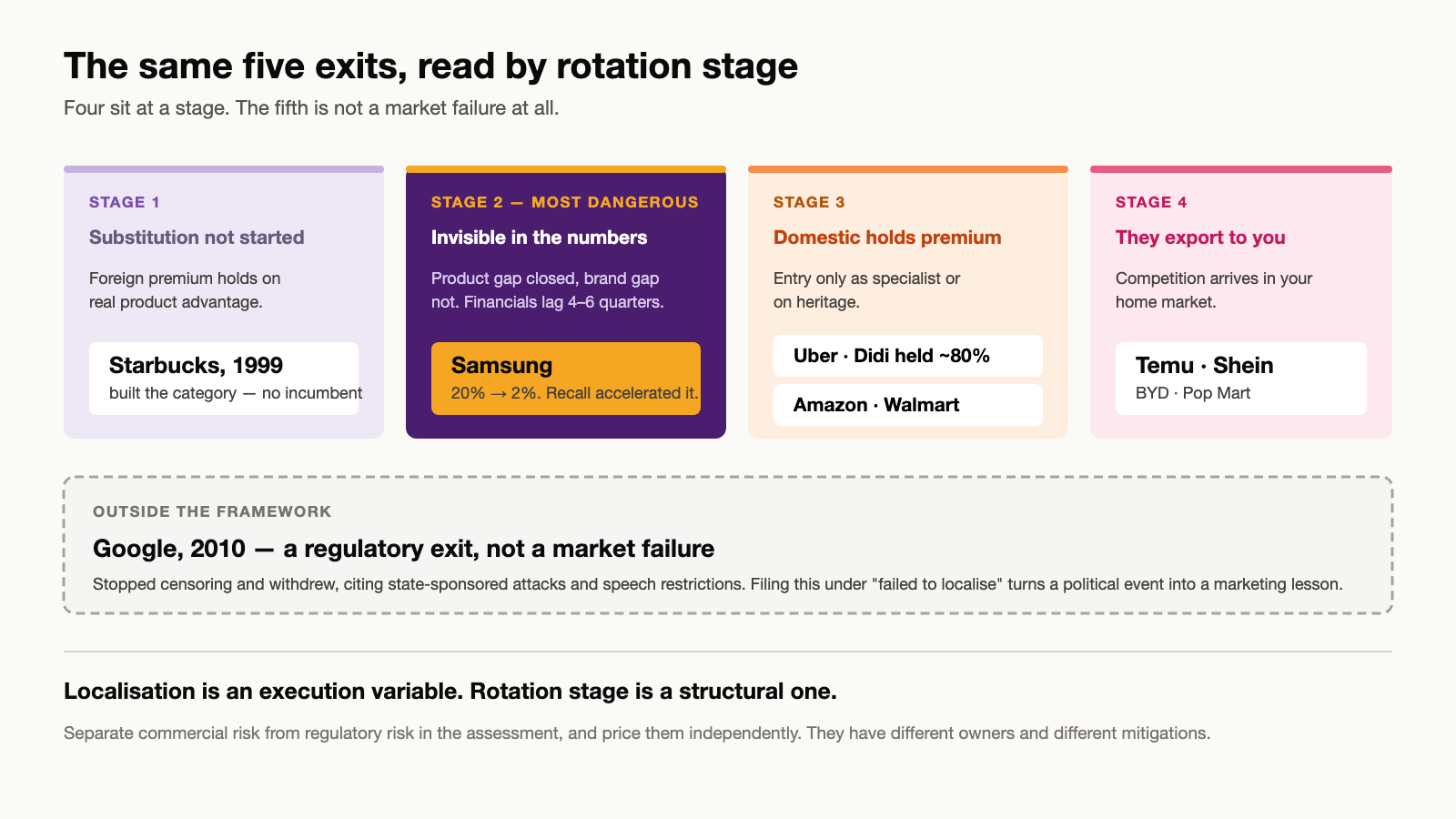
Four of the five sit at a specific rotation stage. The fifth is a different kind of event entirely, and lumping it in is why the standard reading goes wrong.
Categories in China move through four stages, and the entry-mode question that dominates most planning is only answerable once you know which stage your category is in.
Substitution has not started. Foreign brands hold the premium tier on genuine product advantage. The classic playbook works here and still exists in a shrinking number of categories.
Substitution is underway but invisible in the numbers. Domestic players have closed the product gap and not the brand gap. Financials lag sentiment by roughly four to six quarters, which is why this is the most dangerous stage to enter.
Domestic players hold the premium tier. Foreign entry is possible only as a specialist or on heritage, and arriving as a generic Western premium option is arriving as a worse version of what already exists.
Domestic players are exporting. The competition has moved to your home market, and the China entry project may be the wrong project entirely.
"Localisation is an execution variable. Rotation stage is a structural one. Teams argue about the first because it is the one they control, which is a bad reason to believe it is the one that decides."
Uber: a stage-three entry funded as though it were stage one
Uber sold its China operation to Didi Chuxing on 1 August 2016. By then it was losing around a billion dollars a year there and had spent roughly two billion over two years fighting for the market (CNBC, 2016). Didi was spending on a comparable scale and finished 2016 holding something close to 80 percent of Chinese ride-hailing.
The localisation reading says Uber did not understand Chinese payment habits, driver incentives or the role of WeChat. All of that is true and none of it explains the outcome. Uber adapted a great deal, and adapted competently.
What it could not adapt around was arriving in a category where a domestic competitor already held the network. Ride-hailing is a two-sided market with strong local network effects, which means the rotation happens faster and more completely than in a consumer goods category. Didi did not win because it was more Chinese. It won because it was there first at scale, and in that category structure being there first at scale is close to decisive.
The diagnostic question is not whether Uber localised well. It is whether a two-sided network category with an entrenched domestic incumbent can be entered at all by outspending. The answer was no, and it was knowable before the two billion dollars.
Samsung: the textbook stage-two failure
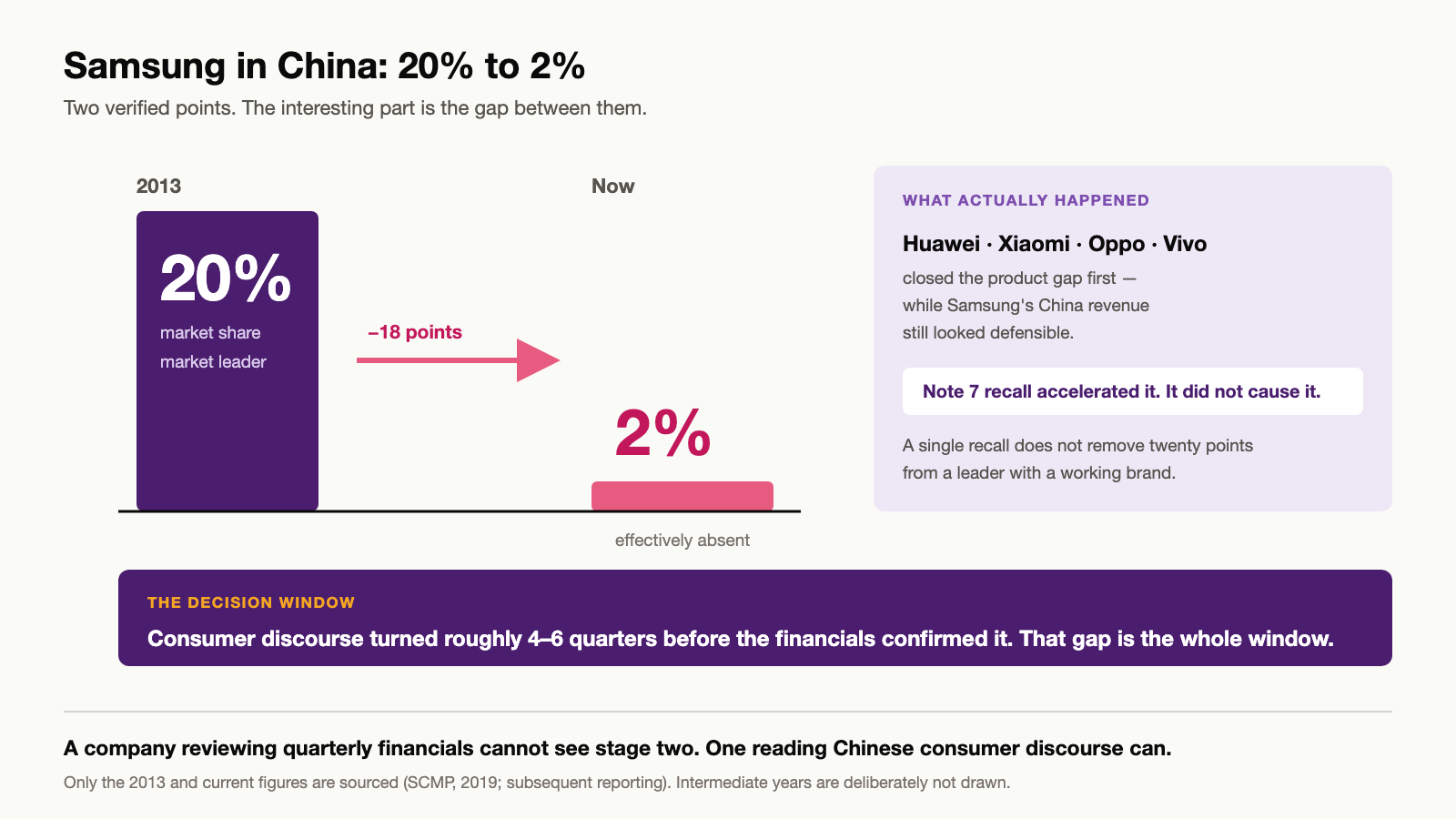
Samsung held roughly 20 percent of the Chinese smartphone market in 2013. It now holds around 2 percent (SCMP, 2019). That is not a decline; it is an evacuation, and it is the single most instructive case in the set.
The gap between when the sentiment turned and when the financials confirmed it is where the decisions were made — and where they were made on the wrong information.
The usual explanation is the Note 7 battery episode and its handling, which generated genuine and lasting anger among Chinese consumers. That is a real contributing cause and it is also insufficient, because a single product recall does not take twenty points of share off a market leader with a functioning brand.
What was actually happening is stage two. Huawei, Xiaomi, Oppo and Vivo closed the product gap during exactly the period when Samsung's Chinese revenue still looked defensible. The brand gap closed later, and the recall accelerated the closing rather than causing it. By the time the financials showed the problem clearly, the decision window had passed.
"Stage two is dangerous precisely because the numbers say you are fine. A company reviewing quarterly financials cannot see it. A company reading Chinese consumer discourse can see it four to six quarters earlier, which is the whole argument for having someone who reads it."
Amazon and Walmart: right category, wrong decade
Amazon announced its withdrawal from the Chinese domestic marketplace in April 2019, effectively closing Amazon.cn as a third-party marketplace. Walmart's China record is more mixed than the failure framing suggests, but its retail position never approached what it holds elsewhere.
Both are usually explained through the same lens: Amazon did not adapt to a market where commerce and social had fused, and Walmart did not understand Chinese shopping behaviour. Again true, again incomplete.
The structural fact is that Chinese e-commerce did not converge on the Western model and then diverge. It developed a different model from the beginning — marketplace-first, social-integrated, livestream-native — and by the time Amazon was competing seriously, Alibaba and JD held both the merchant base and the consumer habit. Amazon was not late to localise. It was late to a category that had rotated before the foreign entrants finished evaluating it.
The uncomfortable implication for a brand today is that the same thing is happening in categories that currently look open, and it is happening on a shorter clock than it did in e-commerce.
Google does not belong on this list
Google announced in January 2010 that it would stop censoring results and pulled its search service out of mainland China in March, citing state-sponsored attacks on its systems and restrictions on speech (MIT Technology Review, 2018).
This is not a market-entry failure. It is a regulatory and political exit, taken deliberately, on grounds that had nothing to do with product-market fit or consumer preference. Baidu's advantage was real and growing, but the decision that ended Google's presence was made in a boardroom about censorship, not in a market.
Including Google in a list of localisation failures is how the standard narrative launders a political event into a marketing lesson. The two categories require completely different responses: one is a strategy question, the other is a question about whether you can operate in the jurisdiction at all.
The practical version for a brand: separate your China risk register into commercial risk and regulatory risk, and do not let a consultant merge them. They have different owners, different time horizons and different mitigations.
The test the framework has to pass
An explanation that only accounts for failures is the same unfalsifiable move as the localisation one, just wearing different clothes. So it is worth checking the other direction: if rotation stage decides outcomes, the foreign brands that did well in China should sit in stage one or hold a genuine specialist position. They do.
Starbucks entered a category that did not exist
There was no domestic coffee-chain incumbent to rotate against in 1999, because there was barely a coffee habit. Starbucks was not competing for share in an existing category; it was building the category, which is stage one in its purest form. That advantage has since eroded exactly as the framework predicts — Luckin and others have moved the category toward stage three, and Starbucks China now faces the ordinary problem rather than the easy one.
Luxury holds because heritage cannot be substituted
European luxury houses retain pricing power in China through the one asset domestic competitors cannot manufacture on a shorter cycle: verifiable provenance. That is the specialist-or-heritage exception the framework names for stage three, and it is narrower than most brands assume. Heritage means a century of it, not a founder story written in 2019.
Where the framework would be wrong
If a foreign brand entered a mature stage-three category with a generic premium position and won on execution alone, the argument here fails. I have not found that case, and I would treat a well-documented one as the most useful thing anyone could send me. Absence of a counterexample is weaker evidence than its presence would be, and it is worth saying so rather than claiming more than the record supports.
What the pattern actually says
Four of these five entered or persisted in a category that had already rotated, or was rotating while the numbers still looked acceptable. None of them failed for lack of effort, budget or competence, and several of them localised extensively.
Determine the rotation stage of your specific category before anything else. Not your industry — your category, in the segment you would actually compete in.
If it is stage three, the honest question is whether you have a genuine specialist or heritage position. Generic Western premium is not one.
If it is stage two, you have roughly four to six quarters of warning that will not appear in your financials. That window only exists if somebody is reading Chinese consumer discourse in Chinese.
Separate regulatory risk from commercial risk in the assessment, and price them independently.
Treat any advice that ends at 'localise better' as unfinished. Ask what it predicts, and whether it would have predicted these five.
Frequently asked questions
Why did Uber fail in China?
Uber sold to Didi in August 2016 after losing around one billion dollars a year and spending roughly two billion over two years. Didi held close to 80 percent of the market. Ride-hailing is a two-sided network category, so the entrenched domestic incumbent could not be displaced by spending alone.
Why did Samsung fail in China?
Samsung fell from roughly 20 percent share in 2013 to around 2 percent. The Note 7 recall and its handling accelerated the decline but did not cause it. Huawei, Xiaomi, Oppo and Vivo had already closed the product gap while Samsung's financials still looked defensible.
Why did Google leave China?
Google announced in January 2010 that it would stop censoring search results, and withdrew from mainland China that March, citing state-sponsored attacks and speech restrictions. This was a deliberate regulatory and political exit rather than a competitive or localisation failure.
Why did Amazon fail in China?
Amazon closed its Chinese domestic marketplace in April 2019. Chinese e-commerce developed as marketplace-first, social-integrated and livestream-native from the beginning, and Alibaba and JD held both the merchant base and the consumer habit before Amazon competed seriously.
Do foreign brands still succeed in China?
Yes, in categories where substitution has not started or where a genuine specialist or heritage position exists. The determining variable is which rotation stage your specific category occupies, not how thoroughly you adapt marketing to local preference.
The summary judgement
The localisation explanation persists because it is comforting and because it implies a fix. If the problem was adaptation, then a better agency, a better country manager or a better campaign solves it. If the problem was that the category had already rotated, then nothing inside the marketing function solves it, and the decision belonged one level up and eighteen months earlier.
The four-stage rotation model these cases are read against is set out at length in the book, with the diagnostic for placing your own category and what each stage permits. There is a sample chapter if you want to see the argument before deciding whether it applies to you.
"Ask what stage your category is in. If nobody in the room can answer that with evidence rather than impression, the entry decision has not been made yet, whatever the budget says."
The framework these cases are read against is set out in China market entry strategy. For what stage four looks like when it arrives in your home market, see Temu and Shein and Pop Mart. For the monitoring that makes stage two visible before the financials confirm it, the six structural challenges covers what that actually requires.
Share:
Free · 24 pages
Read Chapter 1 of the Playbook
AI Foundation Models — how DeepSeek and Qwen crossed a billion downloads while Western boards were counting Mag7 capex, and which layers of the AI stack the rotation has not reached. No excerpt tricks: it is the full chapter.
You will also get the weekly newsletter. Unsubscribe any time — the link is in every email.
The Book · $99
China Market Entry Playbook 2026
456 pages across 22 industry chapters — AI, semiconductors, EVs, payments, logistics, beauty, F&B, healthcare, pets, toys. Every chapter runs the same five questions: the anchor number, the rotation underneath it, which layers of the global stack it has reached, and what to do about it. English and Simplified Chinese editions included.
Ex-Transsion Global Digital Marketing Director · Effie Awards Greater China jury member · Guest lecturer, Peking University School of Economics · Writes Annie Chan Talk, your insider lens on China.