WeChat for B2B: The Official Account Is Not the Programme
Western B2B teams build a WeChat Official Account, publish to it, and measure it like a blog. The commercially decisive unit is somewhere else entirely — on the individual salesperson's account — and that changes what you are actually building.
Annie Chan··13 min read
The standard Western B2B approach to WeChat is recognisable from a distance. Register an Official Account. Commission a content calendar. Translate the thought-leadership pieces that performed on LinkedIn. Report monthly on followers and article opens. Conclude after three quarters that WeChat does not work for B2B in this category.
The conclusion is wrong but the evidence is real, and the reason both things are true is that the programme was built around the wrong object.
In Chinese B2B, the commercially decisive asset is not the brand's Official Account. It is the individual salesperson's contact graph. The Official Account exists to make that person's outreach credible when the prospect checks. Measure the account as a channel and you are measuring the packaging.
WeChat carries over 1.3 billion monthly active users spending more than 80 minutes a day in the app, and around 130 million people use Enterprise WeChat, known as WeCom, for work (Skywise Digital, 2026). Your buyers are there. What is not obvious from those numbers is which surface inside the app the buying actually happens on.
Why the contact graph is the asset
Chinese B2B relationships run through individuals to a degree Western buyers consistently underestimate. A procurement contact does not follow a brand's Official Account and wait to be nurtured. They add a specific salesperson, message that person directly, ask questions in that thread, and route the internal conversation through screenshots of it.
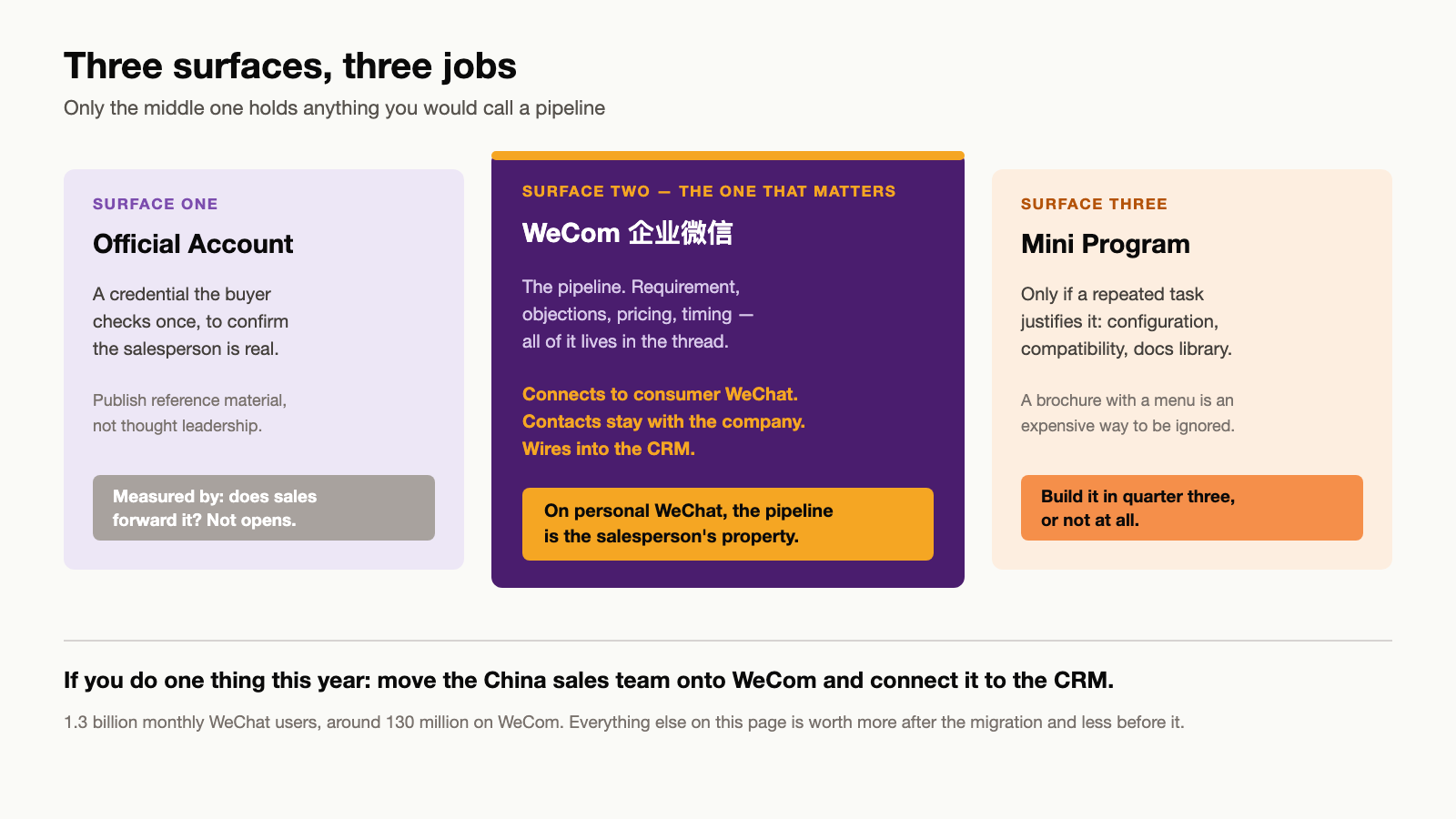
That thread is the pipeline. It contains the requirement, the objections, the pricing conversation and the timing signal, and none of it appears in any marketing report. A team that measures Official Account engagement is reading a surface that the buyer visits once, to check that the salesperson represents a real company, and then leaves.
"The Official Account is a credential the buyer checks. The WeCom thread is where the deal happens. Confusing the two is how a WeChat B2B programme gets judged on the wrong number for three quarters."
This has an uncomfortable corollary. If your salespeople are running that relationship on personal WeChat accounts, the pipeline is personal property. When the salesperson leaves, the contact graph leaves with them, and there is no export. Western firms discover this at the worst possible moment, which is precisely why WeCom exists.
WeCom is the part that is actually infrastructure
Three surfaces, three jobs. Only the middle one holds anything you would call a pipeline.
WeCom is Tencent's enterprise layer, and its commercially important property is that it connects to ordinary consumer WeChat while keeping the relationship attached to the company rather than to the employee. Conversations are visible to the organisation, contacts survive staff turnover, and the whole thing can be wired into a CRM.
For a Western B2B firm this is the single highest-value move available on the platform, and it is usually treated as an IT provisioning detail rather than as the core of the programme. Migrating a China sales team from personal WeChat to WeCom is unglamorous, unpopular with the salespeople whose bargaining position it weakens, and worth more than any amount of content.
If you do exactly one thing on WeChat this year, move the China sales team onto WeCom and connect it to your CRM. Everything described below is worth more once that is done and worth considerably less before it.
Which Official Account type, and why the answer is usually the boring one
There are two Official Account categories and they behave differently enough that the choice constrains the programme.
Subscription Account
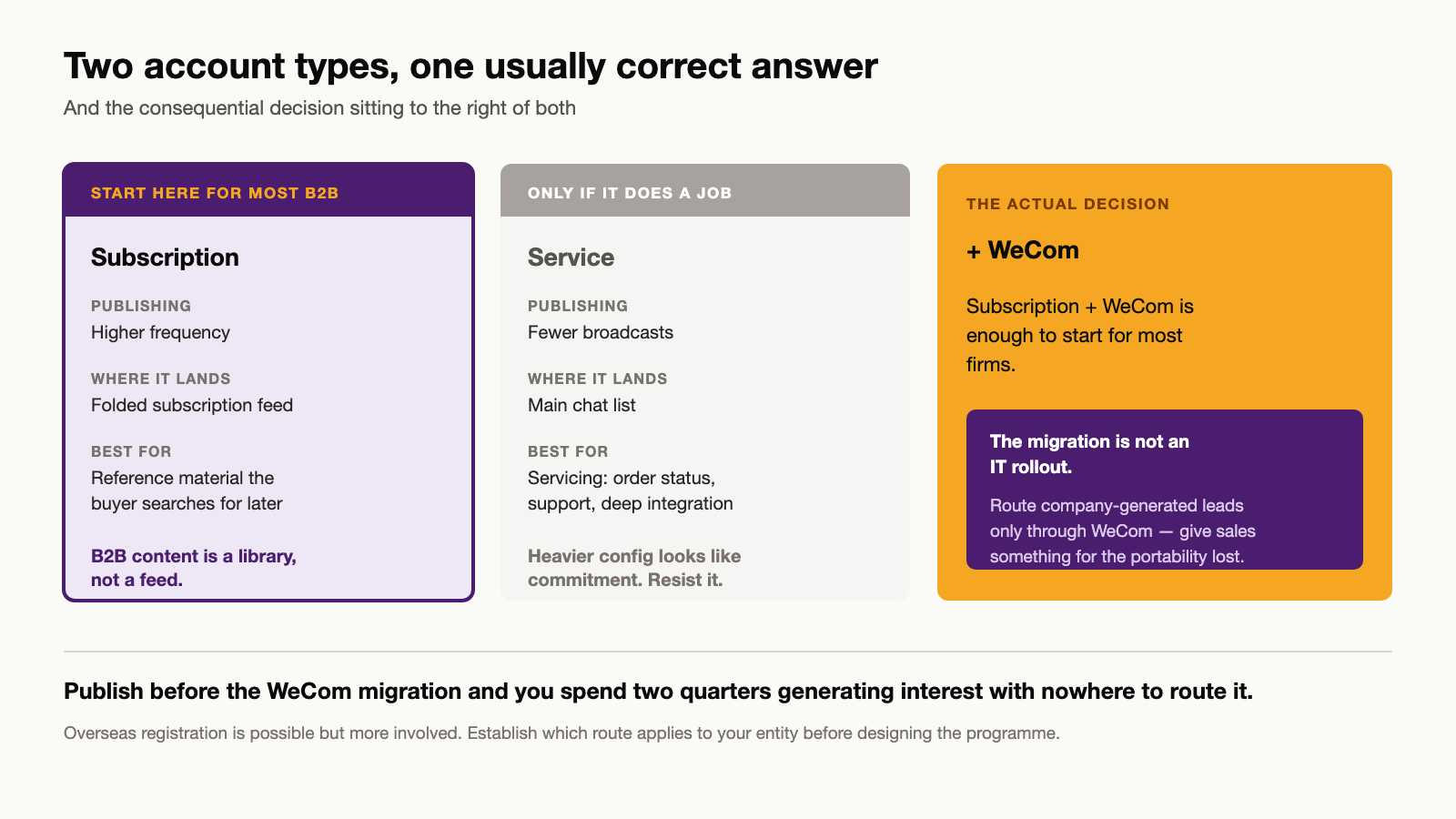
Higher publishing frequency, but messages land in a folded subscription feed rather than the main chat list. Lower interruption, lower visibility, better suited to a publishing cadence. For most B2B firms this is correct, because B2B content is reference material rather than news and the buyer comes to it when they have a question.
Service Account
Fewer permitted broadcasts, but messages appear in the main chat list and it carries heavier functional capability including deeper Mini Program and payment integration. Correct when the account is doing a job — account servicing, order status, technical support — rather than publishing.
The general guidance that a Subscription Account plus WeCom is enough to start is sound for most firms, and the temptation to over-build is strong precisely because the heavier configuration looks more like a commitment. Start with the lighter one and let the requirement for more prove itself.
What B2B content on WeChat is actually for
Not demand generation. In most serious B2B categories demand does not originate on WeChat; it originates from an existing procurement requirement, an industry event, a referral or a specification document. WeChat is where an already-interested buyer verifies you.
That reframing changes what to publish. Thought leadership arguing that an industry is changing performs badly, because the reader did not arrive looking for a point of view. Technical documentation, specification detail, application notes, installation and integration material, and answers to the specific questions a procurement committee has to satisfy internally — these perform, because they are what the buyer came to check.
Write the answers to the questions your salespeople get asked most often, in Chinese, in a form the buyer can forward to a colleague without editing.
Publish specification and compatibility detail rather than positioning. A procurement committee is assembling an internal case and your content is raw material for it.
Make case material specific about industry, scale and application. Generic customer logos do not survive an internal challenge; a comparable installation at comparable scale does.
Treat the account as a searchable library rather than a feed. B2B buyers arrive at a specific question months after publication, which makes archive quality worth more than posting frequency.
Mini Programs earn their place in the same frame. A configuration tool, a specification lookup, a compatibility checker or a documentation library is genuinely useful to a buyer mid-evaluation. A Mini Program that is a brochure with a menu is an expensive way to be ignored.
Getting the Official Account as a foreign company
Two account types, one usually correct answer. The consequential decision is the one to the right of both.
Registration for an overseas company is possible and is more involved than the consumer-facing marketing suggests. Expect to supply business registration from your home jurisdiction, evidence of the entity relationship, and a verification step that carries a fee. A Chinese entity makes the process substantially simpler, which is one of several reasons entity structure keeps turning up as the real gate on China programmes.
The practical advice is to establish which registration route applies to your entity before designing the programme, for the same reason it applies on every other Chinese platform: the administrative gate determines what is available, and discovering it late means rebuilding a plan that was already approved.
The internal obstacle is not technical
Moving a China sales team onto WeCom removes a form of individual security that experienced salespeople understand perfectly well. Their contact graph is currently portable and, on WeCom, it stops being portable. Framing the migration as an IT rollout invites quiet non-compliance, where the team maintains WeCom for reporting and continues the real conversations on personal accounts.
The workable framing is commercial rather than administrative: leads generated by the company are routed only through WeCom, and inbound from the Official Account and Mini Programs lands there. That gives the salesperson something in exchange for the portability they are giving up, which is the only version of this conversation that ends with actual adoption.
How to measure it without lying to yourself
Follower counts and article opens will be flat and will stay flat, and this tells you almost nothing. B2B audiences in a specialised category are small by construction, and an Official Account with 900 followers can be supporting a materially larger revenue line than one with 40,000.
The measurements that mean something all live on the sales side of the boundary.
How many active WeCom threads exist with named accounts in your target segment, and how that number moved this quarter.
How often sales sends a specific published piece into a thread. If nobody forwards the content, the content is not doing the job it exists to do, regardless of its open rate.
Time from first WeCom contact to first technical meeting, which is the part of the cycle this infrastructure actually compresses.
Contact retention through salesperson turnover, which is the entire argument for WeCom and is measurable the first time someone leaves.
You will encounter claims that a large majority of Chinese B2B deals close within the WeChat ecosystem — the figure of 72 percent circulates. It comes from agency material rather than audited research, and the underlying observation is directionally sensible while the precision is not. Do not put it in a board deck.
A twelve-month sequence that does not waste the first two quarters
Quarter one: move the China sales team onto WeCom and connect it to the CRM. Publish nothing. This is unglamorous and it is the only step that changes the underlying economics.
Quarter one, in parallel: collect the twenty questions your salespeople actually get asked, verbatim and in Chinese. This is your content plan and it costs one afternoon.
Quarter two: register the Official Account and publish answers to those twenty questions as reference material rather than as posts. Judge each one by whether sales forwards it, not by opens.
Quarter three: build a Mini Program only if a specific repeated task justifies it — a configuration lookup, a compatibility check, a documentation library. If no such task exists, skip it and save the budget.
Quarter four: review contact retention, thread volume in target segments, and time from first contact to first technical meeting. These are the numbers that will still mean something in year two.
The ordering matters more than the contents. A team that publishes before the WeCom migration spends two quarters producing material with nowhere to route the interest it generates, and then concludes the content did not work.
Frequently asked questions
Does WeChat marketing work for B2B?
Yes, but not as a demand generation channel. With over 1.3 billion monthly users and around 130 million on WeCom, your buyers are present, but they arrive to verify a salesperson they are already talking to. The programme works when it is wired to sales rather than run as publishing.
What is the difference between WeChat and WeCom for B2B?
WeCom is Tencent's enterprise layer. It connects to consumer WeChat while keeping contacts attached to the company rather than the employee, so relationships survive staff turnover and can be connected to a CRM. On personal WeChat, the pipeline is the salesperson's private property.
Should a B2B company use a Subscription or Service Official Account?
Subscription, in most cases. It permits higher publishing frequency and suits reference content that buyers search for later. Service Accounts carry heavier functional and payment integration but fewer broadcasts, and are correct when the account performs a servicing job rather than publishing.
What content works for B2B on WeChat?
Technical documentation, specifications, application notes and answers to procurement questions — material a buyer can forward internally without editing. Thought leadership underperforms because the reader arrived with a specific question rather than looking for a point of view.
How do you measure WeChat B2B performance?
Not by followers. Measure active WeCom threads with target-segment accounts, how often sales forwards published content into those threads, time from first contact to first technical meeting, and contact retention through salesperson turnover.
The summary judgement
WeChat B2B fails for Western firms in a specific and repeatable way: the marketing team builds the visible surface, the sales team runs the actual relationships on personal accounts, and nobody connects the two. The content then gets judged by metrics that were never going to move, and the platform takes the blame for an organisational gap.
"This is a CRM project wearing a marketing costume. Staff it accordingly, and the content question becomes much easier to answer."
AI Foundation Models — how DeepSeek and Qwen crossed a billion downloads while Western boards were counting Mag7 capex, and which layers of the AI stack the rotation has not reached. No excerpt tricks: it is the full chapter.
You will also get the weekly newsletter. Unsubscribe any time — the link is in every email.
The Book · $99
China Market Entry Playbook 2026
456 pages across 22 industry chapters — AI, semiconductors, EVs, payments, logistics, beauty, F&B, healthcare, pets, toys. Every chapter runs the same five questions: the anchor number, the rotation underneath it, which layers of the global stack it has reached, and what to do about it. English and Simplified Chinese editions included.
Ex-Transsion Global Digital Marketing Director · Effie Awards Greater China jury member · Guest lecturer, Peking University School of Economics · Writes Annie Chan Talk, your insider lens on China.