Xiaohongshu Marketing Agencies: You Are Hiring for Four Jobs, Not One
There is no best Xiaohongshu agency, because the work is four separate jobs and almost nobody is good at all four. Which job you are actually buying, what the published retainers say, and the one credential that can be verified.
Annie Chan··13 min read
Search for the best Xiaohongshu marketing agency and you will find listicles, each naming five agencies, each list written by one of the agencies on it. This is not a scandal. It is what happens in any market where buyers cannot evaluate the product before purchase and sellers know it.
The more useful observation is that the question has no answer as asked. Xiaohongshu work is four separate jobs with four different skill profiles, and an agency that is genuinely strong at one is usually mediocre at two of the others and reselling the fourth.
Stop asking which agency is best. Ask which of the four jobs you are hiring for this quarter, then evaluate against that one. A brand that needs qualification and account access is buying a compliance service and should not be impressed by a creative reel. A brand that needs content is buying editorial judgement in Chinese and should not be impressed by an ad-platform certification.
The four jobs, and why one agency rarely holds all four
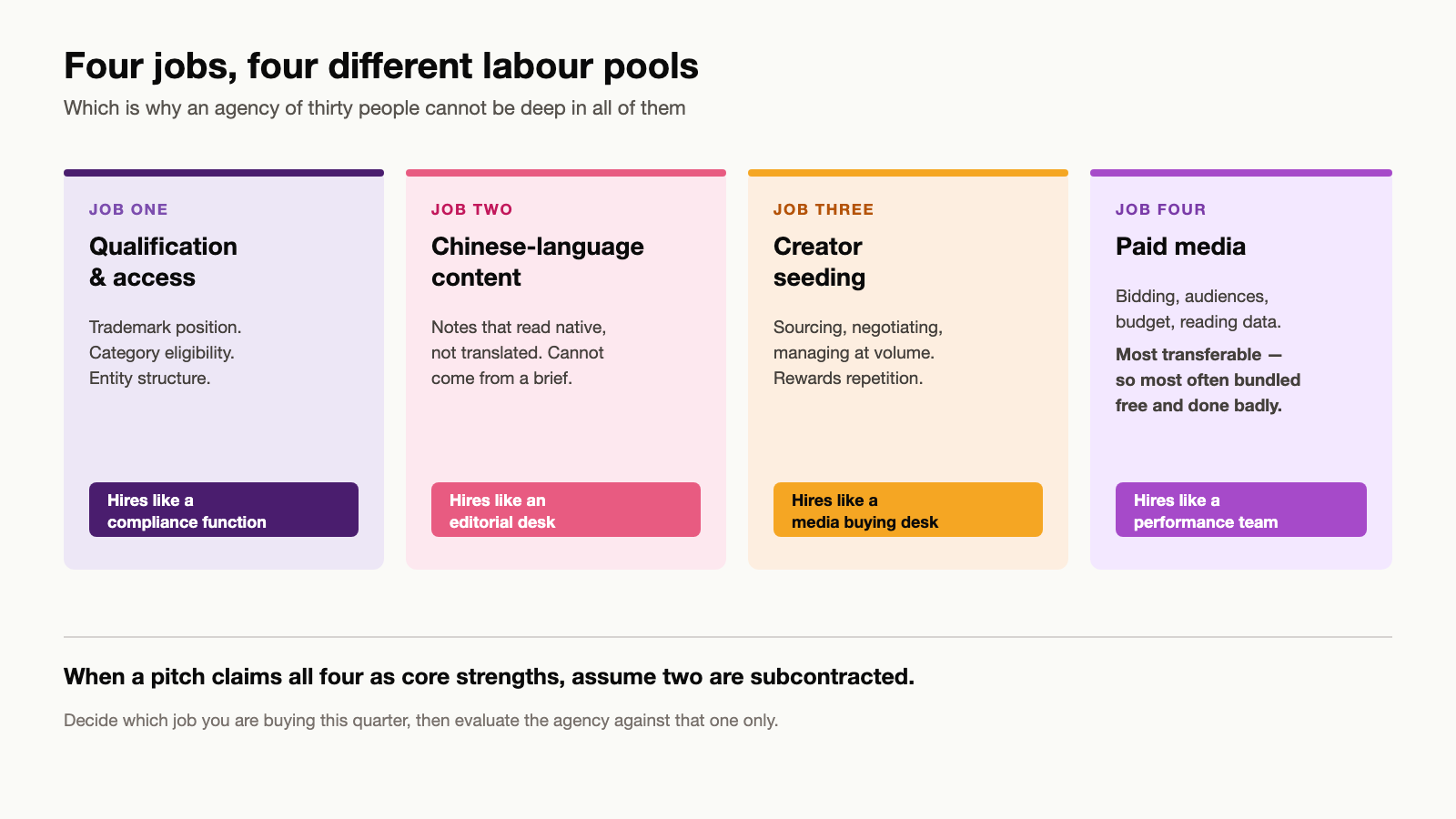
Four jobs, four skill profiles. Agencies are usually strong at one, competent at one, and reselling the rest.
Job one — qualification and account access
Getting you a verified brand account and access to the advertising platform. This is a legal and administrative job: trademark position, category eligibility, document translation, entity structure. The people who are good at it look like a compliance function rather than a marketing one, and they are frequently boring to meet, which counts against them in pitches for no good reason.
Job two — Chinese-language content production
Producing notes that read as native rather than translated. This is an editorial job, and it is the one most often underestimated by Western buyers, because a translated brand message that is grammatically perfect can still be commercially dead. The skill is knowing what a Chinese consumer in this category finds credible, which cannot be acquired from a briefing document.
Job three — creator seeding
Sourcing, negotiating and managing creators through the official collaboration platform. This is a buying and relationship job, closest in character to media buying in a fragmented market. It rewards scale and repeat volume, which means the agencies that are good at it are good because they do a lot of it, and that is at least partially verifiable.
Job four — paid media
Running the advertising account: bidding, audience construction, budget allocation, reading the data. This is a performance-marketing job and the most transferable of the four. An operator who is genuinely good at Meta or Google can become good at this reasonably quickly, which is why it is also the job most often bundled in for free and done indifferently.
The reason bundling fails is not laziness. It is that these four jobs recruit from four different labour pools, and an agency of thirty people cannot be deep in all of them. When a pitch claims all four as core strengths, the sensible assumption is that two are subcontracted and nobody has told you which.
What the published retainers actually say
Retainer figures are published across the region, and the spread between markets is the most interesting thing in them.
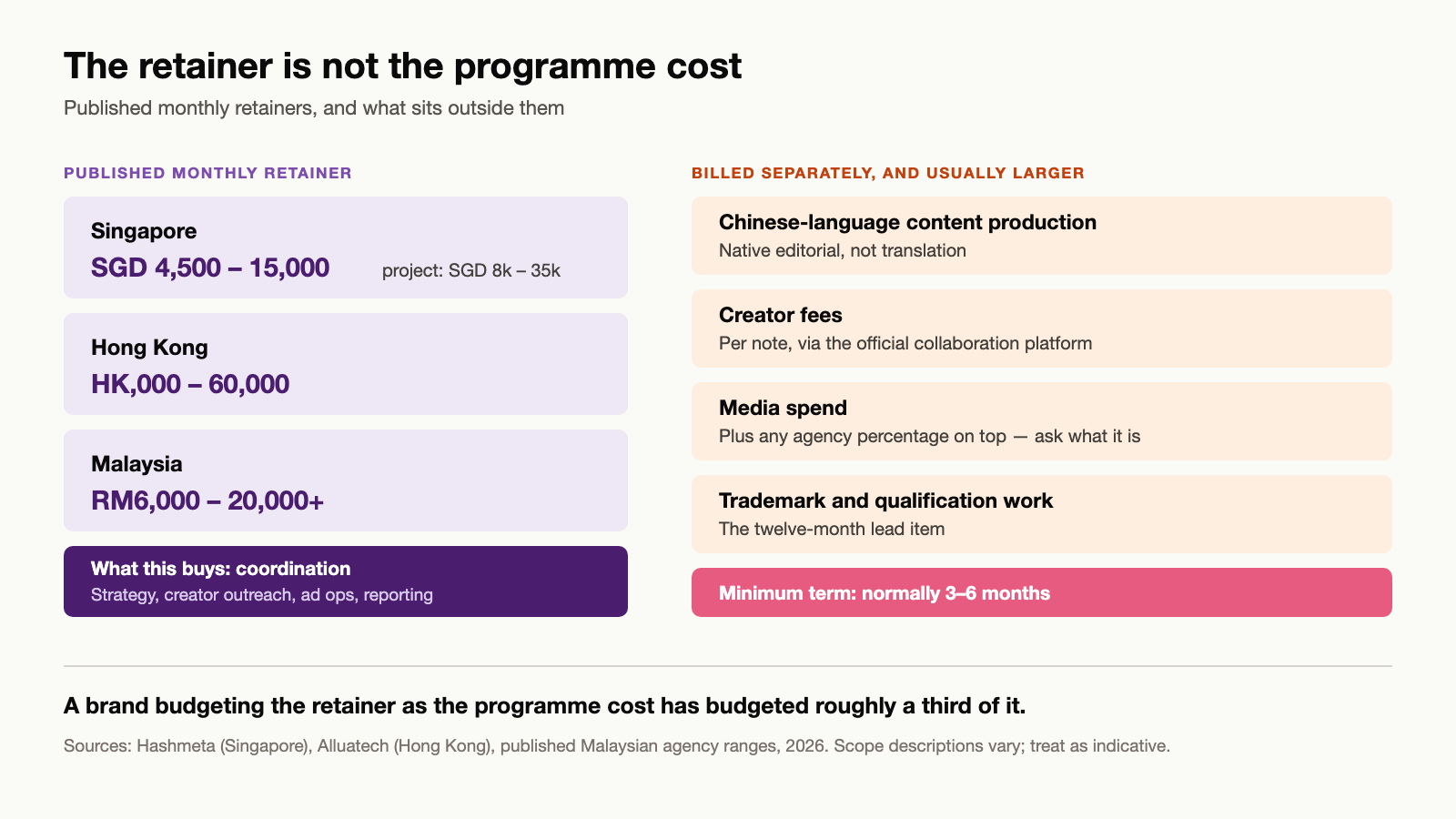
Published monthly retainers for comparable described scope. The gap is not a quality gap, and it is not entirely a cost-of-living gap either.
Singapore agencies publish monthly retainers of roughly SGD 4,500 to 15,000, with project-based work quoted between SGD 8,000 and 35,000 (Hashmeta, 2026). Hong Kong figures for a team covering strategy, creator outreach, ad buying and reporting run HK$15,000 to 60,000 monthly (Alluatech, 2026). Malaysian retainers are published at RM6,000 to 20,000 and above. Broad regional figures in US dollars cluster at 3,000 to 15,000 a month.
Two things matter about these numbers. The first is that content production, creator fees and media spend are normally excluded and billed separately, which means a retainer is buying coordination rather than output. A brand budgeting the retainer as the programme cost has budgeted perhaps a third of it. Once that is clear, the honest comparison is against doing the coordination internally — which is mostly a question of what your own tooling can already carry before you are paying someone to operate it for you.
The second is that most agencies require a three to six month minimum. That is defensible on the merits, because nothing on this platform reads meaningfully inside a month. It also means the selection decision is a two-quarter commitment made on the basis of a two-hour pitch, which is the actual risk being managed here.
"The retainer buys coordination, not output. Everything that produces the result — content, creators, media — sits outside it and is usually the larger number."
Why the good agencies are not where you expect
The agency ecosystem with genuine repeat experience on this platform is concentrated in Singapore, Malaysia and Hong Kong rather than in New York or London, and this is not a cost arbitrage observation. It is a reps observation.
A Singapore or Kuala Lumpur agency serves a client base that includes Chinese-speaking brands, regional brands targeting Chinese diaspora consumers, and Western brands entering the region. The same team runs this work continuously. A London agency with a China practice may run four Xiaohongshu programmes a year, and four is not enough to develop judgement about a platform that changes its enforcement posture quarterly.
This has a practical consequence for procurement. If your agency roster is built around a global network holding company, the Xiaohongshu work will likely be subcontracted anyway, and you will pay the network margin on top of the subcontractor's fee without gaining the ability to evaluate the subcontractor. Going direct is usually both cheaper and more legible.
The one credential that can actually be verified
Almost everything an agency claims in a pitch is unfalsifiable in the room. Platform relationships, senior creator access, insider knowledge of the algorithm — none of it can be checked while someone is describing it to you. One thing can.
Ask them to show you the platform backend. Not a screenshot, not an exported deck, not third-party tool data. The live account, in the meeting, with their partner tier and campaign history visible. An agency with genuine ecosystem standing will do this without hesitation because it is their strongest asset. An agency without it will explain why they cannot.
Recognised standing inside the creator collaboration ecosystem is a real, tiered, checkable status. So is authorised partner status for the advertising platform. Both are the sort of thing that gets displayed proudly by anyone who holds it, which makes reluctance an unusually clean signal.
The second verifiable thing is whether they employ a compliance specialist. China's advertising law, cross-border labelling conventions and the platform's own content rules are a genuine specialism, and violations produce account-level consequences rather than a warning email. An agency that has never needed to hire for this has probably not run programmes at a scale where it mattered.
The red flags, in order of how much they should worry you
They will only show third-party tool data and decline to open the platform backend. This is the single strongest negative signal, and it usually means the platform access is borrowed from someone else.
They have no compliance specialist and steer conversation away from compliance. Ask what happened the last time a client's note was taken down and listen for whether the answer contains specifics.
The proposal quotes one blended CPC or CPM across a mixed media plan. That number is arithmetically meaningless and hides which inventory the budget actually goes to.
Creator recommendations are sorted by follower count. In most categories vertical accounts with smaller followings outperform on conversion, and an agency optimising for headline reach is optimising for the pitch rather than the result.
They cannot describe what they would do differently in your category versus the last client. Category-specific judgement is the thing you are buying, and its absence is detectable in about four minutes.
The four clauses worth arguing about
Selection gets most of the attention and the contract gets almost none, which is inverted. Four clauses account for nearly every dispute I have seen on this kind of engagement.
Who owns the account
If the agency opened the verified brand account under their entity or their partner agreement, find out now whether it transfers when you leave. In some structures it does not, and a brand that spends two quarters accumulating followers, saved notes and search visibility on an account it does not own has built an asset for someone else. This is the clause that costs the most and gets read the least.
Who owns the content
Notes commissioned from creators carry usage rights that are time-bounded and territory-bounded, and the default term is often shorter than the programme. Establish what happens at expiry: whether notes are taken down, whether renewal is priced, and whether you can reuse the creative elsewhere.
What the media margin is
Ask directly whether the agency takes a percentage on media spend on top of the retainer, and if so what it is. This is a normal practice and not objectionable in itself. What is objectionable is discovering it in month four, and an agency that will not state it plainly has told you something.
What happens to compliance failures
If a note is removed or the account is penalised for a compliance breach in agency-produced content, establish who remediates and at whose cost. Vagueness here is common, and it becomes expensive precisely when you are least able to change agencies.
How to run the selection
Name the job. Decide which of the four you need most in the next two quarters, and write it down before the first call so it does not drift during the pitches.
Brief three agencies identically, including the same five questions, and compare where the answers diverge rather than which deck was better.
Ask for the backend in the second meeting, not the first. Requesting it early reads as adversarial; requesting it late reads as diligence.
Ask for one reference in your category who left. Anyone can produce a happy current client. The instructive conversation is with a brand that stopped.
Contract the minimum term they will accept and define one measurable checkpoint inside it. Not a KPI — a specific thing that will be true or false at week eight.
Frequently asked questions
How much does a Xiaohongshu agency cost?
Published monthly retainers run roughly SGD 4,500 to 15,000 in Singapore, HK$15,000 to 60,000 in Hong Kong, and RM6,000 to 20,000 in Malaysia. Content production, creator fees and media spend are normally billed separately and usually exceed the retainer itself.
Do I need a Xiaohongshu agency, or can I run it in-house?
Account qualification alone generally requires an authorised partner for overseas entities without a Chinese subsidiary, so some agency involvement is structural rather than optional. Content and paid media can move in-house later once you have Chinese-language editorial capability, which is the harder of the two to hire for.
Where are the best Xiaohongshu agencies based?
Repeat experience concentrates in Singapore, Malaysia and Hong Kong rather than in Western capitals, because those teams run this work continuously rather than a few times a year. Western network agencies frequently subcontract the work regionally while adding their own margin.
What should I ask a Xiaohongshu agency in a pitch?
Ask to see the live platform backend rather than exported reports, ask whether they employ a compliance specialist, and ask what they would do differently in your category compared with their last client. All three are answerable in minutes and all three are difficult to fake.
How long before a Xiaohongshu programme shows results?
Most agencies require three to six months, and that requirement is honest rather than self-serving. Seeded content accrues search visibility over months rather than days, so a programme reviewed at thirty days has measured the least representative period available.
The summary judgement
The best-agency question is unanswerable, but the selection problem is genuinely tractable once it is restated. You are not choosing a firm. You are choosing which of four capabilities to buy first, and then testing one verifiable claim about whether the firm in front of you has it.
"Name the job before you take the meeting. Ask for the backend before you sign. Those two moves eliminate most of the ways this goes wrong."
AI Foundation Models — how DeepSeek and Qwen crossed a billion downloads while Western boards were counting Mag7 capex, and which layers of the AI stack the rotation has not reached. No excerpt tricks: it is the full chapter.
You will also get the weekly newsletter. Unsubscribe any time — the link is in every email.
The Book · $99
China Market Entry Playbook 2026
456 pages across 22 industry chapters — AI, semiconductors, EVs, payments, logistics, beauty, F&B, healthcare, pets, toys. Every chapter runs the same five questions: the anchor number, the rotation underneath it, which layers of the global stack it has reached, and what to do about it. English and Simplified Chinese editions included.
Ex-Transsion Global Digital Marketing Director · Effie Awards Greater China jury member · Guest lecturer, Peking University School of Economics · Writes Annie Chan Talk, your insider lens on China.