Xiaohongshu Advertising: The Account Comes Before the Content
Most foreign brands discover they cannot open a Xiaohongshu ad account after they have already produced a quarter of content for it. The qualification gate, the four ad products, and how to read CPC quotes that disagree with each other by a factor of five.
Annie Chan··14 min read
The usual sequence for a Western brand approaching Xiaohongshu advertising runs like this. Someone builds a business case, a content budget is approved, a quarter of notes is produced, and then — at the point where the media plan needs an actual account — the brand discovers that it cannot open one. The blocker is normally a trademark registration that does not exist in China, or exists but does not cover the product category being advertised.
This happens often enough that at least one agency publishes an article specifically about why fashion brands struggle to open RedNote ad accounts. It is not an edge case. It is the default outcome for a brand that treats the account as an administrative step to be handled later.
On most Western platforms, the ad account is a formality that follows the strategy. On Xiaohongshu it is a qualification gate that determines whether the strategy is available to you at all, and the qualification is category-specific. Establish what you can buy before you decide what to make.
What follows is the operating layer: what the platform actually sells, what it costs, and what you need in hand before any of it is purchasable. For whether the platform deserves the budget in the first place, that is a different question and covered elsewhere.
The two platforms people confuse with each other
Xiaohongshu runs two separate commercial systems, and a great deal of confused agency conversation comes from treating them as one.
聚光 Juguang — the ad-buying platform
This is the self-service advertising console: bidding, targeting, budgets, the four ad products described below. If someone says they are running Xiaohongshu ads, this is normally what they mean. Access requires qualification documents and, for most overseas entities, an authorised partner agency in the loop.
蒲公英 Pugongying — the creator collaboration marketplace
This is where paid creator collaborations are commissioned and, importantly, declared. Sponsored content is expected to be routed through it, which labels the note as commercial and applies a facilitation fee. Undeclared paid content risks distribution suppression and creates exposure under Chinese advertising law.
The two interact. A creator note commissioned through Pugongying can then be amplified as an ad through Juguang, and that combination is the mechanism most category leaders actually use. Buying Juguang inventory to push brand-published content, without any Pugongying layer underneath it, is the configuration that produces impressions and no purchase intent.
Both layers assume a content supply you have to keep feeding, which is the constraint most brands hit second. If that is where you are, the question is no longer channel strategy but throughput — how to build a content system that produces at platform cadence without the quality collapsing at volume.
What the qualification gate actually requires
The requirements move, they vary by category, and every published list including this one is a snapshot. Confirm the current position with a partner before planning around it. That caveat aside, the recurring components are consistent enough to plan against.
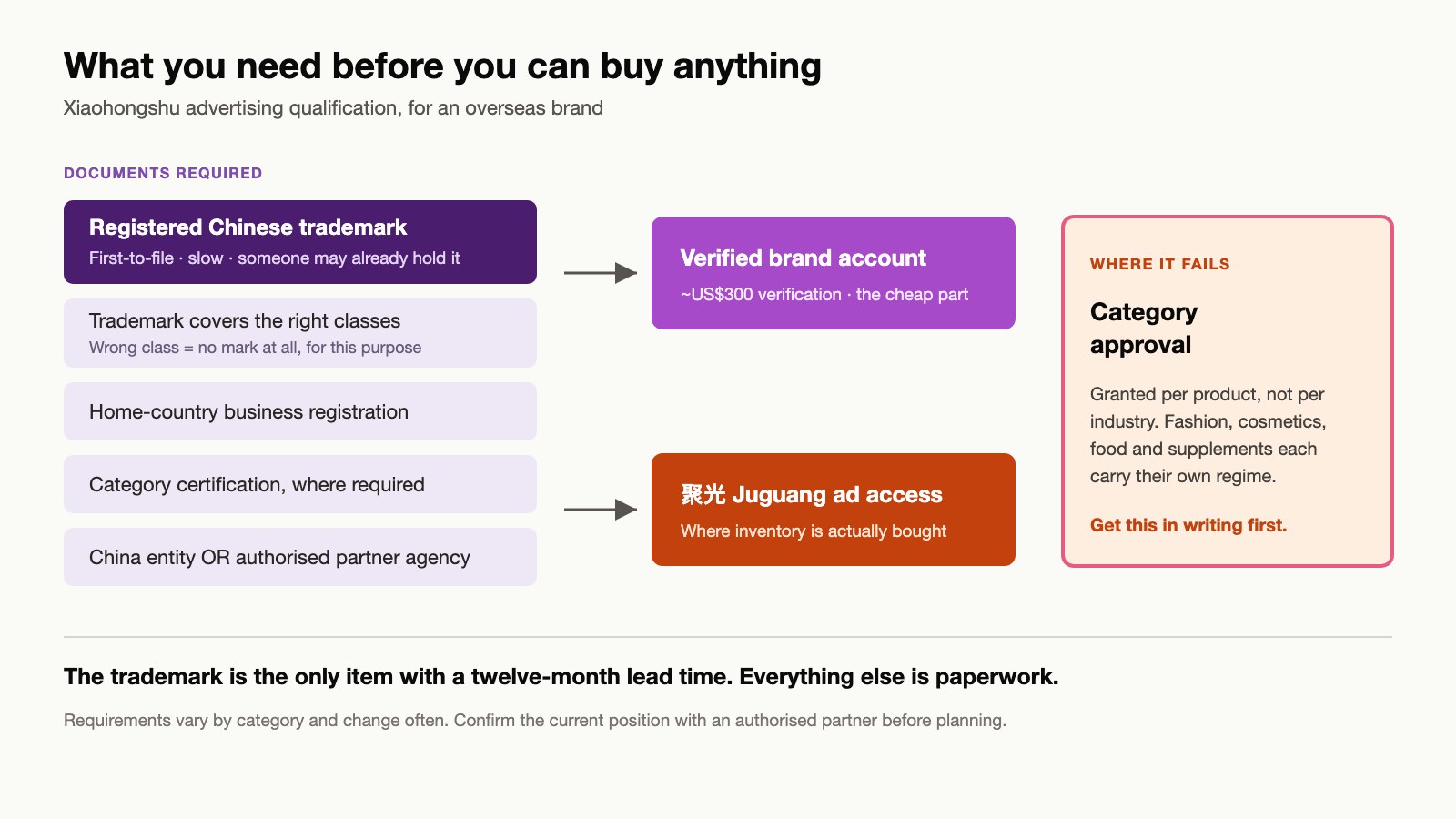
The trademark is the item that cannot be produced on a deadline. Everything else is paperwork.
A registered Chinese trademark, or a pending application with supporting evidence. This is the item that kills timelines, because Chinese trademark registration is slow and China operates first-to-file, so somebody else may already hold your mark.
Evidence that the trademark covers the categories you intend to advertise. A mark registered in the wrong class is functionally no mark at all for this purpose.
A business registration certificate from your home jurisdiction, with certified translation if it is in neither Chinese nor English.
Category-specific certification where the category demands it — cosmetics, food, supplements and medical-adjacent claims all carry their own regimes.
For Juguang access specifically, either a Chinese business entity or a signed agreement with an authorised Xiaohongshu partner acting on your behalf.
Verification of a business account for international entities has been reported at around 300 US dollars as of 2026, which is trivial relative to the cost of the trademark work that has to precede it. Treat the fee as noise and the trademark timeline as the actual constraint.
"The advertising budget is the cheap part. The item with a twelve-month lead time is the trademark, and no amount of media spend compresses it."
The four ad products, and what each one is for
Xiaohongshu sells four things that a Western media planner would recognise as inventory, plus the creator layer described above. They do genuinely different jobs, and the most common planning error is buying the wrong one for the stage the brand is at.
Search ads — the one that matches how the platform is used
Keyword-triggered placements against user queries. Because Xiaohongshu's commercially decisive behaviour is search rather than scroll, this is the format whose logic is easiest to reason about from Western experience: it behaves like paid search, it converts like paid search, and it costs like paid search. Reported ranges cluster around RMB 8 to 20 per click depending on keyword competition.
Feed ads (信息流) — native placements in the Explore feed
Sponsored notes rendered to look like organic ones, distributed by interest and behaviour rather than by query. This is the volume product and the one most brands start with, which is arguably backwards, because feed distribution to an audience with no existing intent is the hardest thing to make work in a category the market does not yet search for.
Splash ads (开屏) — full-screen on app open
Sold on a CPM basis, reported at roughly RMB 80 to 150 per thousand impressions, with campaign minimums reported between RMB 100,000 and 300,000. This is a launch-moment product for brands that already have distribution and want a spike. For an entrant, it buys awareness that the rest of the funnel is not yet built to catch.
Topic and livestream placements
Topic page positions and livestream promotion slots sit at the expensive end of CPM inventory, reported from around RMB 100 per thousand impressions upward, with beauty categories reported above RMB 150 in peak periods. These are event-driven buys rather than always-on ones.
Why the CPC numbers you are quoted disagree with each other
This is worth an entire section, because it is the single most confusing thing about researching Xiaohongshu media costs, and nobody says it plainly.
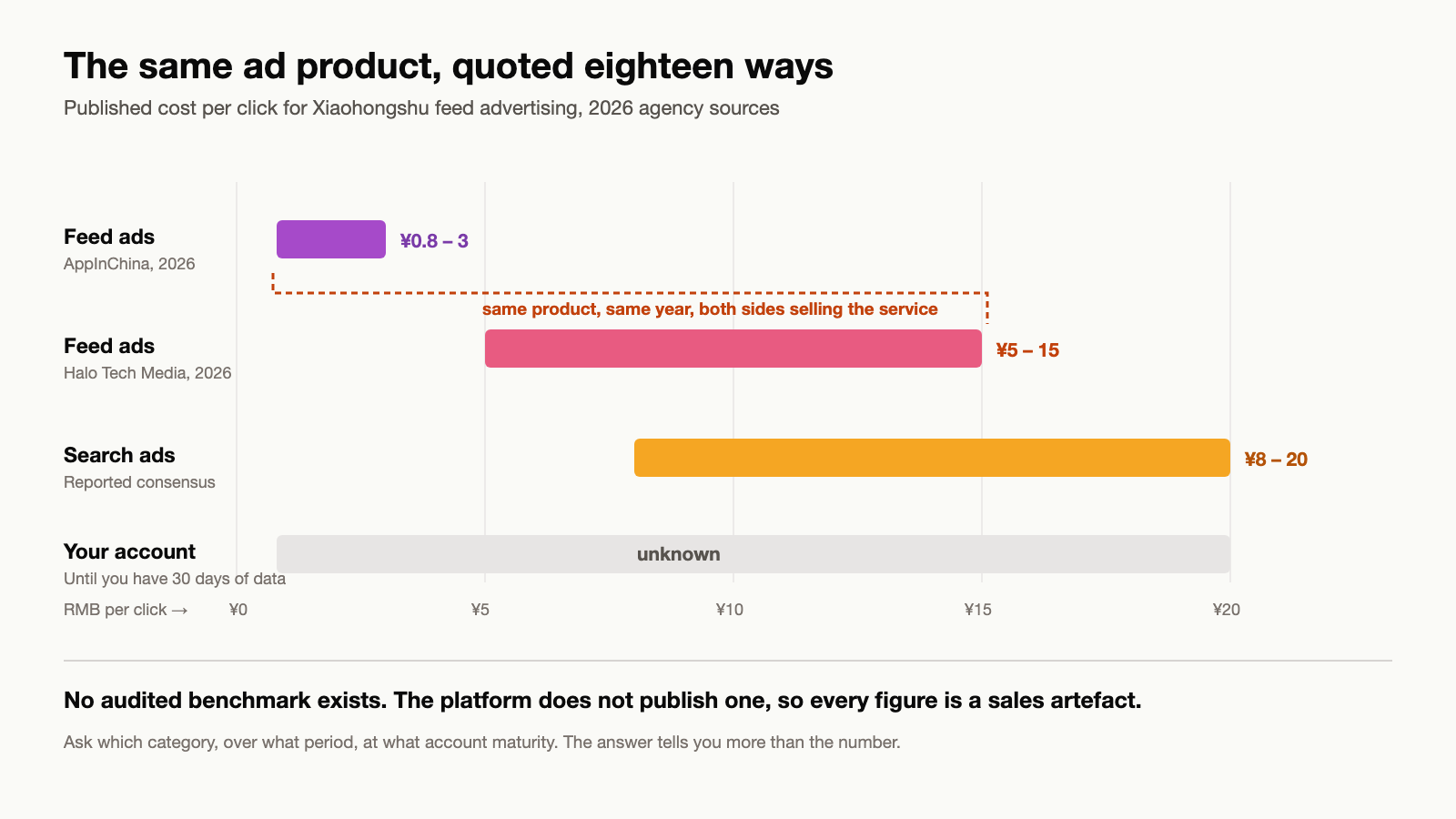
Published feed-ad CPC ranges from agency sources. The spread is roughly eighteen-fold, and the sources rarely state what they are measuring.
Agency material published in 2026 puts feed advertising at roughly RMB 0.8 to 3 per click, with beauty, skincare and mother-and-baby at the top of that band (AppInChina, 2026). Other agency material, describing the same product in the same period, puts it at RMB 5 to 15 per click (Halo Tech Media, 2026). Those are not compatible claims, and both come from firms selling Xiaohongshu services.
The discrepancy is probably not dishonesty. It is that the figures are measuring different things and none of them say which: a blended average across categories, a specific category, an optimised account after three months, a cold account in week one, or a quoted floor used to make a proposal look attractive. There is no audited benchmark to arbitrate between them, because the platform does not publish one.
The practical rule: treat every published Xiaohongshu CPC figure as a sales artefact until you have your own thirty-day account data. Ask any agency quoting you a number which category it came from, over what period, and at what account maturity. The quality of that answer tells you more about the agency than the number does.
The same applies to CPM. Basic banner inventory is reported around RMB 20 per thousand while topic and livestream inventory is reported at RMB 100 or more, which is a five-fold spread inside one platform. Both figures can be true simultaneously because they describe different inventory, and a proposal that quotes one blended CPM for a mixed plan is hiding the mix.
What you can actually target
Targeting on Juguang covers the dimensions a Western buyer expects — demographics, geography, device, interest categories, and behavioural signals derived from what users have searched and saved. Retargeting against people who have engaged with your notes is available. Lookalike expansion exists. None of this will feel unfamiliar.
Two differences are worth planning around. The first is that saving behaviour carries unusual weight, because saving a note on Xiaohongshu is closer to a purchase-consideration signal than a bookmark is on most platforms. Audiences built from saves behave better than audiences built from likes, and the gap is larger than the equivalent gap elsewhere.
The second is that geographic targeting inside China is more consequential than in most markets, because tier-one and lower-tier city consumers differ sharply in price sensitivity, category maturity and what they consider a premium brand. A national campaign at a single bid is averaging across populations that should be bought separately, and the averaging is usually invisible in the reporting until someone breaks the account out by city tier.
"Build audiences from saves, not likes. Buy city tiers separately, not nationally. Those two adjustments account for most of the gap between a competent account and a mediocre one."
What a genuine first test costs
Self-service campaigns through Juguang operate with a practical minimum daily budget reported around RMB 300. That number is widely repeated and close to useless, because a budget at that level produces data too thin to learn anything from.
A test that generates a usable read needs several thousand RMB running for at least two to three weeks. The reason is not spend volume so much as time: the platform's optimisation needs a learning period, and a campaign killed at day five has measured the learning phase rather than the steady state. Brands that run a two-week RMB 5,000 test, see a poor cost per acquisition and conclude the platform does not work have measured almost nothing.
Budget the surrounding costs honestly as well. Chinese-language creative production, native editorial review, and the agency retainer required for account access will together normally exceed the media spend in a first quarter. A media plan that shows only media is not a plan.
The sequence that works
Establish trademark position in China first, in the correct classes. If the mark is unavailable or held by someone else, that changes the entire commercial question and needs to surface before any content budget is committed.
Confirm category eligibility for advertising with a partner, in writing, for your specific products rather than your industry generally.
Open the verified business account and complete verification before content production begins.
Build a small Pugongying creator layer first, so there is validated content worth amplifying rather than brand-published material to push.
Start with search ads, not feed. Search buys existing intent, which is measurable in weeks. Feed buys attention in a category that may not yet exist in Chinese consumer vocabulary, which is measurable in quarters.
Run a minimum of three weeks at a budget that will actually clear the learning phase, and refuse to read the account before then.
Frequently asked questions
How much do Xiaohongshu ads cost?
Search ads are reported around RMB 8 to 20 per click and feed ads anywhere from RMB 0.8 to 15 depending on which agency you ask. Splash inventory runs RMB 80 to 150 CPM with campaign minimums reported at RMB 100,000 to 300,000. Treat all published figures as unverified until you have your own data.
Can a foreign brand advertise on Xiaohongshu without a Chinese entity?
Generally yes, through an authorised partner agency acting on your behalf, but you still need a registered Chinese trademark covering the advertised categories plus home-jurisdiction business registration. The agency route removes the entity requirement, not the trademark requirement.
What is the difference between Juguang and Pugongying?
Juguang is the advertising platform where inventory is bought and targeted. Pugongying is the creator marketplace where paid collaborations are commissioned and declared as commercial. Most effective programmes use both: Pugongying to create validated content, Juguang to amplify what works.
What is the minimum budget to test Xiaohongshu ads?
The platform's practical daily minimum is reported around RMB 300, but a test producing usable data needs several thousand RMB over two to three weeks so the campaign clears its learning phase. Add Chinese-language creative and agency costs, which usually exceed media spend in quarter one.
Should I start with search ads or feed ads?
Search, in almost every case. Xiaohongshu's decisive user behaviour is querying rather than scrolling, so search ads buy demand that already exists and produce a readable result inside a few weeks. Feed ads buy attention in categories that may not yet be searched for at all.
The summary judgement
Xiaohongshu advertising is not difficult to operate once you are inside it. The console is comprehensible, the formats map reasonably onto Western equivalents, and the optimisation logic is familiar. What is difficult is getting in, and the difficulty is legal rather than commercial.
"Find out what you are permitted to buy before you decide what to make. Every expensive Xiaohongshu failure I have seen inverted that order."
AI Foundation Models — how DeepSeek and Qwen crossed a billion downloads while Western boards were counting Mag7 capex, and which layers of the AI stack the rotation has not reached. No excerpt tricks: it is the full chapter.
You will also get the weekly newsletter. Unsubscribe any time — the link is in every email.
The Book · $99
China Market Entry Playbook 2026
456 pages across 22 industry chapters — AI, semiconductors, EVs, payments, logistics, beauty, F&B, healthcare, pets, toys. Every chapter runs the same five questions: the anchor number, the rotation underneath it, which layers of the global stack it has reached, and what to do about it. English and Simplified Chinese editions included.
Ex-Transsion Global Digital Marketing Director · Effie Awards Greater China jury member · Guest lecturer, Peking University School of Economics · Writes Annie Chan Talk, your insider lens on China.
The Xiaohongshu Blue Tick Is a Permissions Key, Not a Trust Badge
Agencies sell blue tick verification on credibility, which is the least valuable thing it does. It costs 600 RMB a year, and without it you cannot advertise, cannot attach a link, cannot open a shop and cannot see your own data.
August 27, 2026 · 12 min read
How Xiaohongshu Ads Actually Work · Annie Chan Talk