The Six Xiaohongshu Challenges Better Execution Does Not Fix
Most Xiaohongshu advice treats every difficulty as a mistake you could have avoided. Six of them are not mistakes. They are structural properties of the platform, and the only useful response is to price them before you commit.
Annie Chan··13 min read
There is a genre of Xiaohongshu article that lists the challenges brands face and then, in each case, explains that the challenge is solved by working with a good partner. Translating your global content is a mistake. Buying the top creator tier first is a mistake. Reading the account at thirty days is a mistake. All true, all avoidable, all covered elsewhere.
This is about the other category: difficulties that persist after you have hired well, briefed correctly and stopped making the obvious errors. They are properties of the platform rather than failures of execution, and treating them as solvable is how planning assumptions get built on sand.
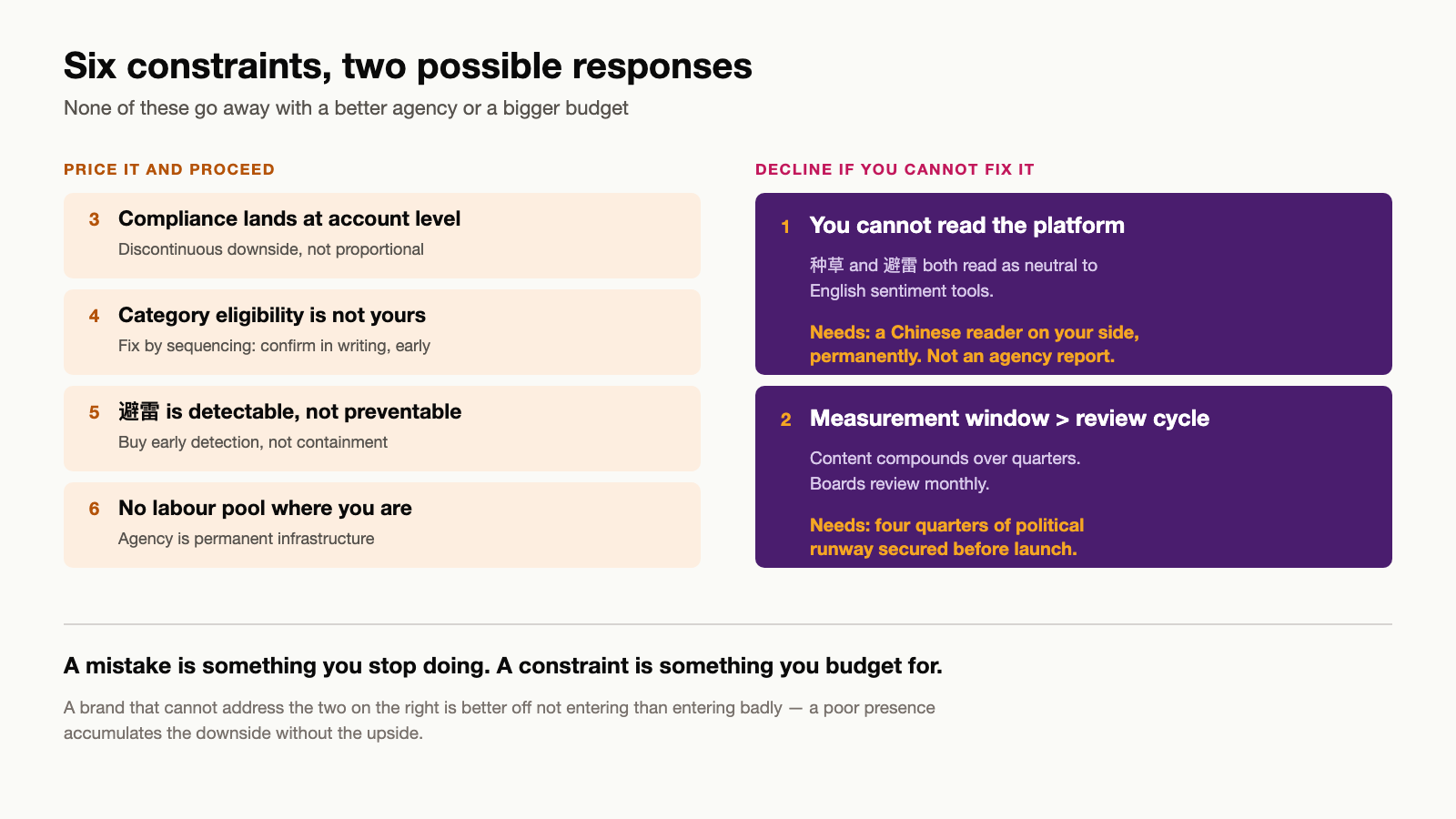
A mistake is something you stop doing. A constraint is something you budget for. The six below are constraints, and two of them are severe enough that a brand which cannot absorb them should decline the market rather than enter it badly.
One — you cannot read the platform yourself
The commercially decisive activity on Xiaohongshu happens in Chinese, inside an app, in content that is not indexed by anything you own or can license cheaply. There is no equivalent of running a search on your own brand and understanding what comes back.
This is not a language problem in the ordinary sense. Machine translation handles the surface adequately. What it does not handle is the two native semantic modes the platform runs on — 种草 as positive purchase-planting, 避雷 as warning others away — both of which read as neutral to a sentiment model trained on English. A brand monitoring translated sentiment can watch a genuine reputational problem develop and see nothing.
The cost: a Chinese-reading person on your side of the table, permanently, not as a project. Not a translator and not an agency report. Someone whose job includes opening the app. Brands that skip this are managing a channel they cannot see, and the first time it matters they will find out from a sales number rather than from monitoring.
Worth doing that arithmetic before assuming a hire is the only route. A subscription that reads the platform for you costs a fraction of a China-capable headcount, and the comparison is rarely made explicitly because the two options arrive from different budgets.
Two — the measurement window is longer than your reporting cycle
Seeded content on Xiaohongshu behaves like an index asset rather than a broadcast one. It accrues search visibility over months and keeps serving long after publication. This is the platform's main commercial advantage and it is fundamentally incompatible with a monthly marketing review.
The mismatch is organisational, not analytical. Everyone involved can understand that the curve is slow. What they cannot do is defend a flat month four to a board that reviews channels quarterly and has three other options competing for the same budget. Programmes get cancelled at the point where they were about to start working, and the cancellation is a rational response to an internal incentive rather than to the data.
"The failure mode is not misreading the numbers. It is being unable to survive them internally for long enough. Secure the runway politically before you secure it financially."
Three — compliance risk lands at account level, not campaign level
Six constraints, two responses. Four are costs to price; two are entry-blocking.
On most Western platforms a policy violation kills a creative or pauses a campaign. On Xiaohongshu, the consequences of undeclared commercial content, non-compliant claims or category-rule breaches attach to the account, and the account is where your accumulated followers, saved notes and search visibility live.
That changes the risk arithmetic. A campaign-level penalty costs you the campaign. An account-level penalty costs you every quarter of compounding you have paid for, and there is no meaningful appeal process designed for a foreign brand. This is why the compliance specialist question is not procurement box-ticking, and why paid collaborations should be declared through the official platform even when a creator suggests otherwise.
The constraint is not that compliance is hard. It is that the downside is discontinuous. Most marketing risk is proportional; this one is not.
Four — category eligibility is not yours to control
Advertising access is granted per product category, and the rules vary by category, change without much notice, and are not published in a form a Western brand can plan against. Cosmetics, food, supplements and anything medical-adjacent each carry their own regime.
The practical consequence is that a brand can complete every other step — entity, trademark, verification, content — and then discover that the specific product it wanted to advertise sits in a class that requires a certification it does not hold. At least one agency publishes a piece specifically about why fashion brands struggle to open advertising accounts (Fashion China, 2026), which suggests this is common enough to generate inbound search traffic.
The response is sequencing, not effort. Get category eligibility confirmed in writing for your specific products before any content budget is committed. This costs nothing except the willingness to ask an uncomfortable question early.
Five — the downside is detectable but not preventable
避雷 content is written to warn other buyers away, and it carries direct purchase-prevention intent rather than general negativity. A 避雷 thread can reach broad visibility quickly, and once it does, the platform's own search behaviour keeps surfacing it to exactly the people evaluating your category.
There is no version of good practice that prevents this from forming. If your product has a genuine failure mode in a subset of use cases, someone will document it, and the documentation will rank. Brands used to markets where a PR function can contain a story find this genuinely disorienting, because the containment tools do not exist here and the content is not defamatory — it is a customer describing an experience.
What is available is early detection and product response. A brand that finds a 避雷 pattern in week two and changes the product instruction, the packaging or the category targeting has done the only thing that works. A brand that finds it in month nine from a distributor has lost the window. Building that detection in-house is a hiring decision; buying it is what the monitoring service exists for, and either answer is better than the reporting cadence most brands currently run.
Six — the capability cannot be hired where you are
There is no meaningful labour pool for Xiaohongshu operation in London, New York or Berlin. The people with genuine repeat experience are in Singapore, Malaysia, Hong Kong and mainland China, and they are not looking to relocate into a Western marketing department at Western marketing salaries.
This means the capability arrives as an agency relationship or not at all, at least for the first several years. Brands that intend to bring the function in-house on a normal timeline are planning against a labour market that does not exist, and the intention usually produces a junior hire who is asked to manage an agency they cannot evaluate.
"Plan for the agency to be permanent infrastructure rather than a transitional arrangement. The in-house version is a five-year proposition, not an eighteen-month one."
The one nobody lists: your competitors are three years ahead in the index
This belongs with the six and is usually left out because it is uncomfortable rather than because it is unimportant.
Xiaohongshu behaves as a search index, and a domestic competitor that has been seeding continuously since 2023 holds a note corpus covering the queries in your category. Those notes rank. They have accumulated saves, comments and engagement history that a new corpus cannot match on any timescale you control, and the platform has no reason to reshuffle a working result set for a new entrant.
Estimates of how dominant search behaviour is on the platform come mostly from agencies and platform marketing rather than audited disclosure, and cluster around 70 percent of monthly active users performing product searches. Treat the precision sceptically and the direction as settled — the behaviour is visible to anyone who watches a Chinese consumer use the app for ten minutes.
The practical consequence is that head terms in a mature category are not winnable in year one, and a plan that assumes otherwise is not a plan. What is winnable is the long tail: specific situations, specific skin types, specific use cases, specific comparison queries. Those are numerous, individually small, and collectively where an entrant's entire opportunity sits.
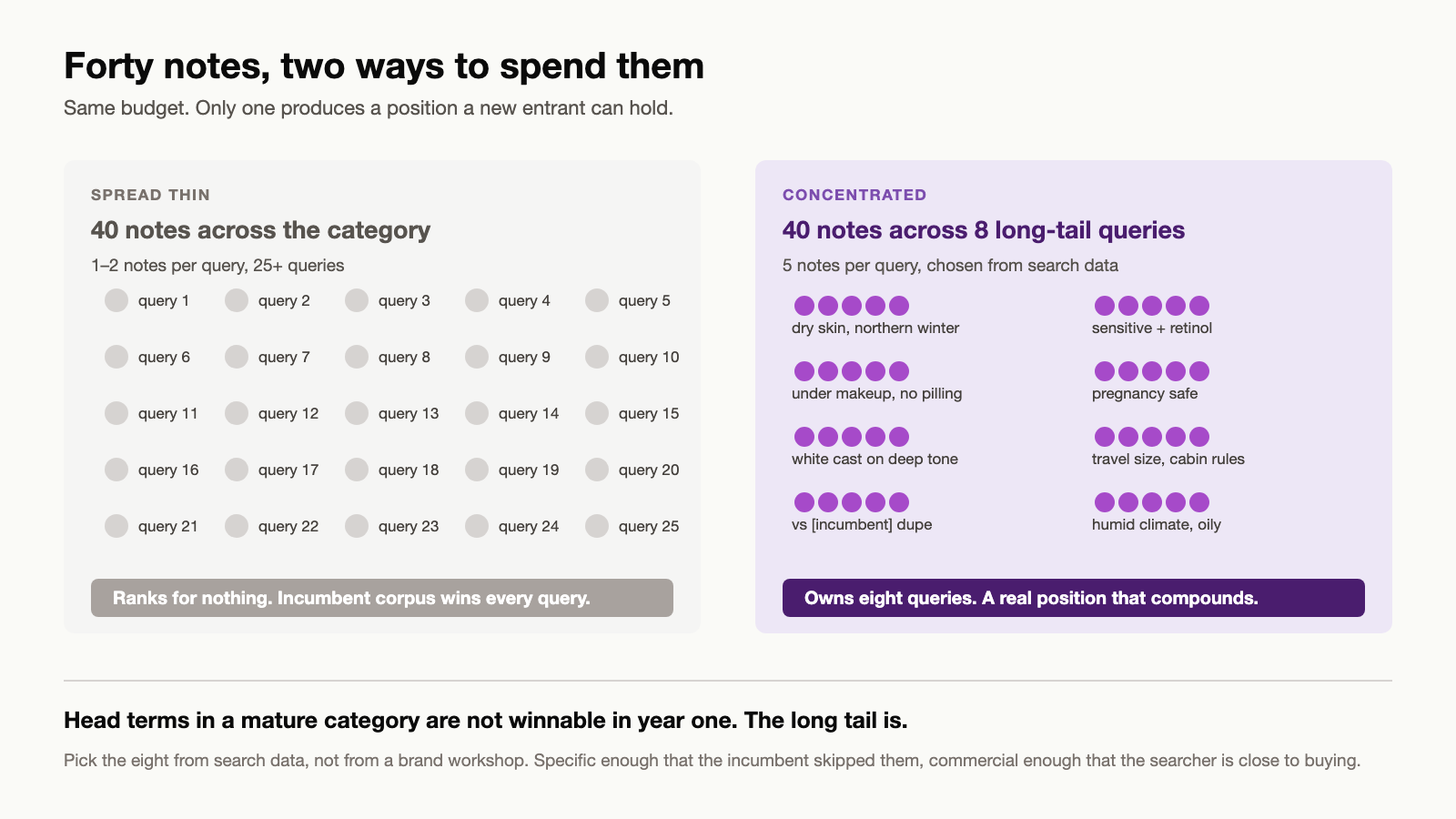
This reframes the seeding volume question. Forty notes spread thinly across a category does nothing. Forty notes concentrated on eight closely related long-tail queries can own those queries, and owning eight queries is a real commercial position that compounds.
Same budget, same note count. Concentration is the only version that produces a position an entrant can hold.
Choosing those eight queries is the decision that determines the whole programme, and it is made from search data rather than from a brand workshop. The right ones are specific enough that a domestic incumbent has not bothered to cover them, and commercial enough that the people typing them are close to buying. That combination is narrower than it sounds and it is worth spending real time on before a single note is commissioned.
Which of these should stop an entry
Four of the six are expensive but survivable. Two are different in kind, and a brand that cannot address them is better off not entering than entering badly, because a poorly run presence accumulates the downside without the upside.
If you cannot fund a Chinese-reading person on your own side of the table, permanently, decline. Everything else in the programme depends on someone being able to see what is happening, and an agency reporting on itself is not a substitute.
If you cannot secure four quarters of political runway before launch, decline. A programme cancelled at month five has spent the entire cost and captured none of the compounding, which is the worst available outcome.
The other four — compliance exposure, category gating, the 避雷 dynamic and the labour market — are all costs to price rather than reasons to stop. Price them honestly and the business case either survives or it does not, which is the point of pricing them.
Frequently asked questions
What is the biggest challenge for foreign brands on Xiaohongshu?
Visibility into the platform itself. The decisive activity is in Chinese, inside an app, and the two native semantic modes — 种草 and 避雷 — both read as neutral to English sentiment tools. Brands without a Chinese reader on their own side are managing a channel they cannot observe.
Why do Xiaohongshu programmes get cancelled early?
Because seeded content compounds over quarters while marketing reviews happen monthly. A programme that is working normally shows a flat month four, which is indefensible internally against three competing budget lines. The cancellation is usually rational politics rather than a misreading of data.
Can a brand recover from a Xiaohongshu account penalty?
Sometimes, but the risk is discontinuous rather than proportional. Penalties attach to the account, which holds your accumulated followers, saved notes and search visibility, and no appeal process is designed around foreign brands. This is why declaring paid collaborations officially matters more than it appears to.
What is 避雷 and why can it not be prevented?
避雷 means avoid the landmine — content explicitly warning other buyers away. It carries purchase-prevention intent and spreads quickly. It cannot be prevented because it is customers describing genuine experiences, and the platform's search behaviour keeps surfacing it to people evaluating your category.
Should we build Xiaohongshu capability in-house?
Eventually, but not on a normal hiring timeline. The experienced operator pool sits in Singapore, Malaysia, Hong Kong and mainland China rather than in Western capitals. Treat the agency relationship as permanent infrastructure for the first several years rather than as a transitional arrangement.
The summary judgement
Almost every published list of Xiaohongshu challenges is a list of mistakes, which is comforting because mistakes imply that a better version of you would not have made them. The six here do not work that way. They are the shape of the platform, and the useful question is not how to overcome them but what each one costs and whether the business case survives after they are all priced in.
"Price the constraints before you buy the strategy. A business case built on the assumption that these are solvable is not a business case."
AI Foundation Models — how DeepSeek and Qwen crossed a billion downloads while Western boards were counting Mag7 capex, and which layers of the AI stack the rotation has not reached. No excerpt tricks: it is the full chapter.
You will also get the weekly newsletter. Unsubscribe any time — the link is in every email.
The Book · $99
China Market Entry Playbook 2026
456 pages across 22 industry chapters — AI, semiconductors, EVs, payments, logistics, beauty, F&B, healthcare, pets, toys. Every chapter runs the same five questions: the anchor number, the rotation underneath it, which layers of the global stack it has reached, and what to do about it. English and Simplified Chinese editions included.
Ex-Transsion Global Digital Marketing Director · Effie Awards Greater China jury member · Guest lecturer, Peking University School of Economics · Writes Annie Chan Talk, your insider lens on China.