You Cannot Open a Thai TikTok Shop. What a Foreign Brand Can Actually Do.
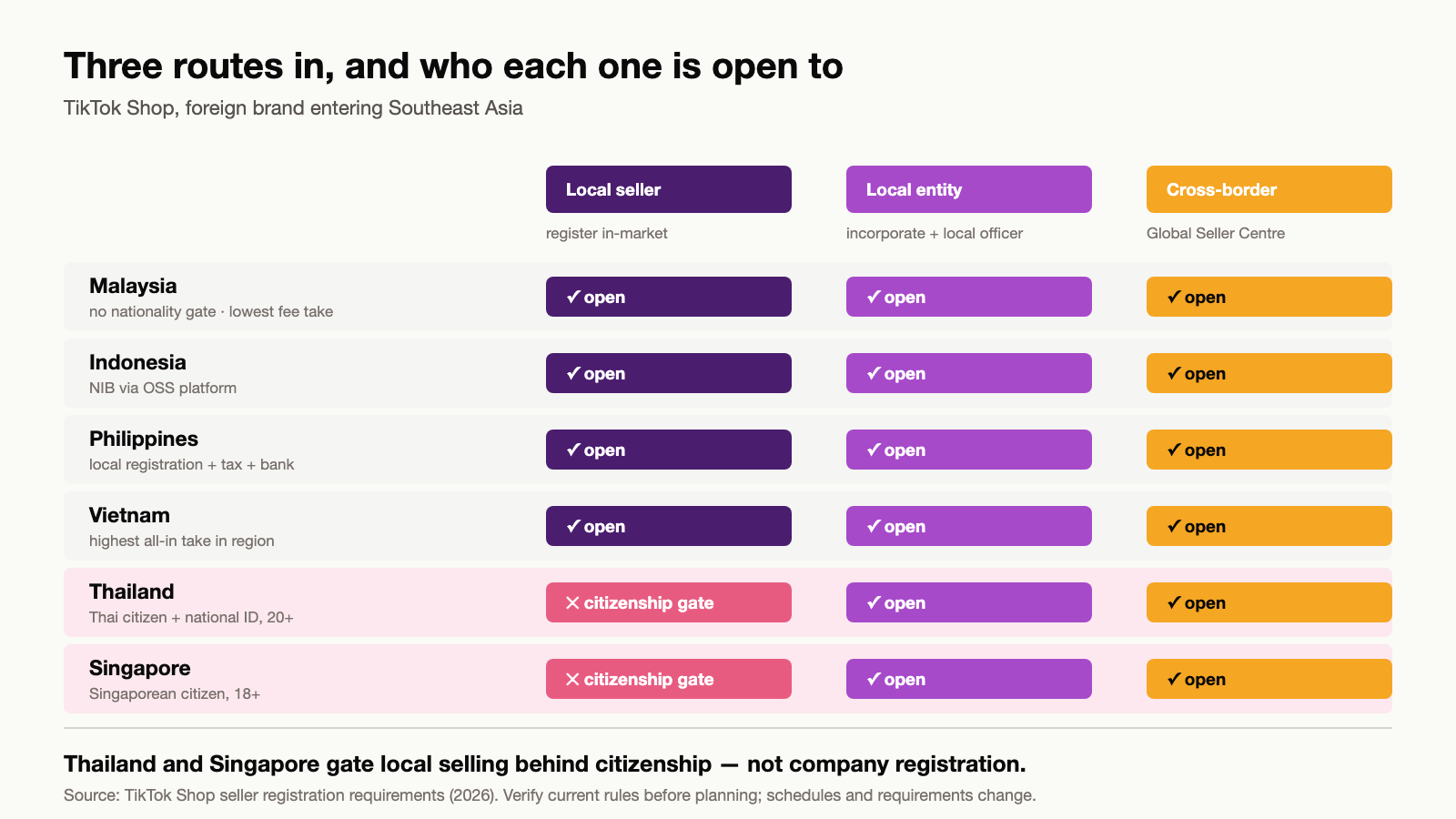
Thailand and Singapore require the seller to be a citizen, not merely a registered business. That single fact reshapes the entry question, and almost no English-language guide states it plainly.
Annie Chan··12 min read
Search for how to open a TikTok Shop in Thailand and you will find step-by-step guides. Download the app, go to Seller Centre, upload documents, wait for approval. They are accurate as far as they go, and for a foreign brand they describe a door that will not open.
Thailand's local seller registration requires the applicant to be at least 20 years old, a Thai citizen, and to present a government-issued Thai National ID card. Singapore's requires the applicant to be at least 18 and a Singaporean citizen (TikTok Shop, 2026).
That is a nationality requirement, not a company requirement. No amount of paperwork converts a foreign company into an eligible local seller in those markets. A brand planning Thai or Singaporean entry through the ordinary registration route is planning something that does not exist, and will find out after the content budget is committed.
The useful version of the question is not how to register. It is which of three structures your target market actually permits, and that differs enough between the five markets to change which one you enter first.
The three routes, and who can use them
Three routes, and the first one is closed to foreign nationals in two of the five markets. That constraint is upstream of every other decision.
Route one — local seller, registered in-market
The default path, and the one every guide describes. Across the region it generally requires a business registered in the country of sale, local tax registration such as VAT or GST, and a local bank account to receive payouts in local currency. Indonesia additionally requires a company registration certificate — the Nomor Induk Berusaha, obtained through the Online Single Submission platform.
This route gives the best commercial position: domestic delivery times, full category access and the algorithmic treatment domestic sellers receive. It is also the route that Thailand and Singapore gate behind citizenship. Full category access is itself conditional, mind you, because the national certificates behind food, cosmetics and supplements usually have to be held by a local entity rather than by you, which is set out in what the restricted categories actually require in each market. And for what happens after the account exists, where creator reach is rationed by trailing GMV and a new shop cannot simply push harder, see scaling a TikTok Shop in Southeast Asia.
Route two — local entity with local participation
Where the citizenship requirement bites, the workaround is structural rather than administrative: incorporate locally with a qualifying local director or shareholder who satisfies the requirement. This is ordinary corporate practice in Southeast Asia and there is a professional services industry for it.
It is also a genuine commitment. You are creating a legal entity in a foreign jurisdiction with local officers, which brings tax residency, filing obligations and a relationship with a person or firm whose cooperation you now depend on. Worth doing for a market you are serious about. Absurd for a market you are testing.
Route three — cross-border through the Global Seller Centre
TikTok runs a structured cross-border programme with defined source-to-destination lanes, whitelisted logistics providers and stricter performance thresholds than domestic selling. It is the route that lets a brand reach a market without standing up an entity there.
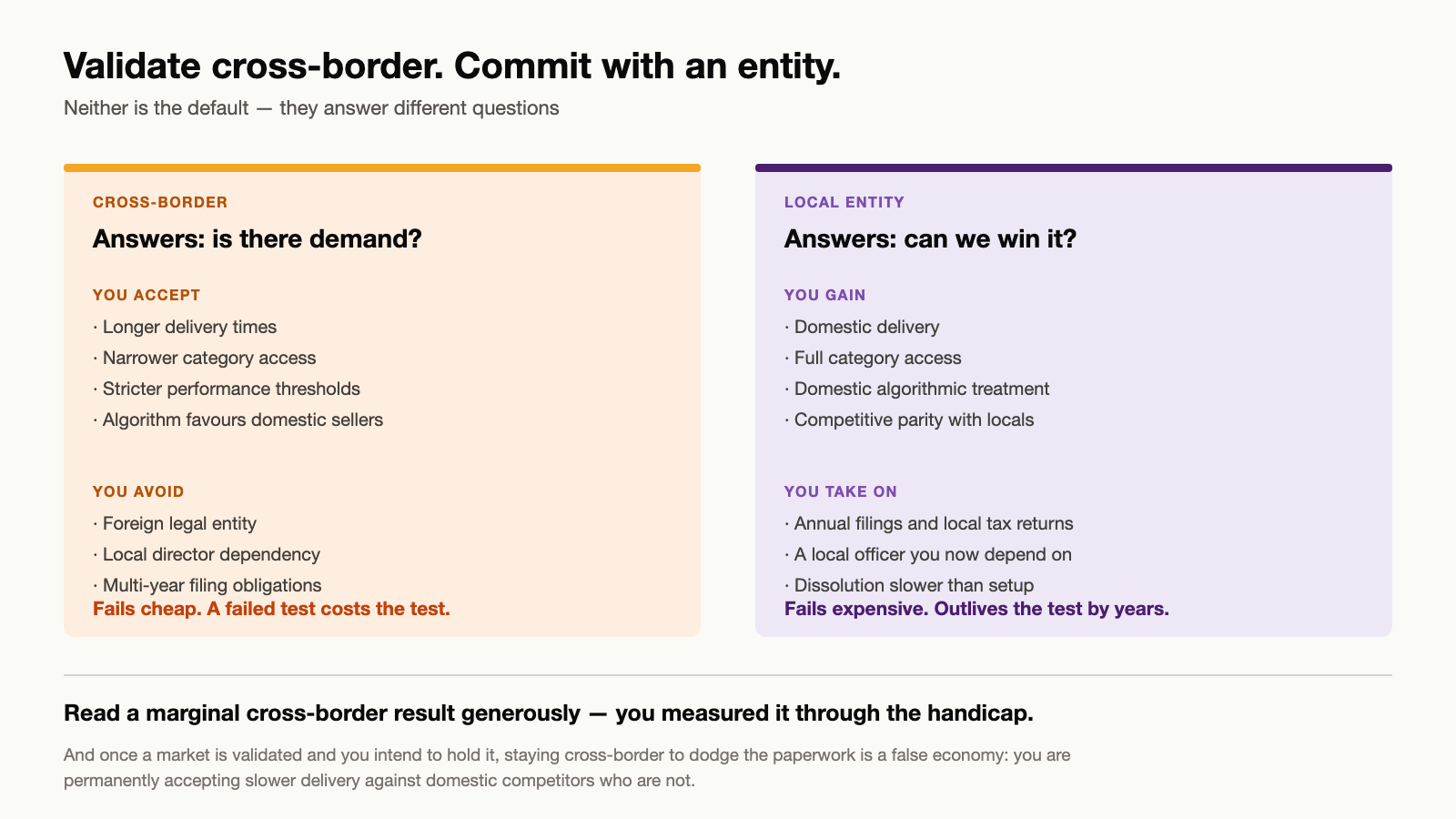
The trade is explicit and worth stating in the plan rather than discovering in month three: longer delivery, narrower category access, tighter performance tolerances, and algorithmic treatment that favours domestic sellers. Cross-border is how you validate demand. It is not how you win a market you have already validated.
From March 2026 that trade also carries a fixed in-market cost: cross-border merchants must hold a local return address. It is a small line in the fee schedule and a large one in the operating plan, because it puts a physical dependency inside the route that was supposed to avoid having one.
What each market actually requires
Malaysia
Business must be registered in Malaysia, with business licences or equivalent official documents supporting eligibility to sell your product category. No nationality requirement on the applicant, which makes Malaysia the most accessible of the five for a foreign brand willing to incorporate. Combined with its commercial English usage and an all-in fee take at the low end of the region, this is a strong argument for Malaysia as a first market that has nothing to do with market size.
Indonesia
Requires an NIB obtained through the OSS platform — a specific, checkable document rather than a general business registration. The process is well-trodden and slower than it looks. Indonesia is the largest market in the region, which means the incorporation effort is more defensible here than anywhere else, and also that everyone else has already done it.
Thailand
Local seller registration requires Thai citizenship and a Thai National ID, minimum age 20. For a foreign brand this means route two or route three, with no third option. Thailand also carries foreign ownership restrictions in a range of business activities under its own company law, so the local-entity route needs proper local advice rather than a template.
Singapore
Local seller registration requires Singaporean citizenship, minimum age 18. Singapore is otherwise the easiest jurisdiction in the region to incorporate in and has the cleanest platform fee structure, so the citizenship gate on the registration path is a narrow obstacle in an otherwise straightforward market.
Philippines and Vietnam
Both follow the general pattern: local business registration, local tax registration, local bank account. Vietnam's platform economics changed materially in May 2026 and its all-in take is now the highest in the region, which is a separate reason to sequence it carefully regardless of how straightforward the registration is.
The banking requirement nobody schedules
Every route above ends at the same practical wall: payouts land in a local bank account, in local currency. That sentence appears in the requirements list as one line and behaves in practice as a multi-week dependency.
Opening a corporate bank account as a newly incorporated foreign-owned entity is the slowest step in most Southeast Asian markets. Banks apply their own know-your-customer standards on top of the incorporation, frequently want a director present in person, and are markedly less enthusiastic about a company with no local trading history than the incorporation agent implied.
Sequence the bank account in parallel with incorporation, not after it. Teams routinely finish the company registration, celebrate, and then discover the account takes another six weeks — during which the entity exists, costs money, and cannot receive a single payout.
There is a second consequence worth modelling. Payouts arrive in local currency, so the repatriation question is yours: conversion cost, timing, and in some markets the rules on moving funds out. None of that appears in a platform fee schedule, and for a low-margin category the conversion spread is a real line rather than a rounding error — worth pricing alongside the platform take rather than after it.
The question behind 'how to access TikTok Shop in another country'
A large share of search traffic on this topic is people trying to reach a market's TikTok Shop from outside it, or to move an existing shop from one market to another. Both reflect the same underlying misunderstanding.
TikTok Shop is not one marketplace with regional views. Each market is a separate commercial jurisdiction with its own seller registration, fee schedule, category rules, logistics network and buyer base. A shop registered in Indonesia does not sell into Malaysia by changing a setting, and there is no toggle that moves it.
"Reaching a second market means registering in that market or entering it through the cross-border programme. Those are the only two mechanisms, and neither is a settings change."
This matters more than a technical footnote because it determines how a multi-market plan is costed. Five Southeast Asian markets is not one project with five outputs. It is five registrations, five fee models, five logistics arrangements and, in two of them, a local entity question. Teams that budget it as one project underestimate by a wide margin.
What the local entity actually costs you
The cross-border handicap is real and priced. The entity commitment is real and hard to unwind. Neither is the default.
Teams tend to treat incorporation as a procurement task with a fee attached. It is closer to a hiring decision, and the recurring parts outlast the setup by years.
Annual filings, statutory accounts and local tax returns, in the local language, for as long as the entity exists — including the years you are not trading through it.
A local director or shareholder where the jurisdiction requires one. That person is a dependency, not a line item. Their cooperation is required for bank changes, filings and eventually dissolution.
Tax residency and transfer pricing questions once the entity trades. Group finance will have opinions about this that marketing did not anticipate.
Dissolution, which is slower and more expensive than incorporation in most of the region. Entities created for a market test tend to outlive the test by several years.
This is the argument for validating cross-border first, stated commercially rather than strategically. A cross-border test that fails costs you the test. A local entity created for a market that then fails costs you the test plus several years of maintaining a company you no longer want.
The reverse case is equally worth naming. For a market you have already validated and intend to hold, staying cross-border to avoid the paperwork is a false economy — you are permanently accepting slower delivery and narrower category access against domestic competitors who are not. The entity is the cost of competing properly, once competing properly is the plan. Worth noting that the entity, once you have it, is not TikTok-specific: Shopee and Lazada reach substantially the same buyers, so the registration effort amortises across all three rather than one.
A sequence that does not waste the incorporation
Validate demand cross-border first, in one market, before incorporating anywhere. The cross-border route exists precisely so this test does not require an entity.
Pick the validation market for legibility rather than size. Malaysia has no citizenship gate, commercial English works, and its all-in fee take is at the low end — which makes it the cheapest place to learn.
Read the result against the cross-border handicap. You are measuring demand through longer delivery and narrower category access, so a marginal result cross-border may be a good result domestically. Do not kill a market on cross-border numbers alone.
Incorporate only where the validated demand justifies a legal entity, and only after establishing what local ownership or directorship the jurisdiction requires.
Treat Thailand and Singapore as entity decisions from the outset. There is no light-touch version of local selling in either, so the choice is cross-border or commitment, made deliberately rather than discovered.
Frequently asked questions
Can a foreign company open a TikTok Shop in Thailand?
Not through local seller registration, which requires the applicant to be a Thai citizen aged 20 or over with a Thai National ID. The available routes are a locally incorporated entity with qualifying local participation, or the cross-border programme through the Global Seller Centre.
How do I open a TikTok Shop in Malaysia as a foreign brand?
Register a Malaysian business, obtain the licences that cover your product category, complete local tax registration and open a local bank account for payouts. Malaysia imposes no citizenship requirement on the applicant, which makes it the most accessible of the five markets for a foreign brand.
Can I sell into another Southeast Asian market from my existing shop?
No. Each market is a separate registration with its own fees, category rules and logistics. Reaching a second market requires registering there or entering through the cross-border programme, which uses defined source-to-destination lanes and whitelisted logistics providers.
What documents does TikTok Shop Indonesia require?
A valid company registration certificate — the Nomor Induk Berusaha, obtained through the Online Single Submission platform — plus local tax registration and a local bank account. The NIB is a specific document rather than a general business registration, and obtaining it takes longer than the guides suggest.
Is cross-border selling worse than local selling?
Commercially, yes: longer delivery, narrower category access, stricter performance thresholds and algorithmic treatment that favours domestic sellers. Strategically it is the right first step, because it validates demand without requiring a foreign legal entity.
The summary judgement
The registration guides are not wrong, and they are not written badly. They are written for local sellers, which is nearly everyone who searches this topic, and they omit the single constraint that decides the answer for a foreign brand. Two of the five markets gate local selling behind citizenship, and that is upstream of every other question a brand is asking.
"Establish which route the market permits before you build anything. The answer is a corporate structuring question in two markets, an incorporation question in two more, and only in one is it close to the process the guides describe."
AI Foundation Models — how DeepSeek and Qwen crossed a billion downloads while Western boards were counting Mag7 capex, and which layers of the AI stack the rotation has not reached. No excerpt tricks: it is the full chapter.
You will also get the weekly newsletter. Unsubscribe any time — the link is in every email.
The Book · $99
China Market Entry Playbook 2026
456 pages across 22 industry chapters — AI, semiconductors, EVs, payments, logistics, beauty, F&B, healthcare, pets, toys. Every chapter runs the same five questions: the anchor number, the rotation underneath it, which layers of the global stack it has reached, and what to do about it. English and Simplified Chinese editions included.
Ex-Transsion Global Digital Marketing Director · Effie Awards Greater China jury member · Guest lecturer, Peking University School of Economics · Writes Annie Chan Talk, your insider lens on China.