TikTok Shop Fees in Southeast Asia: The Commission Rate Is the Smallest Number
Vietnam takes roughly double what Malaysia takes on the same platform, and the published commission rates do not show it. What the all-in take rate actually is in each market, and why comparing headline commission is how margin plans go wrong.
Annie Chan··13 min read
A brand modelling Southeast Asian unit economics usually starts by looking up the commission rate. Malaysia comes back at 4 to 6 percent. Vietnam comes back at 12.5 percent. The obvious conclusion is that Vietnam costs about twice as much, and that conclusion is roughly right by accident, for entirely the wrong reason.
The commission line is not the platform's take. It is one component of it, and the other components differ by market in ways the headline number hides completely.
Every Southeast Asian market stacks a different combination of commission, transaction fee, payment fee, service fee and tax. Two markets quoting similar commission can have all-in take rates six points apart, and one market applies an 11 percent VAT that most English-language guides omit entirely. Model the stack, not the headline.
What follows is the stack, market by market, with the caveat that platform fee schedules change frequently and several of these changed in the first half of 2026. Treat every figure here as a planning input to verify in your own seller centre, not as a contract term.
The all-in take rate, by market
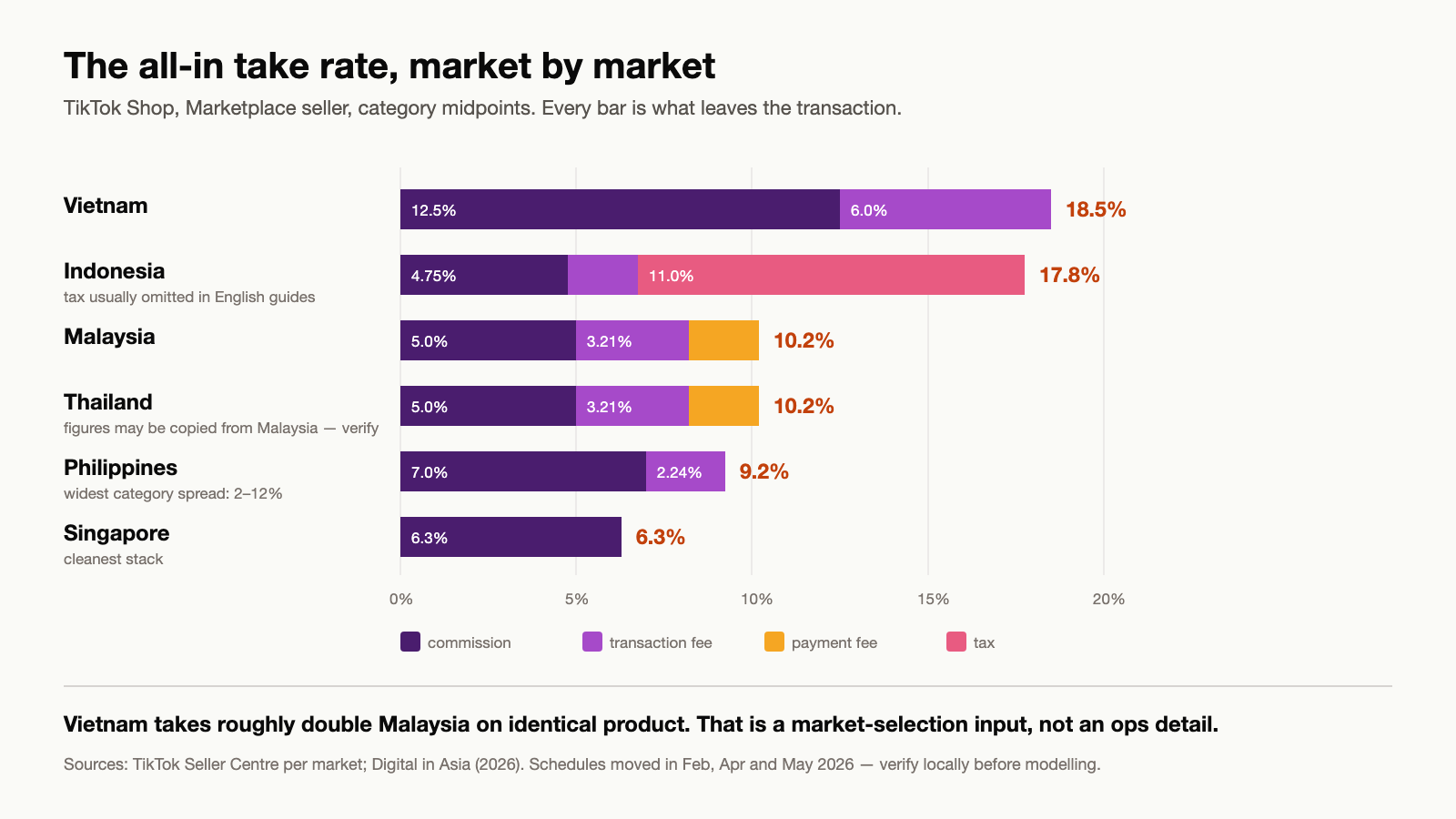
Same platform, six different stacks. Vietnam's total is roughly double Malaysia's, and the commission line only explains part of the gap.
Vietnam — the outlier, and it changed in May 2026
From 9 May 2026 the default commission is 12.50 percent for Marketplace sellers and 15.50 percent for Mall sellers, with a 6 percent transaction fee on top (TikTok Seller Vietnam, 2026). That puts the all-in take at roughly 18.5 percent for Marketplace and 21.5 percent for Mall.
This is the single most consequential number in the region and the most recently changed. A margin model built on pre-May figures understates Vietnamese cost of sale substantially, and Vietnam was the fastest-growing of the five markets in 2025 — which means a lot of brands modelled it during exactly the window when the numbers moved.
Indonesia — where the tax line matters more than the commission
Platform commission runs roughly 1.5 to 8 percent, with a 2 percent transaction fee, and Mall sellers pay an additional 2 percent service fee taking the commission band to 3.5 to 10.5 percent. Pre-order goods carry a further 3 percent service fee per product sold.
Then there is PPN, Indonesian VAT, at 11 percent. English-language fee guides routinely leave this out because it is a tax rather than a platform fee, which is analytically tidy and commercially useless — it comes out of the same transaction. A brand reading only the commission band sees a market that looks cheaper than Malaysia. Once VAT is in the model, it is not.
Malaysia and Thailand — the middle, with a caveat
Non-Mall sellers in both markets are reported at 4 to 6 percent commission by category, plus a 3.21 percent transaction fee and a 2 percent payment fee, giving an all-in take of roughly 9.2 to 11.2 percent. Mall sellers face category-based commission — electronics reported around 4.86 to 9.18 percent, fashion around 8.10 to 10.26 percent — plus a 3.78 percent transaction fee and a small per-order support fee.
One honest flag: the Thai and Malaysian figures published in English are close to identical, including a per-order support fee quoted in Malaysian ringgit for both. That is a strong sign the Thai numbers have been copied from the Malaysian schedule somewhere upstream. Verify Thailand in the Thai seller centre before modelling it, rather than trusting the English secondary sources — this one included.
Singapore — simpler, and priced accordingly
From 1 April 2026, Marketplace sellers pay 5.45 percent on electronics and lifestyle and 7.085 percent on other categories. The structure is cleaner than the other markets, with fewer stacked components, which makes Singapore the easiest market to model and — not coincidentally — the one where fee surprises are least likely to break a plan.
Philippines — the widest category spread
Commission is category-based across an unusually wide band: roughly 2 to 4 percent on electronics rising to 8 to 12 percent on food, plus a transaction fee around 2.24 percent and payment-method fees on top. The practical consequence is that Philippine viability is a category question rather than a market question. Two brands can reach opposite conclusions about the same market and both be right.
Why the headline comparison misleads
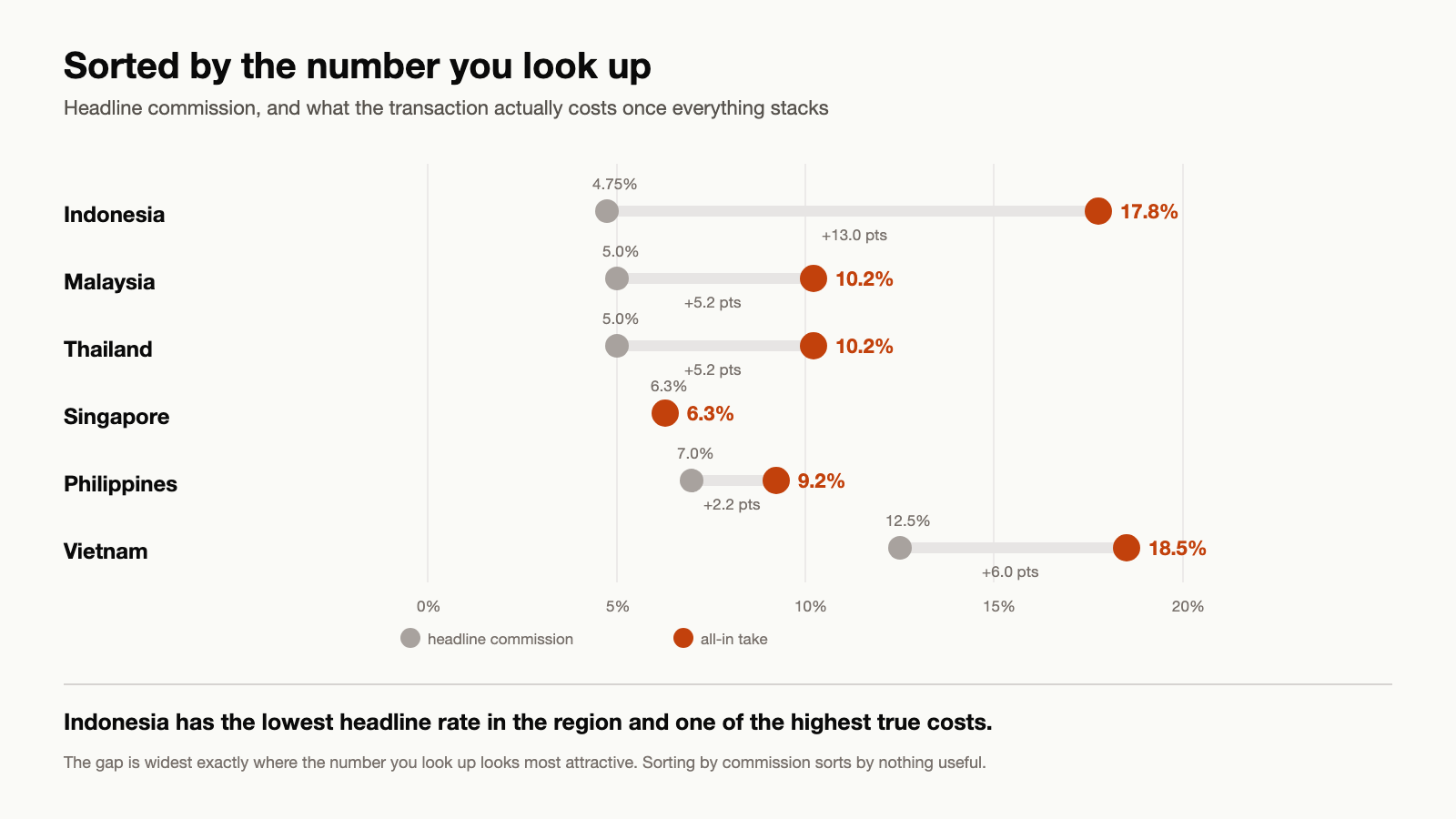
The gap between the number you look up and the number you pay is not constant. It is widest exactly where the headline looks most attractive.
Three structural reasons the commission line fails as a comparison tool.
The stack differs in kind, not just size. Vietnam adds a 6 percent transaction fee; Indonesia adds 2 percent plus 11 percent VAT; Malaysia adds 3.21 percent plus a 2 percent payment fee. These are different line items with different bases, and averaging them into a single 'fee percentage' loses the thing you needed to know.
Category bands overlap across markets. Philippine food at 8 to 12 percent and Philippine electronics at 2 to 4 percent are further apart than Philippines and Singapore are from each other. Comparing markets without fixing the category compares nothing.
Mall versus Marketplace changes the answer materially. Vietnam Mall at 15.50 percent against Marketplace at 12.50 percent is a three-point difference before the transaction fee, and Mall status is a decision you make rather than a condition you inherit.
"The right comparison unit is your category, in Mall or Marketplace, with every line item stacked and tax included. Anything shorter produces a number that is comparable to nothing."
The platform comparison nobody runs correctly either
Brands choosing between TikTok Shop, Shopee and Lazada usually compare commission bands and conclude the platforms are broadly similar. In 2026 that conclusion is less wrong than it used to be, but for a reason worth understanding.
Shopee introduced a 5 percent technical support fee in February 2026 across Singapore, Malaysia, Thailand and Vietnam, on top of commission of roughly 2 to 6 percent and a transaction fee around 2.18 percent. Its all-in take now typically lands between 12 and 22 percent (Digital in Asia, 2026). Lazada sits at 4 to 6 percent commission with transaction and processing adding roughly ten points.
The convergence is real: all three platforms now take somewhere in the low-to-high teens once everything stacks. Which means fee structure has stopped being a useful basis for choosing between them, and the decision should turn on demand shape, content requirement and fulfilment fit instead. If a proposal recommends a platform primarily on take rate, it is optimising a variable that no longer differentiates.
Audience does not differentiate them either, which is the part that surprises people — the same Thai buyers use all three at penetration rates of 75, 67 and 51 percent. That changes what the platform choice is actually about.
There is a second-order point here for anyone who last looked at this in 2024. Fee schedules across all three platforms moved upward in the first half of 2026. A margin model that has not been rebuilt this year is describing a market that no longer exists.
One product, two markets, worked through
Abstract percentages are hard to argue with and easy to misread. Take a single item at a 500,000 VND / 90 MYR equivalent selling price — call it a mid-priced beauty product, Marketplace rather than Mall, and run it through both stacks.
Vietnam
Commission at 12.50 percent and transaction fee at 6 percent give an all-in platform take of 18.5 percent. On a 100 unit of revenue, 18.50 goes to the platform before you have paid for the creator who sold it, the ad that surfaced it, or the courier who moved it.
Malaysia
Commission in the 4 to 6 percent band, a 3.21 percent transaction fee and a 2 percent payment fee give 9.2 to 11.2 percent. Take the midpoint at roughly 10.2, and the same 100 of revenue loses 10.20.
The gap is roughly 8 points of revenue on identical product at identical price. On a category running 35 percent gross margin, that is nearly a quarter of the margin, decided entirely by which market the order landed in. It is not an operations variable and no amount of execution recovers it.
The reason this matters more than it first appears: brands typically choose the market on demand size and choose it once. Vietnam grew fastest of the five in 2025, which is a good reason to want it and a bad reason to model it optimistically. The growth and the take rate are both real, and only one of them shows up in the excitement.
What the fee stack does not include
Every figure above is platform take on the transaction. The costs that actually decide whether a Southeast Asian programme is profitable sit outside it.
Affiliate commission. Creator-driven sales carry their own commission on top of platform take, negotiated per campaign or per creator. In content-led categories this is frequently larger than the platform fee — the combined number reaches 38.5 percent in Vietnam.
Advertising. Paid distribution is a separate budget line and, during the new-shop ramp, one that can actively hurt you by generating orders against a late-dispatch tolerance you cannot yet meet.
Fulfilment and returns. Cross-border shipping, local warehousing and return handling differ enormously between domestic and cross-border seller status, and returns policy varies by market.
Local-language operations. Content production, customer response and community management in the market language. This is a real recurring cost and the one most often absent from the first version of the model.
A useful sanity check: if your model shows platform fees as the largest cost line after COGS, the model is probably incomplete rather than the business unusually efficient. The other half most models omit is timing — when any of this becomes cash. And if the COGS line itself is the one under pressure, that is a different problem with a different answer: what sourcing looks like when you are a brand rather than a reseller.
How to build the number you actually need
Fix the category first. Fee bands are category-based in every market, so a market-level number without a category is not an input to anything.
Decide Mall or Marketplace before modelling, because it moves the commission line by several points and it is a choice rather than a given.
Stack every component: commission, transaction fee, payment fee, service fees, per-order fees, and tax where the market applies it.
Verify in the local seller centre rather than in English secondary sources. The Thai and Malaysian figures circulating in English appear to share a common upstream error, which is a reasonable warning about the whole genre.
Rebuild the model on a schedule. Vietnam changed in May 2026, Singapore in April, Shopee added a fee in February. Annual review is not frequent enough.
Frequently asked questions
How much commission does TikTok Shop take in Southeast Asia?
It varies by market and category. Vietnam is 12.50 percent for Marketplace and 15.50 percent for Mall from May 2026. Malaysia and Thailand run 4 to 6 percent non-Mall. Singapore is 5.45 to 7.085 percent. Indonesia is 1.5 to 8 percent, and the Philippines spans roughly 2 to 12 percent by category.
Which Southeast Asian market has the lowest TikTok Shop fees?
On all-in take, Malaysia at roughly 9.2 to 11.2 percent is at the low end and Vietnam at around 18.5 percent Marketplace is the highest. Indonesia looks cheap on commission alone but carries 11 percent PPN on top, which moves it materially once included.
What is the TikTok Shop transaction fee?
A separate line from commission, charged per market: around 6 percent in Vietnam, 3.21 percent in Malaysia non-Mall, roughly 2 percent in Indonesia and about 2.24 percent in the Philippines. It stacks on top of commission rather than replacing it.
Is TikTok Shop cheaper than Shopee or Lazada?
Not meaningfully in 2026. Shopee added a 5 percent technical support fee in February across four markets, putting its all-in take at roughly 12 to 22 percent, and Lazada's transaction and processing add around ten points to a 4 to 6 percent commission. All three now converge, so fee structure has stopped being a good basis for choosing.
Do TikTok Shop fees include tax?
No, and Indonesia is where this matters most — PPN at 11 percent applies on top of platform fees and is frequently omitted from English-language fee guides because it is a tax rather than a platform charge. It comes out of the same transaction regardless.
The summary judgement
The commission rate is the number that is easy to look up, which is why it is the number that gets compared. It is also the number that explains the least. Two markets on the same platform can sit six points apart on all-in take with similar headline commission, and the market that looks cheapest on commission is not the cheapest once tax is included.
"Fix the category, choose Mall or Marketplace, stack every line, include the tax, and verify locally. Any number produced by a shorter process is not comparable to any other number."
For the decision this feeds into — which market first, and as which kind of seller — see TikTok Shop in Southeast Asia. For the capacity caps that constrain the ramp regardless of margin, probation and Account Health Rating, and for where operational fee changes get discussed before they reach English sources, seller communities market by market. The channel whose costs sit outside this stack entirely, because it is priced in staffed hours rather than percentages, is covered in live selling in Southeast Asia. And before any of this stack matters, the realised price the format produces decides whether the product belongs here at all, which is worked through in what sells on TikTok Shop.
Share:
Free · 24 pages
Read Chapter 1 of the Playbook
AI Foundation Models — how DeepSeek and Qwen crossed a billion downloads while Western boards were counting Mag7 capex, and which layers of the AI stack the rotation has not reached. No excerpt tricks: it is the full chapter.
You will also get the weekly newsletter. Unsubscribe any time — the link is in every email.
The Book · $99
China Market Entry Playbook 2026
456 pages across 22 industry chapters — AI, semiconductors, EVs, payments, logistics, beauty, F&B, healthcare, pets, toys. Every chapter runs the same five questions: the anchor number, the rotation underneath it, which layers of the global stack it has reached, and what to do about it. English and Simplified Chinese editions included.
Ex-Transsion Global Digital Marketing Director · Effie Awards Greater China jury member · Guest lecturer, Peking University School of Economics · Writes Annie Chan Talk, your insider lens on China.