TikTok Shop Probation Is Not a Penalty — But Your Account Health Rating Is
New sellers search for a way out of probation, which is a capacity ramp everyone starts on. Meanwhile the system that can actually close the shop was replaced in July 2026, and most published guidance still describes the old one.
Annie Chan··12 min read
One of the more revealing things about a marketplace is what its sellers panic about. On TikTok Shop, a large volume of search traffic goes to questions about escaping probation — including a steady stream of people looking for answers to the onboarding quiz. Almost none goes to the Account Health Rating, which replaced the entire violation system in July 2026 and is the mechanism that actually closes shops.
The attention is inverted, and the reason is a naming accident.
Probation is not a sanction. It is the capacity ramp every new shop starts on, with daily order and listing caps that lift automatically as you demonstrate fulfilment reliability. Nobody put you there for doing something wrong. The thing that does punish you is the Account Health Rating, and it is new enough that most guidance you will find describes a system that no longer exists.
Why the word causes the confusion
TikTok calls the same programme different things in different markets, and the naming does most of the damage. In the US, UK and Ireland it is the Shop Probation Program. In Singapore, Thailand and Vietnam it is the New Shop Adjustment Period. In Brazil it is the Guidelines for New Shop Probation Period.
Adjustment Period describes the mechanism accurately. Probation does not, and it is the word that reaches English-language search. A brand reading US-oriented material arrives believing it has been placed under supervision, and starts optimising for an exit that was always going to happen on schedule.
"The English-language name is the least accurate of the three, and it is the one that shapes what sellers believe. Read your own market's documentation, not the version that ranks."
For a Western brand entering Southeast Asia, this matters twice over: the market you are entering uses the calmer name, the caps are different, and searching in English will return the US framing by default.
The tier ladder, and why Southeast Asia is not the same shape as the US
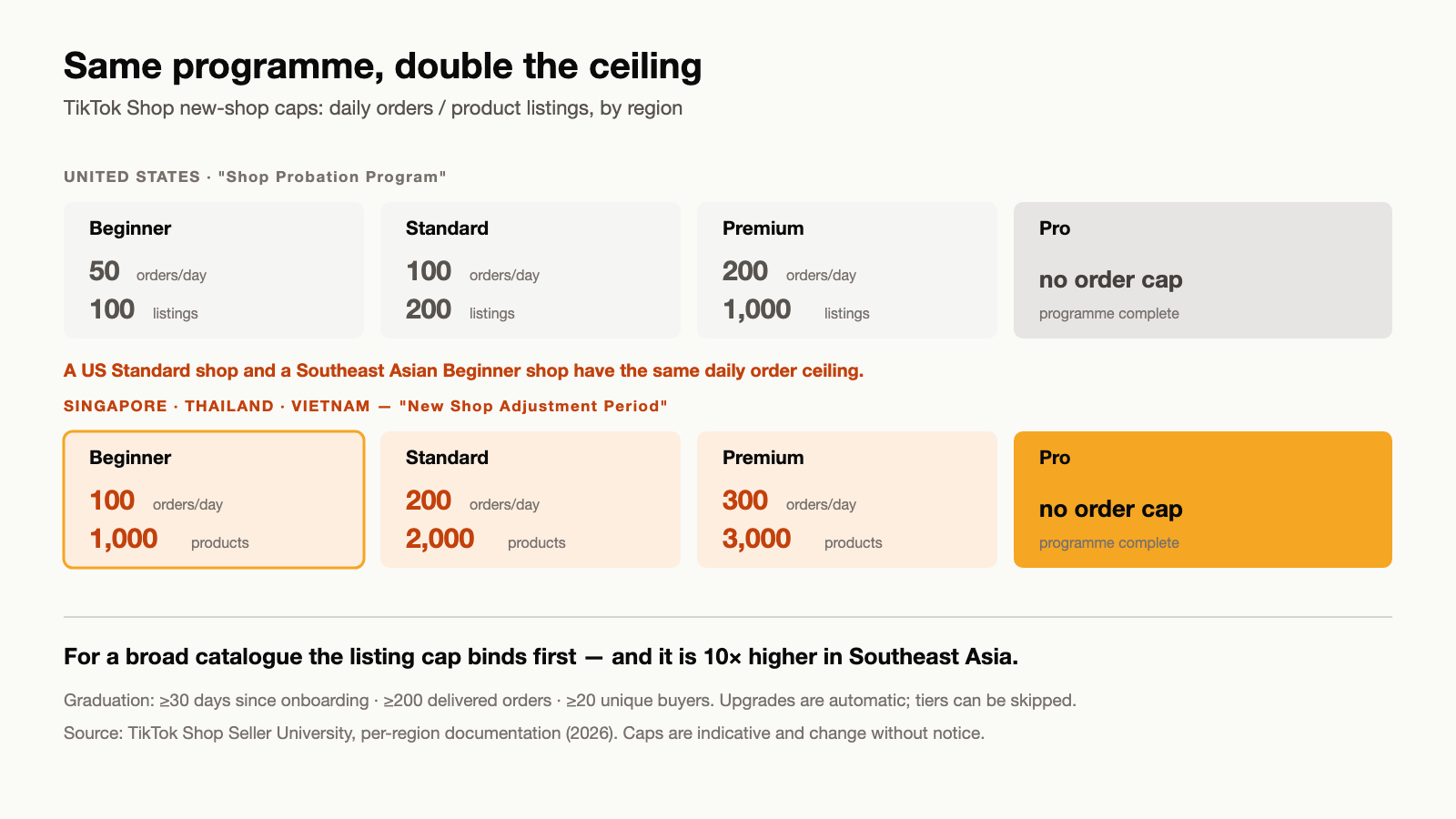
Same programme, different ceilings. A Southeast Asian Beginner shop starts with the daily order cap a US shop reaches at Standard.
There are four tiers — Beginner, Standard, Premium, Pro — and each carries a daily order cap and a product listing cap. The caps differ by region, and the difference is large enough to affect which market you launch in.
United States
Beginner allows roughly 50 orders a day against 100 listings. Standard doubles that to about 100 orders and 200 listings. Premium moves to around 200 orders and 1,000 listings. Pro removes the order cap entirely.
Singapore, Thailand and Vietnam
Beginner allows around 100 orders a day and 1,000 products. Standard moves to roughly 200 orders and 2,000 products. Premium reaches about 300 orders and 3,000 products.
Read those two lists next to each other and the practical consequence is obvious. A Southeast Asian shop opens at the daily order ceiling a US shop only reaches at the second tier, and it opens with ten times the listing headroom. For a brand with a broad catalogue, that listing cap is frequently the binding constraint rather than the order cap, and the US number is genuinely restrictive.
If your catalogue runs to several hundred SKUs, launching in the US first means uploading a hundred of them and waiting. The same catalogue goes live on day one in Singapore, Thailand or Vietnam. This belongs in the market-selection decision, not in the operations plan you write afterwards.
How you actually graduate
The requirements are specific, published, and reassuringly boring. Graduation generally requires at least 30 calendar days since onboarding, at least 200 delivered or matured orders, and orders from at least 20 unique buyers.
Two details make this easier than sellers assume. Tier upgrades are automatic and need no application — there is no form, no review queue, and nobody to appeal to. And shops do not have to climb every rung: meeting the Pro criteria completes the programme outright, so a shop that ramps quickly can skip the middle tiers entirely.
The 20-unique-buyer requirement is the one worth reading carefully. It exists to stop a seller manufacturing 200 orders through a handful of accounts, and it means the graduation clock is genuinely a demand test rather than a volume test. A brand that pushes 200 orders through its own distributor network has not satisfied it.
Ship on time with valid tracking. Late dispatch is the single largest cause of a stalled ramp.
Answer customer messages quickly. Response time feeds the reliability signals the programme reads.
Keep cancellations and returns low, particularly cancellations attributable to you rather than the buyer.
Protect the Account Health Rating throughout, because a shop losing health does not graduate regardless of order volume.
After graduation the daily order cap disappears, though product upload limits can still apply at around 1,000 per day. That is a throughput limit on the act of uploading rather than a cap on catalogue size, and it only matters during a bulk migration. Plan a large catalogue import across several days rather than discovering the ceiling halfway through one.
The system that actually ends shops changed in July
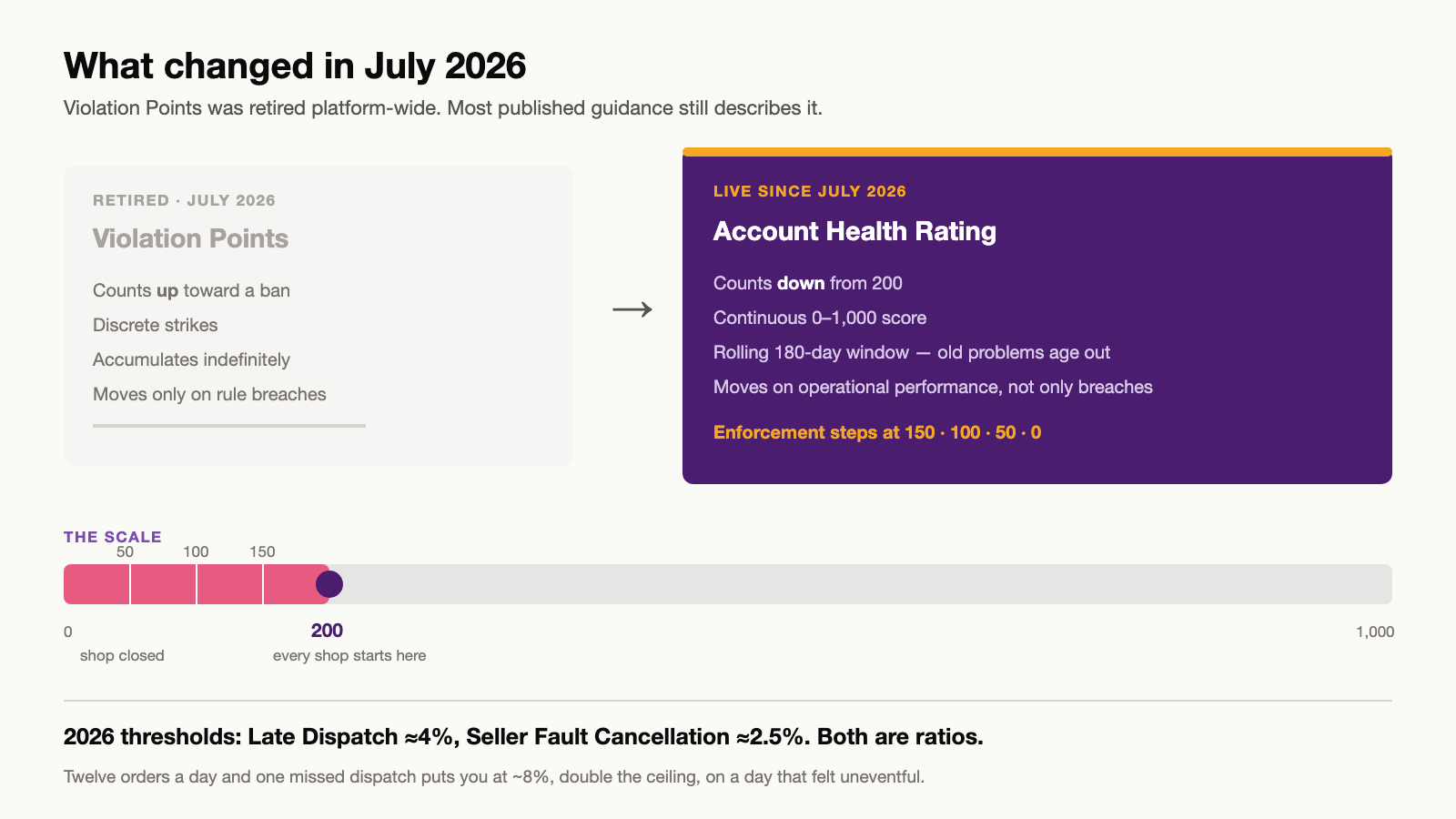
Violation Points counted up toward a ban. AHR counts down from 200 on a rolling window. Most published guidance still describes the left-hand column.
TikTok Shop previewed Account Health Rating in May 2026 and completed the platform-wide replacement of Violation Points in July (AdBeacon, 2026). This is the change that matters, and the search behaviour has not caught up with it.
AHR is a continuous score from 0 to 1,000 reflecting shop health across a rolling 180-day window. Every account starts at 200 points. Further enforcement action follows as the rating falls through 150, 100, 50 and 0.
Three structural differences from the old system are worth internalising. The window rolls, so old problems age out rather than accumulating forever — which is genuinely more forgiving. The score is continuous rather than a count of discrete strikes, so degradation is gradual and observable before it becomes terminal. And because it is a health score rather than a punishment counter, it moves on operational performance and not only on rule breaches.
"The old system told you how many times you had been caught. The new one tells you how you are doing. Those require different management, and only the second one can be improved by shipping better."
The 2026 service-level thresholds attached to this are specific: a Late Dispatch Rate ceiling around 4 percent and a Seller Fault Cancellation Rate ceiling around 2.5 percent. Both are tight for a cross-border seller with a long fulfilment chain, which is one more argument for domestic seller status in the market you are serious about.
Reading your own rating, and what to do when it drops
The rating lives in Shop Health inside Seller Center, and the useful habit is checking the trajectory rather than the number. A shop sitting at 190 and falling is in more trouble than one sitting at 160 and climbing, because the rolling window means the first is accumulating fresh problems while the second is ageing out old ones.
The two rates that move it most
Late Dispatch Rate and Seller Fault Cancellation Rate carry the operational weight, with 2026 thresholds around 4 percent and 2.5 percent respectively. Both are ratios, which has a consequence people miss: a low-volume shop can breach either on a handful of bad orders. Twelve orders a day and one missed dispatch puts you at roughly 8 percent, double the ceiling, on a day that felt uneventful.
This is the argument for not scaling media spend during the ramp, stated arithmetically. Volume is the denominator. A shop doing 200 orders a day absorbs a bad afternoon; a shop doing twelve does not.
Appeals exist and are underused
Service-point appeals now run directly through Seller Center, and violation appeals go through Shop Health. Sellers routinely skip both, on the assumption that platform appeals are decorative. For genuinely mis-attributed events — a carrier scan failure recorded as a late dispatch, a buyer-initiated cancellation logged as seller fault — the appeal is worth filing, and the evidence requirement is usually a tracking record you already hold.
File them promptly. The rolling window means a successful appeal removes the event, but an event that has already spent four months depressing your rating has done most of its damage regardless of the outcome.
"Check the trajectory weekly, not the number monthly. A rating falling from 200 is a system telling you something in your fulfilment chain broke, and it says so before enforcement arrives."
What this means for a brand rather than a dropshipper
Most content on this topic is written for individual sellers looking for a shortcut, which is why the quiz-answer queries exist. A brand's situation is different in three ways.
The order cap is rarely your constraint; the listing cap usually is. A brand with 400 SKUs is blocked by a 100-listing ceiling long before it is blocked by 50 orders a day, and that reverses the usual advice about which tier to chase.
Your fulfilment chain is longer than a domestic seller's, so the 4 percent late dispatch threshold is a real operational risk rather than a formality. Model it before launch, not after the first breach.
You cannot buy your way out. Advertising spend does not accelerate graduation, because the criteria measure fulfilment reliability and unique-buyer breadth. Paid distribution during probation can actively hurt, by generating orders you then miss the dispatch window on.
The counterintuitive move during the adjustment period is to spend less, not more. Use the window to prove fulfilment against a modest order flow, graduate, and then open the media budget against uncapped capacity. Brands that launch a campaign into a 50-order daily ceiling pay for demand they are structurally unable to serve.
Frequently asked questions
Is TikTok Shop probation a punishment?
No. It is the onboarding capacity ramp every new shop starts on, with daily order and listing caps that lift automatically as fulfilment reliability is demonstrated. In Singapore, Thailand and Vietnam the same programme is called the New Shop Adjustment Period, which describes it more accurately.
How long does TikTok Shop probation last?
Graduation generally requires at least 30 calendar days since onboarding, at least 200 delivered or matured orders, and orders from at least 20 unique buyers. Upgrades are automatic with no application, and a shop meeting the Pro criteria completes the programme without passing through the middle tiers.
What replaced TikTok Shop violation points?
Account Health Rating, phased in from May 2026 and completed platform-wide in July. It is a continuous 0 to 1,000 score over a rolling 180-day window, starting at 200 points, with further enforcement as the rating falls through 150, 100, 50 and 0.
How many orders per day can a new TikTok Shop seller take?
It depends on the region. A US Beginner shop is capped around 50 orders a day against 100 listings, while a Singapore, Thailand or Vietnam Beginner shop is capped around 100 orders against 1,000 products. Southeast Asian ceilings are roughly double the US equivalents at every tier.
Can advertising speed up TikTok Shop graduation?
No, and it can slow it down. The criteria measure fulfilment reliability and unique-buyer breadth rather than volume, so paid distribution during the adjustment period mostly generates orders you must then dispatch inside a 4 percent late-dispatch tolerance.
The summary judgement
The seller anxiety on this topic is pointed at the wrong object. Probation resolves itself on a published schedule for anyone who ships on time, and no quiz answer anywhere on the internet changes that timeline by a single day. The Account Health Rating does not resolve itself, is two months old, and is barely described in the material a new seller will find.
"Stop trying to leave the adjustment period faster. Spend the window proving you can dispatch, because the rating that outlasts it is the one that decides whether you get to keep trading."
AI Foundation Models — how DeepSeek and Qwen crossed a billion downloads while Western boards were counting Mag7 capex, and which layers of the AI stack the rotation has not reached. No excerpt tricks: it is the full chapter.
You will also get the weekly newsletter. Unsubscribe any time — the link is in every email.
The Book · $99
China Market Entry Playbook 2026
456 pages across 22 industry chapters — AI, semiconductors, EVs, payments, logistics, beauty, F&B, healthcare, pets, toys. Every chapter runs the same five questions: the anchor number, the rotation underneath it, which layers of the global stack it has reached, and what to do about it. English and Simplified Chinese editions included.
Ex-Transsion Global Digital Marketing Director · Effie Awards Greater China jury member · Guest lecturer, Peking University School of Economics · Writes Annie Chan Talk, your insider lens on China.