TikTok Shop Seller Communities in Southeast Asia: The Regional One Does Not Exist
Searching for a Southeast Asian seller community returns course sellers, and that is not an accident. The operators are in five separate language markets on five separate platforms, and the English-language groups are a different business entirely.
Annie Chan··13 min read
Southeast Asia produced 45.6 billion dollars of TikTok Shop GMV in 2025, roughly double the year before, and about 70.9 percent of the platform's global total (TNGlobal, 2026). By any reasonable measure this is the centre of gravity for social commerce on earth. So it is strange that a Western seller who types "TikTok Shop seller community Southeast Asia" into a search bar gets back a wall of course landing pages, a Discord server with 400 members, and three Facebook groups whose most recent useful post is from 2024.
The obvious conclusion is that the communities are hard to find. The actual conclusion is that the thing being searched for does not exist, and the search itself is the first symptom of a more expensive misunderstanding.
There is no Southeast Asian seller community because there is no Southeast Asian market. There are five commercially significant national markets running in five languages on five different messaging platforms, and none of them are organised around the English-language internet. What you can find in English is not the operator layer. It is the layer that sells to people looking for the operator layer.
That distinction is worth about a quarter of your first-year learning curve, so it is worth being precise about.
Why the regional search returns the wrong thing
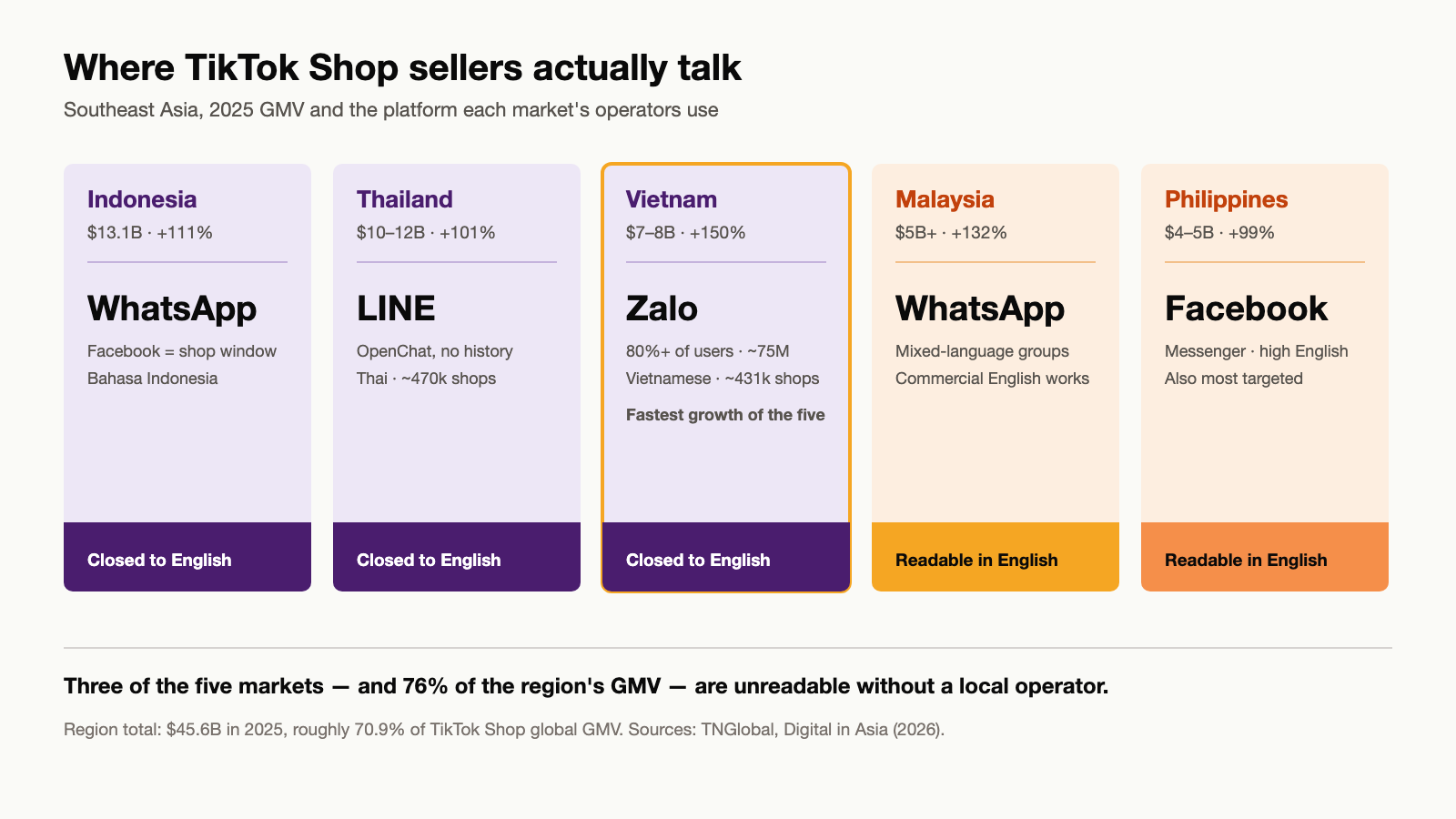
TikTok Shop supports local seller access across 24 markets as of August 2026, seven of them in Asia. The five that matter commercially in Southeast Asia are Indonesia, Thailand, Vietnam, Malaysia and the Philippines, and the 2025 growth figures make clear they are not one thing: Indonesia at 13.1 billion dollars, Thailand between 10 and 12 billion, Vietnam between 7 and 8 billion, Malaysia above 5 billion, the Philippines between 4 and 5 billion. Vietnam grew fastest at roughly 150 percent; the Philippines slowest at roughly 99 percent. Both of those are extraordinary numbers, and they describe different businesses.
Seller counts diverge the same way. Thailand carries around 470,000 shops and Vietnam around 431,000, and together with Indonesia those three account for more than half of the global TikTok Shop storefront count. A community serving 470,000 Thai sellers has no structural reason to operate in English, and it does not.
"A market with 470,000 domestic sellers does not need a foreigner-facing community, and will not build one. If a group is speaking to you in English, ask what it is selling before you ask what it knows."
This is where the search fails. Query language selects for audience, and an English query about Southeast Asia selects for people whose business is Westerners entering Southeast Asia. Some of those people are competent operators. Most of them are selling a course, an agency retainer, or a dropshipping software subscription, because that is the only reliable way to monetise an audience that is defined by not yet having a business.
Where the operators actually talk, market by market
Each market's seller conversation lives on whichever messaging platform already won that country, not on whichever platform is largest globally. This is the single most useful fact in this article and the one most often missed, because the platforms in question are close to invisible from a Western desk.
The seller conversation follows the country's dominant messenger, not TikTok's global footprint. Four of the five are effectively closed to non-speakers.
Indonesia — WhatsApp groups, with Facebook as the shop window
WhatsApp is used daily by roughly 90 percent of Indonesian internet users, and the operator conversation reflects that. Working seller groups are WhatsApp groups, they are capped by the platform's member limits, and admission is normally by referral from someone already inside. Facebook groups exist and are large, but they function as the public-facing recruitment surface for those WhatsApp groups rather than as the place decisions are discussed. The language is Bahasa Indonesia throughout.
Thailand — LINE, and effectively only LINE
LINE is the dominant messenger in Thailand and the default for both commerce and workplace coordination. Thai seller communities run as LINE OpenChats, which behave differently from a Facebook group in a way that matters: they are searchable within LINE, they carry no post history for outsiders to skim, and they are moderated tightly. There is no equivalent of scrolling a Facebook group for a week to work out who knows what. You are either in the room or you have no visibility at all.
Vietnam — Zalo, which most Western operators have never opened
Zalo covers upward of 80 percent of Vietnamese internet users and carries an estimated 75 million-plus accounts. It is where Vietnamese seller groups, supplier coordination and livestream scheduling happen. Vietnam also grew fastest of the five markets in 2025, which makes the inaccessibility of its seller layer the most expensive of the five gaps. A Western brand planning Vietnam without a Vietnamese-speaking operator is planning it blind.
Malaysia — WhatsApp, with a genuine English-language layer
Malaysia is the exception worth knowing about. WhatsApp leads, but Malaysian commercial English is widespread enough that mixed-language seller groups function normally, and a competent English-speaking operator can participate without a translator. For a Western brand that wants one Southeast Asian market where the seller conversation is legible from the outside, Malaysia is the answer, and that is a reasonable input into which market you enter first.
Philippines — Facebook and Messenger, the most open of the five
The Philippines runs on Facebook and Messenger to an extent unusual even in this region, and messaging activity there grew 19 percent in 2025 with interactions through mobile messaging apps up 139 percent (Manila Times, 2026). English usage is high. The practical consequence is that Philippine seller groups are the ones a Western operator can actually read, which is useful, and also means they are the most heavily targeted by course sellers, which is not.
Why the English-language groups fill up with course sellers
This is not a moral observation. It is an arithmetic one, and understanding it tells you which groups to discount without having to judge anyone's character.
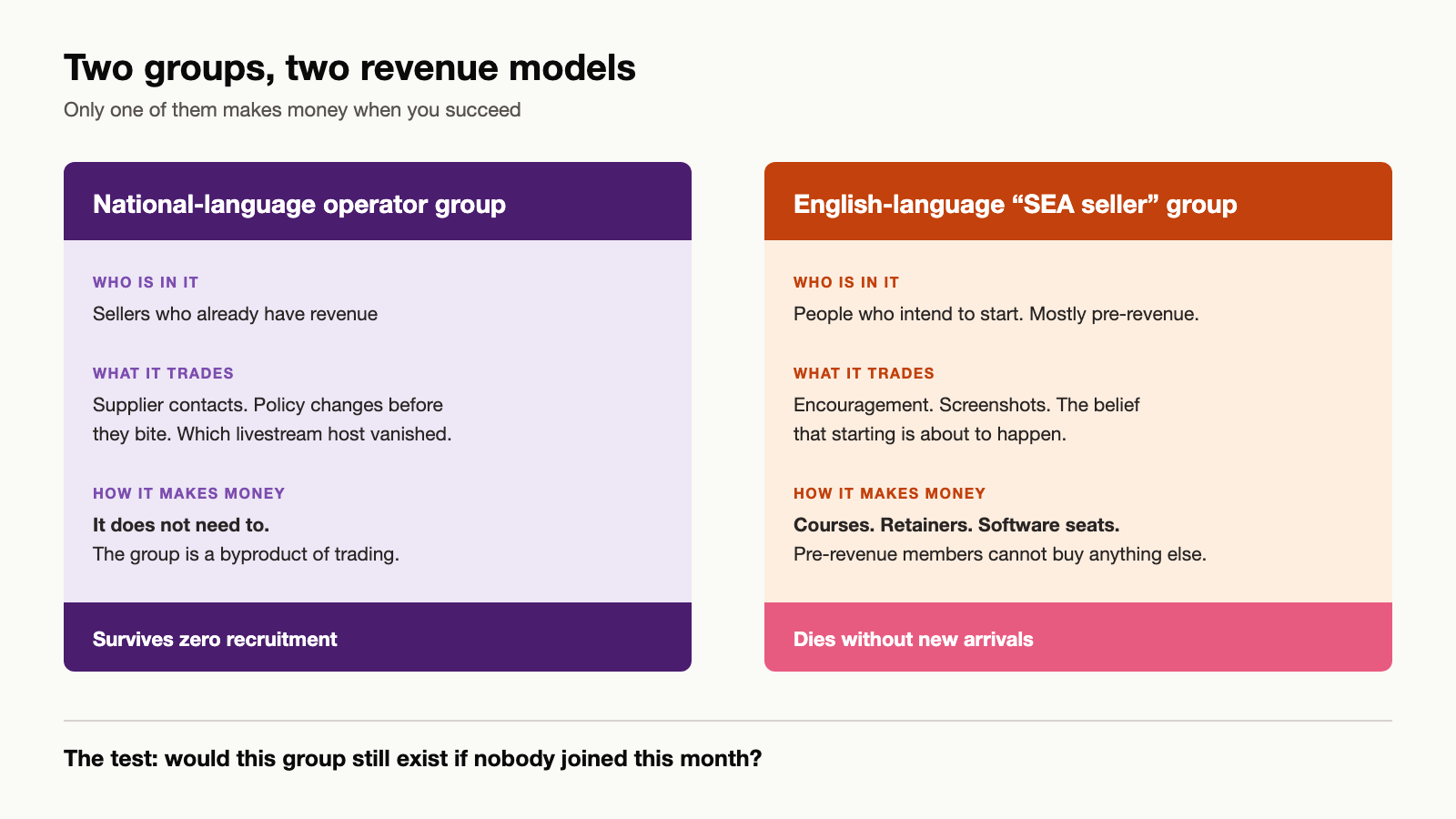
Two groups, two revenue models. Only one of them makes money when you succeed.
A Thai-language group of active sellers has a membership that already has revenue. Its value to members is supplier contacts, warning about a policy change before it bites, and finding a livestream host who did not disappear last month. Nobody needs to monetise the group, because the group is a byproduct of people who are already trading.
An English-language group about selling in Southeast Asia has a membership defined by aspiration rather than operation. Most members have no revenue. That population cannot be monetised by supplier introductions, because they are not buying yet. It can be monetised by selling them the belief that they are about to start, which is what a course is.
The test is not whether a group contains promotional material. It is whether the group would still exist if nobody joined this month. Operator groups serve people who are already trading and would survive zero recruitment. Course-funnel groups die without new arrivals, which is why recruitment is the visible activity.
There is a second-order risk attached. Cybersecurity firm CTM360 has documented campaigns using AI-generated imitations of TikTok sellers and storefronts to hijack accounts and extract payments, and fake TikTok store fraud has spread widely across Asia. Seller communities are a natural distribution channel for that, because they aggregate people who are actively looking for shortcuts and who have just been told that a shortcut exists. Treat any in-group offer involving upfront payment, off-platform checkout, or account access as hostile until proven otherwise.
What the official channels are actually for
TikTok Shop Academy is the platform's own training and policy resource, and TikTok runs dedicated seller education and community engagement teams in markets including Thailand and Vietnam. Western operators tend to skip all of it, on the reasonable assumption that first-party material is marketing. That assumption is half right and costs more than it saves.
The official channels are genuinely poor at strategy. They will not tell you which market to enter, what a realistic margin looks like after commission and returns, or which categories are saturated. Nothing in there will help you decide anything.
They are, however, the only authoritative source on the things that will actually get your shop suspended: category qualification requirements, prohibited claims, livestream conduct rules, and the local documentation each market demands. Those change, they change per market, and every secondary source describing them is stale by construction. The correct use of Academy content is compliance, not education.
"Use the official channels for the rules and the communities for the reality. Reversing that is how sellers end up confidently non-compliant."
If you cannot get into the local rooms yet
Most brands reading this will not have a Vietnamese or Thai operator on payroll next week, and the honest answer is that there is no full substitute. There are, however, three partial ones, and they are ranked here by how much signal they carry per hour spent.
Seller-facing agencies, used as sources rather than vendors
TikTok Shop Partner agencies in each market sit inside the operator layer by definition. A scoping call with three of them, framed as due diligence rather than a brief, will surface current commission structures, category saturation and the two or three policy changes everyone in that market is currently annoyed about. You are paying for this in sales-cycle time rather than money, which is a reasonable trade at the research stage. Ask each one the same five questions and pay attention to where the answers diverge.
Livestream monitoring, which nobody does and which is free
Every commercially relevant thing happening in a market is visible in its livestreams. Which categories are running, what discount depth is normal, how many concurrent viewers a mid-tier host actually holds, what the pace of a working stream sounds like. An hour a week of watching Indonesian or Thai livestreams without understanding a word will teach you more about realistic expectations than any English-language group will, because it is unmediated observation rather than someone's account of it.
Machine translation of the public layer
The public Facebook groups in Indonesia and Vietnam are readable through translation, and while they are the recruitment surface rather than the operator layer, recruitment surfaces still leak. Complaint threads in particular translate well, because complaints are specific. What you cannot get this way is the closed discussion, and you should not mistake a well-translated public group for having found the room.
None of these three replace a local operator. What they do is stop you making the market-entry decision on the basis of English-language content written by people selling entry advice, which is the failure mode this article exists to prevent.
How to vet a seller community in twenty minutes
Five checks, in the order that eliminates fastest. Any one failure is usually sufficient.
Read the last thirty posts and count how many are questions from members versus announcements from admins. A working group is majority questions. A funnel is majority announcements.
Look for a post where someone reports a loss. Operator groups contain failure reports because failure is the most useful information they trade. Groups that contain only wins are curating, and you should ask why.
Check whether specific numbers appear — commission percentages, return rates, a category's actual take rate after fees. Vagueness about numbers in a commercial group is a deliberate choice, not an oversight.
Find out what the admin sells. Not whether they sell something; almost everyone does. Whether their product is bought by members of the group, and whether the group's growth is what makes it valuable.
Ask one narrow operational question with a verifiable answer — a current qualification requirement in a specific category, for instance. Compare what you get against the Academy documentation. You are testing whether the room knows things, not whether it is friendly.
A group that passes all five is worth real time. In practice, most English-language groups fail at the second check, which takes about four minutes.
What to do this week
The practical sequence, for a brand rather than an individual seller.
Decide the first market before looking for any community. The community you need is a function of that decision, not an input to it.
If the answer is Malaysia or the Philippines, the seller conversation is accessible in English and you can begin reading it directly this week.
If the answer is Indonesia, Thailand or Vietnam, budget for a local operator as a condition of entry rather than as a later optimisation. The seller layer in those markets is not accessible any other way, and the alternative is buying that knowledge back later at agency rates.
Read the Academy compliance material for your specific category in your specific market, and treat everything else you hear as commentary on it.
Join at most two communities and apply the five checks before contributing anything. Time spent in the wrong room is the cost people underestimate.
Frequently asked questions
Is there an official TikTok Shop seller community for Southeast Asia?
No single regional one exists. TikTok Shop Academy provides official training and policy documentation, and TikTok runs seller education teams in individual markets such as Thailand and Vietnam, but community organisation is national and language-specific rather than regional. Expect to work market by market.
Are TikTok Shop seller Facebook groups worth joining?
In the Philippines and Malaysia, often yes, because those markets genuinely operate in English and on Facebook. Elsewhere Facebook groups usually function as recruitment surfaces for closed WhatsApp, LINE or Zalo groups where the real discussion happens. Apply the five vetting checks before investing time.
Which Southeast Asian market should a Western brand enter first?
Indonesia is largest at 13.1 billion dollars of 2025 GMV and Vietnam grew fastest at roughly 150 percent, but both require local-language operation. Malaysia is smaller at above 5 billion dollars and considerably more legible to an English-speaking team, which for a first market is frequently worth more than raw size.
How do I avoid seller community scams?
Refuse upfront payments, off-platform checkout and any request for account access. CTM360 has documented AI-generated imitations of TikTok sellers and storefronts used to hijack accounts across Asia, and seller groups are an efficient distribution channel for that because they aggregate people actively seeking shortcuts.
Do I need a local entity to sell on TikTok Shop in Southeast Asia?
Not necessarily to start, since cross-border selling is available in most markets, but domestic seller status changes delivery times, category access and algorithmic treatment materially. The requirements vary by market and change often, so confirm the current position in the Academy documentation for your category.
The summary judgement
The instinct to find the community before committing to a market is a reasonable one, and in most industries it works. Here it inverts. The regional community does not exist, the English-language substitutes are selling something, and the real rooms only open after you have made the market decision that lets a local operator take you into one.
"Pick the market, hire the language, then find the room. Doing it in the other order is how a year gets spent reading advice written for someone who was never going to trade."
For the decision that comes before this one — which market, and as which kind of seller — see TikTok Shop in Southeast Asia. If you are weighing Southeast Asia against Europe as a first expansion, TikTok Shop Europe for US brands covers that comparison, and the global seller guide covers the first hundred orders. For what these operators are mostly comparing notes about once trading starts, which is what actually converts on camera, TikTok Shop content that converts sets out the fifteen-second structure the region rewards.
Share:
Free · 24 pages
Read Chapter 1 of the Playbook
AI Foundation Models — how DeepSeek and Qwen crossed a billion downloads while Western boards were counting Mag7 capex, and which layers of the AI stack the rotation has not reached. No excerpt tricks: it is the full chapter.
You will also get the weekly newsletter. Unsubscribe any time — the link is in every email.
The Book · $99
China Market Entry Playbook 2026
456 pages across 22 industry chapters — AI, semiconductors, EVs, payments, logistics, beauty, F&B, healthcare, pets, toys. Every chapter runs the same five questions: the anchor number, the rotation underneath it, which layers of the global stack it has reached, and what to do about it. English and Simplified Chinese editions included.
Ex-Transsion Global Digital Marketing Director · Effie Awards Greater China jury member · Guest lecturer, Peking University School of Economics · Writes Annie Chan Talk, your insider lens on China.