TikTok Shop Attribution: Your GMV Max ROAS Is Not Wrong, It Is Unfalsifiable
Once a GMV Max campaign is running, every order on the selected products is attributed to it, whether or not the shopper ever saw an advertisement. That is the documented design rather than a tracking fault, and it means the campaign cannot report a bad number.
Annie Chan··12 min read
A brand turns on GMV Max, and within a fortnight the reported return on ad spend looks excellent. Better than Meta ever managed, better than the agency promised. The finance team asks whether the number is real, the marketing team says the platform reports it directly, and everybody moves on feeling rather good.
The number is real in the sense that it has been calculated correctly. It is also incapable of telling you what you want to know, and the reason is written into how the campaign counts.
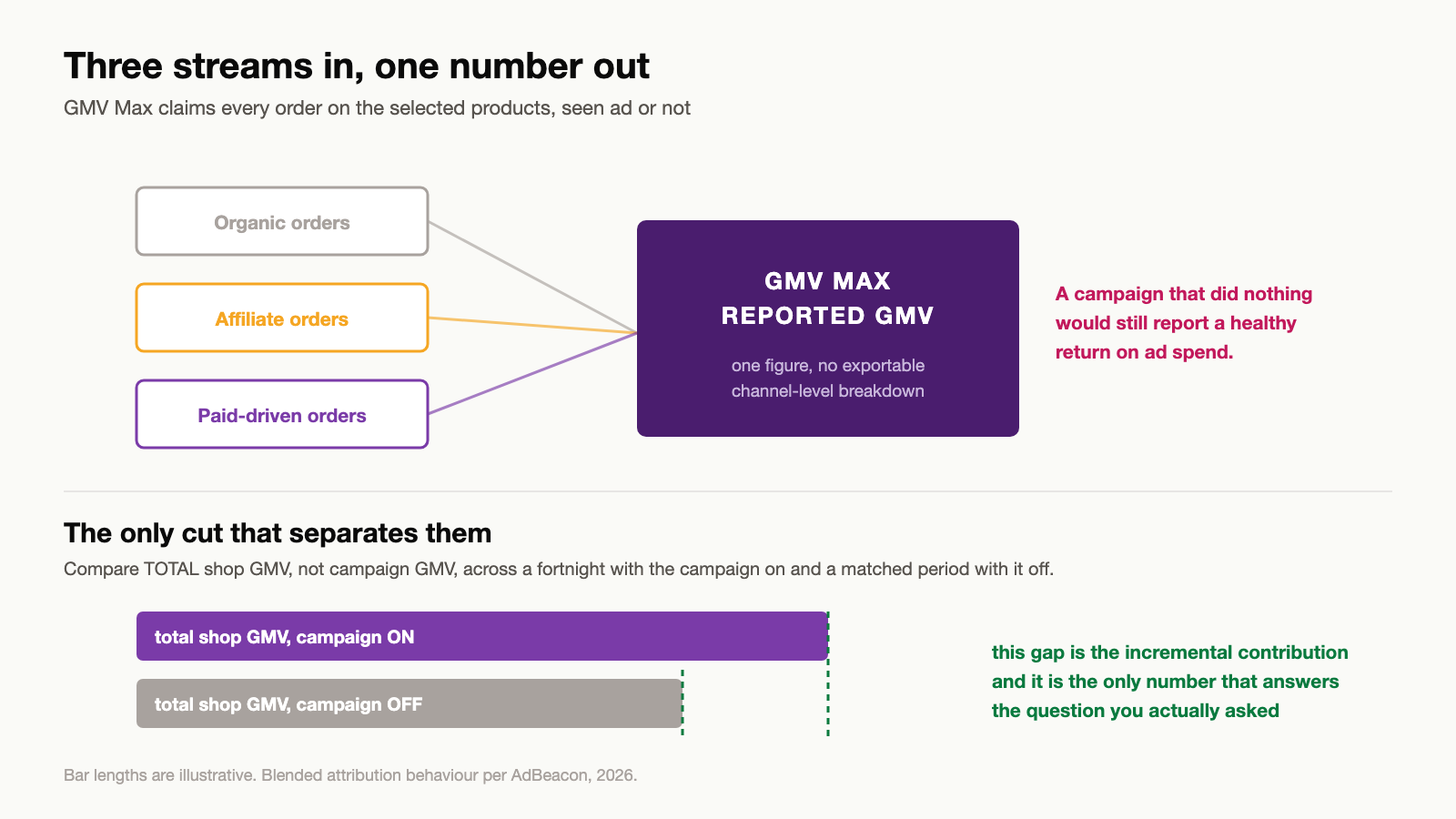
Once a GMV Max campaign is running, every order on your selected products is attributed to that campaign, whether or not the shopper ever saw or clicked an advertisement. Organic sales and affiliate sales are absorbed into the campaign's own reported metrics. This is described as a deliberate blended attribution model rather than a tracking error.
Sit with what that means arithmetically. If the campaign claims credit for orders it did not cause, then switching it on cannot produce a poor return on ad spend, because the denominator is your ad budget while the numerator is your entire product revenue. A campaign that did absolutely nothing would still report a healthy figure. The metric has no way of failing, which is precisely what makes it useless as evidence.
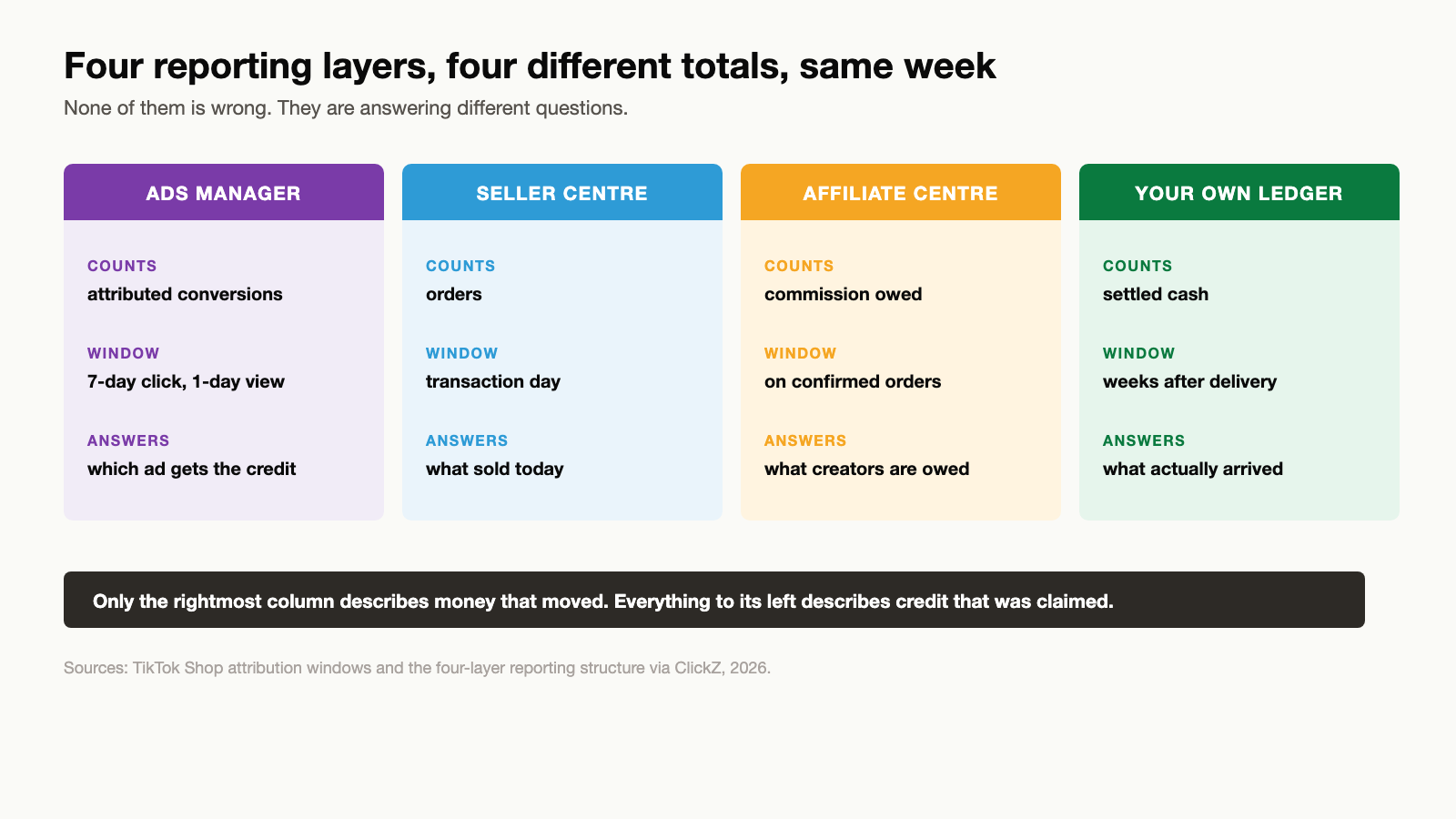
Four systems, four different numbers, same week
Before the GMV Max question there is a plainer one, which is that the platform's own surfaces do not agree with each other, and for defensible reasons.
None of these is lying. They are answering four different questions, and only one of them is about money that actually moved.
Ads Manager reports on a 7-day click and 1-day view attribution window, so a sale today can be booked against an advertisement from last Tuesday. Seller Center records sales on the transaction day, full stop. Those two systems will therefore disagree in any week where spend was not perfectly flat, and the disagreement grows the moment you change budget. Affiliate Center records what creators are actually owed. Your own ledger records what arrived in the bank, which happens weeks later again.
A practical structure uses all four deliberately: Ads Manager for attribution logic, Seller Center for commerce metrics, Affiliate Center for payout truth, and an internal layer that reconciles orders, revenue, commissions and creator influence. Most reporting in this channel breaks at that last step, because reconciliation is unglamorous work that nobody owns and every dashboard quietly assumes somebody else has done.
Why the usual cross-checks do not work here
An experienced e-commerce team responds to a suspicious platform number by triangulating against something independent. That reflex is correct and the tools it relies on are unavailable in this channel.
In-app purchases never touch a website pixel, so there is no server-side event, no GA4 session and no independent record of the transaction outside the platform.
Native TikTok attribution cannot be cross-referenced against your direct-to-consumer store or your Amazon data, because the customer identity does not carry across.
GMV Max runs as a single optimisation with no exportable channel-level detail, so you cannot decompose the reported figure into paid, organic and affiliate after the fact.
Post-purchase surveys, the usual last resort, work poorly for impulse purchases made inside a feed, where the honest answer to how did you hear about us is that the customer does not remember and did not experience it as hearing about anything.
So the standard measurement toolkit is not merely inconvenient here. Most of it is structurally absent, and a team waiting for better dashboards is waiting for something that cannot arrive while purchases stay inside the application.
The one test that still works
Three streams enter, one number leaves. The only cut that separates them is turning the spend off and watching what total revenue does.
If attribution cannot tell you what the spend caused, incrementality can. The method is old, unfashionable and almost entirely reliable: run a holdout. Turn GMV Max off for a defined period, or for a defined subset of products or markets, and compare total shop GMV against a matched period when it was on. You are no longer asking the campaign to grade itself. You are asking whether total revenue changed.
Three rules make this trustworthy rather than merely interesting. Measure total shop GMV rather than campaign-reported GMV, because the whole point is to escape the campaign's own accounting. Run it long enough to clear the 7-day click window plus a buffer, so a fortnight at minimum. And hold everything else still, which means no creator pushes, no flash sales and no new SKUs in the test window, since a holdout contaminated by a promotion tells you nothing at all.
The uncomfortable part is that nobody enjoys running this test. Switching off spend that appears to be working requires somebody senior to accept a fortnight of visibly worse dashboard numbers in exchange for finding out whether those numbers meant anything. That conversation is easier to have before the campaign launches than six months into it, which is an argument for building the holdout into the plan at the start rather than proposing it as a challenge later.
Build the spine on money, not on models
There is one number in this channel that is not a model, and it is the settlement. Attribution is an opinion, reported GMV is an opinion with a timestamp, and the amount that reaches your bank account is a fact.
So the reporting spine should be built on settlements and reconciled upward, rather than built on dashboards and reconciled downward. Start from what was paid, subtract what creators were owed, and work back to which orders produced it. That approach is slower and it has the useful property of being unarguable, which matters a great deal when the finance team and the marketing team are looking at two different truths about the same quarter. The timing of those settlements, which lags delivery rather than order, is set out in when TikTok Shop actually pays you.
Affiliate commission deserves particular attention in that reconciliation, because Affiliate Center is the one surface recording an obligation rather than an achievement, and obligations are precise. The structure of those payouts and what they do to unit economics is worked through in running a TikTok Shop affiliate programme in Southeast Asia.
What this does to creative testing
Blended attribution has a second-order effect that is easy to miss and expensive to ignore. If you are testing hooks, formats or creators while GMV Max is absorbing every order on those products, your creative test results are contaminated by the same blending. The winning variant may simply be the one that ran during a week with more organic momentum.
Creative testing therefore needs its own clean conditions: hold the paid campaign constant across variants, or run the test on products outside the GMV Max selection, and read three-second retention and video-level engagement rather than attributed sales. Retention is measured on the video itself and cannot be blended by a campaign, which makes it the most trustworthy creative signal available in this environment. It also happens to be the metric whose improvement multiplies through the entire funnel, as set out in TikTok Shop content that converts.
Southeast Asia is an unusually good laboratory for this
The standard objection to a holdout is that nobody will approve switching off revenue. It is a fair objection and operating across five markets largely dissolves it, which is a genuine structural advantage this region has over a single-market business.
Rather than turning spend off and on in sequence, run the comparison across geography. Keep GMV Max live in Indonesia and Vietnam, hold it off in Malaysia and the Philippines, then compare total shop GMV per market against each market's own trailing baseline. Nobody has to accept a blackout. You are running two states of the world simultaneously, which is a cleaner experiment than a before-and-after anyway, because it controls for seasonality, platform-wide campaigns and the shopping festivals that wreck sequential tests in this part of the calendar.
Two cautions keep it honest. Markets are not interchangeable, so compare each one against its own prior performance rather than against the other markets directly, since Vietnamese and Malaysian baselines have no business being set equal. And rotate which markets sit in the holdout each quarter, because the same two markets permanently unsupported will eventually diverge for reasons that have nothing to do with the test. How different these markets actually are, and why that matters before you treat them as comparable units, is set out in choosing a Southeast Asian market to open first.
A brand operating in one market has to buy this information with a fortnight of visibly worse numbers. A brand operating in five can buy it with an asymmetry nobody outside the measurement team will even notice.
A measurement setup that survives contact with this channel
Write down, before launch, which number will be used to judge the channel, and get finance and marketing to agree on it while nobody is defending anything yet.
Never compare Ads Manager against Seller Center and expect agreement. One counts on a 7-day click window, the other on transaction day, and reconciling them is a category error rather than a task.
Treat campaign-reported ROAS as a directional operations signal, not as evidence of contribution. It is genuinely useful for spotting breakage and genuinely useless for justifying budget.
Schedule a holdout every quarter, at least a fortnight long, with everything else held still, and measure total shop GMV rather than campaign GMV.
Build reporting upward from settlements, so the base of the model is money that moved rather than credit that was claimed.
Keep a creative testing lane outside the GMV Max product selection, and judge creative on retention rather than on attributed sales.
Re-read the platform's attribution documentation each quarter, because TikTok is working on tooling to separate incremental paid contribution from organic and affiliate within GMV Max, and that would change several of these answers.
"A metric that cannot report a bad result is not a strong metric. It is a mirror, and the campaign is holding it."
FAQ
Why does GMV Max report higher sales than my other analytics?
Because it is counting differently and doing so deliberately. Once a GMV Max campaign is live, every order on the selected products is attributed to that campaign regardless of whether the buyer saw or clicked an advertisement, so organic and affiliate sales are absorbed into its reported figures. This is a documented blended attribution model rather than a tracking fault, which is why the numbers will not reconcile with Google Analytics or a store platform no matter how long you spend trying.
What is the TikTok Shop attribution window?
Campaigns reported through TikTok Ads Manager use a 7-day click and 1-day view attribution window. Seller Center, by contrast, records sales on the transaction day itself. Those two definitions guarantee that the same week produces different totals in the two systems, and the gap widens whenever spend levels change. Neither figure is incorrect, and expecting them to match is the mistake.
How can I tell what my TikTok Shop ads actually contributed?
Run a holdout test, because attribution alone cannot answer it. Switch the campaign off for a defined period, product subset or market, then compare total shop GMV against a matched period when it was running. Keep the window to at least a fortnight so it clears the 7-day click window, and hold everything else constant, with no promotions, creator pushes or new listings during the test. The comparison measures incremental contribution rather than claimed credit.
Can I track TikTok Shop sales in Google Analytics?
Not meaningfully for in-app purchases. Transactions completed inside the application never touch a website pixel, so there is no session, no server-side event and no independent record outside the platform. Native TikTok attribution also cannot be cross-referenced against direct-to-consumer or marketplace data, because customer identity does not carry across. Any reporting built on the assumption of pixel coverage will understate this channel severely.
Which TikTok Shop number should I actually trust?
The settlement. Attribution is a model, reported GMV is a model with a timestamp, and the amount that reaches the bank is a fact. Building the reporting spine upward from settlements and creator payouts, then working back to the orders that produced them, gives a base that cannot be argued with. Everything above that line is useful for operating the channel and unreliable for justifying it.
The short version
GMV Max is not deceiving you and it is also not evidence. It reports on a blended basis by design, which means it absorbs organic and affiliate orders and cannot produce a disappointing figure. Use it to run the channel and stop using it to justify the channel. Judge contribution with quarterly holdouts measured on total shop GMV, keep creative testing outside the blended selection and judge it on retention, and build the whole reporting structure upward from settlements, because that is the only layer describing money rather than credit. It is more work than reading a dashboard. It is also the difference between knowing your return and being shown one.
Sources: GMV Max blended attribution behaviour documented by AdBeacon; attribution windows and the four-layer reporting structure via ClickZ.
Share:
Free · 24 pages
Read Chapter 1 of the Playbook
AI Foundation Models — how DeepSeek and Qwen crossed a billion downloads while Western boards were counting Mag7 capex, and which layers of the AI stack the rotation has not reached. No excerpt tricks: it is the full chapter.
You will also get the weekly newsletter. Unsubscribe any time — the link is in every email.
The Book · $99
China Market Entry Playbook 2026
456 pages across 22 industry chapters — AI, semiconductors, EVs, payments, logistics, beauty, F&B, healthcare, pets, toys. Every chapter runs the same five questions: the anchor number, the rotation underneath it, which layers of the global stack it has reached, and what to do about it. English and Simplified Chinese editions included.
Ex-Transsion Global Digital Marketing Director · Effie Awards Greater China jury member · Guest lecturer, Peking University School of Economics · Writes Annie Chan Talk, your insider lens on China.