TikTok Shop Content That Converts in Southeast Asia: Fifteen Seconds, and Only Four of Them Are About Your Product
The format with the most stable conversion rate in the region gives the product four seconds out of fifteen. Western brand creative usually inverts that ratio, which is why it fails here for structural reasons rather than aesthetic ones.
Annie Chan··12 min read
Ask a brand team why their TikTok Shop videos are not converting in Indonesia and the answers arrive in the language of taste. The creative is not fun enough. The creator was wrong. The edit is too corporate. Occasionally that is the problem. Usually it is not, because the failure is structural and it can be measured with a stopwatch.
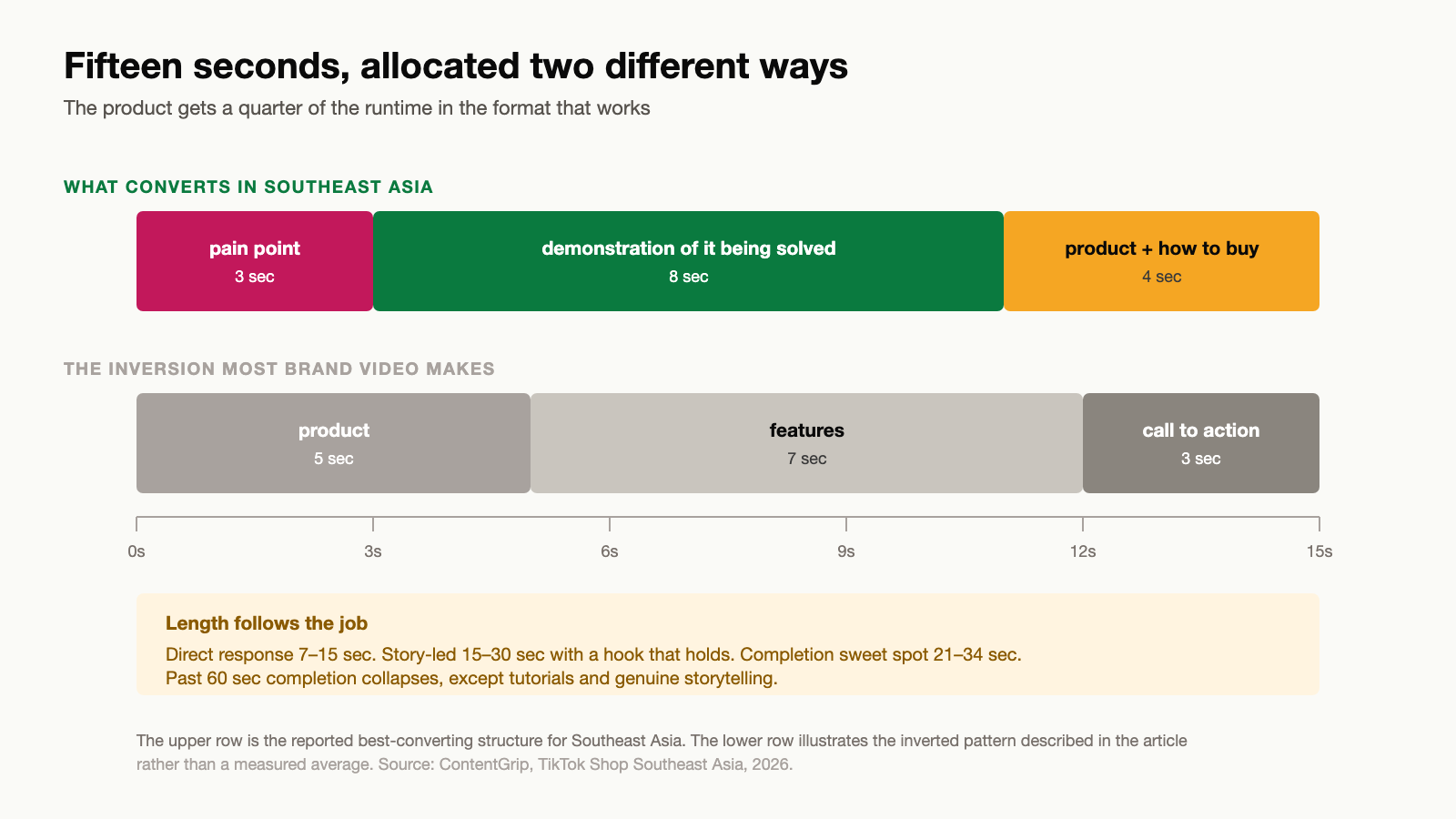
The format with the most stable conversion rate for TikTok Shop in Southeast Asia has a fixed shape. Three seconds establishing a real pain point. Eight seconds demonstrating the product solving it. Four seconds on the product itself and how to buy it. Fifteen seconds total, with roughly a quarter of the runtime given to the thing the brand actually wants to talk about.
Most brand-made product video inverts that ratio almost exactly, opening on the product, spending the middle on features, and closing with a call to action. It is not a worse version of the winning format. It is the winning format played backwards.
The stopwatch is the brief
Same fifteen seconds, opposite allocation. The winning structure earns the right to show the product by spending eleven seconds not showing it.
Length itself follows the job. Direct response works best somewhere between 7 and 15 seconds. Story-led content can run 15 to 30 if the opening genuinely holds. There is a sweet spot around 21 to 34 seconds where completion stays high while leaving enough room for a demonstration and the orange cart prompt. Past 60 seconds completion collapses, and the exceptions are tutorials and a genuinely gripping story rather than anything a brand would recognise as an advertisement.
None of this is a style guide. It is a description of what a viewer's thumb does, and the thumb is the same in Jakarta whether your brand is premium or not.
Why the first three seconds are worth more than everything after them
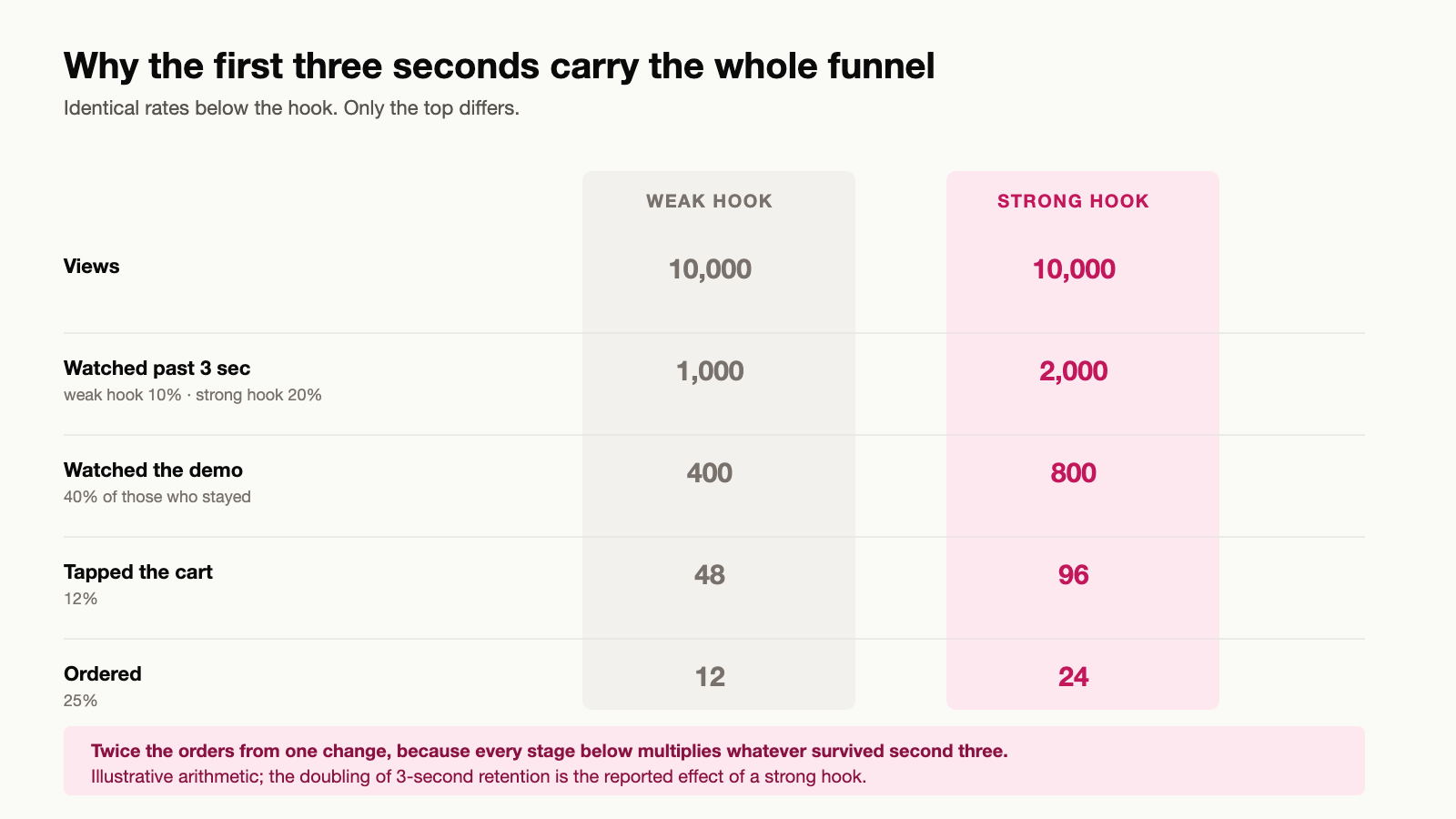
A strong hook can roughly double the share of viewers who watch past the three-second mark. That sounds like one improvement among many. It is not, because of where it sits in the arithmetic.
Every step after the hook operates on a percentage of whatever survived it. Demonstration retention is a share of those who stayed. Cart taps are a share of those who watched the demonstration. Purchases are a share of the taps. Doubling the top of that chain doubles the bottom of it, no matter how good or bad the middle happens to be. Improving the closing call to action by a fifth improves only the last multiplication.
Identical rates at every stage below the hook. The only difference is how many people got past second three, and that difference carries all the way to the order.
This has an uncomfortable implication for how creative work is usually reviewed. Brand teams spend most of their attention on the close, because the close is where conversion feels like it happens, and it is also the part that contains the logo and the claim and the thing legal wants to check. The close is the second that does the least work in the whole video. If the review meeting spends forty minutes on the end card and four on the opening frame, the process is upside down.
Swapping the subtitles is not localisation
The second structural failure is treating Southeast Asia as one market with five languages. Shoppers in these markets respond to different content formats outright, not to the same format in translation, and a local creator who understands local shopping habits and language nuance converts better than a translated video from a home-market creator with a much larger following.
TikTok Shop learned this expensively in the United Kingdom, and the lesson it took away was localisation at a granular level: content, creator partnerships and product strategy adapted country by country rather than region by region. A brand running one strategy across five markets does not get five results. It gets no result, five separate times, and each failure has a different cause.
The specifics are worth knowing because they are so unalike. In Indonesia the listing may be pulled before the first video even posts, which is a compliance failure rather than a creative one. In Vietnam a creator will commonly ask for half the fee up front. In Thailand, opening with a flat fee tends to stall the conversation entirely, because Thai creators negotiate in commission ladders. Three markets, three different points of breakage, none of which a shared regional plan anticipates. The commercial mechanics behind those creator relationships are worked through in running a TikTok Shop affiliate programme in Southeast Asia.
What the demonstration has to actually contain
Eight seconds is not long, and the temptation is to fill it with features. The winning structure uses it for proof: the problem visibly ceasing to be a problem, on camera, in one continuous take where possible. A stain lifting. A tangle combing out. A pan not sticking. The viewer is not being persuaded, they are being shown, and the distinction matters because persuasion invites scepticism while demonstration invites the next second.
Top-performing videos follow a hook, body and close shape and look native to the platform rather than polished for it. That is not an argument for low production standards. It is an argument against the visual grammar of television advertising, which signals to a viewer that they are watching an advertisement, which is the one signal that reliably ends the view.
There is also a hard boundary around what the demonstration may claim, and it is narrower in this region than most brands expect. Whitening, bleaching and melanin-reduction claims are prohibited on the platform, as is supplement messaging tied to body shaming or dangerous weight loss, and in Thailand the regulator enforces advertising rules against the holder of the product registration rather than the creator. A demonstration that works and a demonstration that is permitted are two different briefs, set out market by market in TikTok Shop restricted categories in Southeast Asia.
When the product has nothing to demonstrate
The eight-second proof structure assumes a visible transformation, and plenty of categories do not have one. A supplement does nothing on camera. A fragrance does nothing on camera. Neither does a mattress, an insurance policy or a sixty-dollar serum whose effect takes four weeks. Pretending otherwise produces the worst videos in the category, because a demonstration that demonstrates nothing reads as a claim, and claims invite the scepticism the format was designed to avoid.
Two substitutions work. The first is to demonstrate the problem rather than the solution, at length, and let the product arrive as relief: the tangled drawer, the fourth night of bad sleep, the receipt for the thing that broke. The viewer supplies the resolution themselves, which is more persuasive than being handed it. The second is to demonstrate somebody else's verdict, which is why unboxing, reaction and before-and-after formats persist in categories with no visible mechanism. Neither is a trick. Both keep the structural ratio intact, which is the part that matters, by spending eleven seconds on something other than your product.
What does not work is extending the runtime to explain the mechanism. A longer video does not create proof, it only creates more opportunities to leave, and past sixty seconds completion falls away regardless of how good the explanation is.
Volume is the strategy, not the fallback
One further thing separates brands that scale here from brands that produce three beautiful videos and conclude the channel does not work. Steady iteration beats cleverness, consistently and by a wide margin. Top performers are not producing better single videos, they are producing many videos inside a stable structure and letting the platform find the ones that travel.
That has a practical consequence for how the work is resourced. A brand studio making four polished assets a month cannot generate the sample size this requires, and no amount of craft substitutes for it. Creator networks exist partly to solve exactly this, because a programme of thirty creators working to one structural brief produces both the volume and the local variation that a central team cannot. The output looks less controlled and it performs considerably better, which is an uncomfortable trade for most marketing departments and the right one here.
How to run this without burning a quarter
Write the brief as a stopwatch, not as a mood. Three seconds of problem, eight of proof, four of product and purchase. Hand that to the creator as a structure and let them own the execution inside it.
Test hooks separately from everything else. Same body, same close, five different openings. This is the only test where a win doubles the whole funnel rather than improving one stage of it.
Measure three-second retention as a primary metric, not as a diagnostic buried under conversion rate. It is the number the rest of the video inherits.
Brief one market at a time. A shared regional creative brief is the most expensive document in this channel, because it produces five failures that each look like a creative problem.
Use local creators for the demonstration even when a global creator is cheaper per view. Conversion, not reach, is what you are buying, and the two are not correlated across languages.
Clear the claims before the shoot rather than after the edit. Reshoots are expensive and takedowns are worse.
Keep the close boring. It needs to be clear and it needs to be short, and every extra second spent on it is taken from a part of the video that does more work.
Live selling sits alongside all of this as a separate discipline with different economics, because it is priced in staffed hours rather than in edits, and it converts several times better than feed content when it is run properly. The two are complements rather than alternatives, and the operational demands are covered in live selling in Southeast Asia.
"A brand video that opens on the product is asking for attention it has not earned yet. The winning format spends eleven of its fifteen seconds earning it, and then takes four."
FAQ
How long should a TikTok Shop video be?
For direct response, 7 to 15 seconds performs best. Story-led content can run 15 to 30 seconds provided the opening holds attention. There is a useful band around 21 to 34 seconds that maximises completion while still leaving room for a product demonstration and the cart prompt. Beyond 60 seconds completion collapses, with tutorials and genuinely compelling storytelling as the only reliable exceptions.
What video structure converts best on TikTok Shop in Southeast Asia?
The most consistently converting structure runs about fifteen seconds: three seconds establishing a real pain point, eight seconds demonstrating the product resolving it, and four seconds on the product and how to buy. The product therefore occupies roughly a quarter of the runtime. Brand-produced video usually reverses this allocation by opening on the product and spending the middle on features, which is the single most common structural reason for weak performance.
Why does the hook matter more than the call to action?
Because of where each sits in the chain. A strong hook can roughly double the share of viewers who watch past three seconds, and every subsequent stage is a percentage of that surviving audience, so doubling the top doubles the final order count. Improving the closing call to action affects only the last step in the sequence. The hook is the only element whose improvement multiplies through the entire funnel rather than adding to one part of it.
Can I reuse my US or UK TikTok creative in Southeast Asia with subtitles?
Generally not with good results. Shoppers in these markets respond to different formats rather than to the same format translated, and a local creator who understands local shopping behaviour and language nuance tends to convert better than a much larger home-market creator whose content has been subtitled. TikTok Shop's own experience in the United Kingdom pushed it towards country-level rather than region-level localisation across content, creator partnerships and product strategy.
Can one creative strategy cover all five Southeast Asian markets?
It can be written, and it will fail differently in each market. In Indonesia a listing may be removed on compliance grounds before the first video posts. In Vietnam creators commonly expect half the fee in advance. In Thailand a flat fee tends to stall negotiation because creators there work in commission ladders. These are three unrelated failure modes, so a single regional plan produces one outcome per market and none of them is the intended one.
The short version
Treat the brief as a stopwatch. Give the problem three seconds, the proof eight, and the product four, and accept that the product getting the smallest share is the mechanism rather than a compromise. Put your testing effort into hooks, because that is the only change that multiplies through everything downstream. Then brief each market separately, with local creators, because the five markets fail for five unrelated reasons and a regional document anticipates none of them. Which market to start that work in is its own decision, worked through in choosing a Southeast Asian market to open first.
Sources: regional format and length benchmarks via ContentGrip; market-by-market creator and localisation differences via Creative For More.
Share:
Free · 24 pages
Read Chapter 1 of the Playbook
AI Foundation Models — how DeepSeek and Qwen crossed a billion downloads while Western boards were counting Mag7 capex, and which layers of the AI stack the rotation has not reached. No excerpt tricks: it is the full chapter.
You will also get the weekly newsletter. Unsubscribe any time — the link is in every email.
The Book · $99
China Market Entry Playbook 2026
456 pages across 22 industry chapters — AI, semiconductors, EVs, payments, logistics, beauty, F&B, healthcare, pets, toys. Every chapter runs the same five questions: the anchor number, the rotation underneath it, which layers of the global stack it has reached, and what to do about it. English and Simplified Chinese editions included.
Ex-Transsion Global Digital Marketing Director · Effie Awards Greater China jury member · Guest lecturer, Peking University School of Economics · Writes Annie Chan Talk, your insider lens on China.