TikTok Shop Restricted Categories in Southeast Asia: The Banned List Is Not the One That Ends Shops
Every seller reads the prohibited products page, confirms they sell no weapons and no tobacco, and files the question as settled. The list that actually closes shops is the conditional one, where the product is perfectly legal and the paperwork has to be held by somebody who is not you.
Annie Chan··12 min read
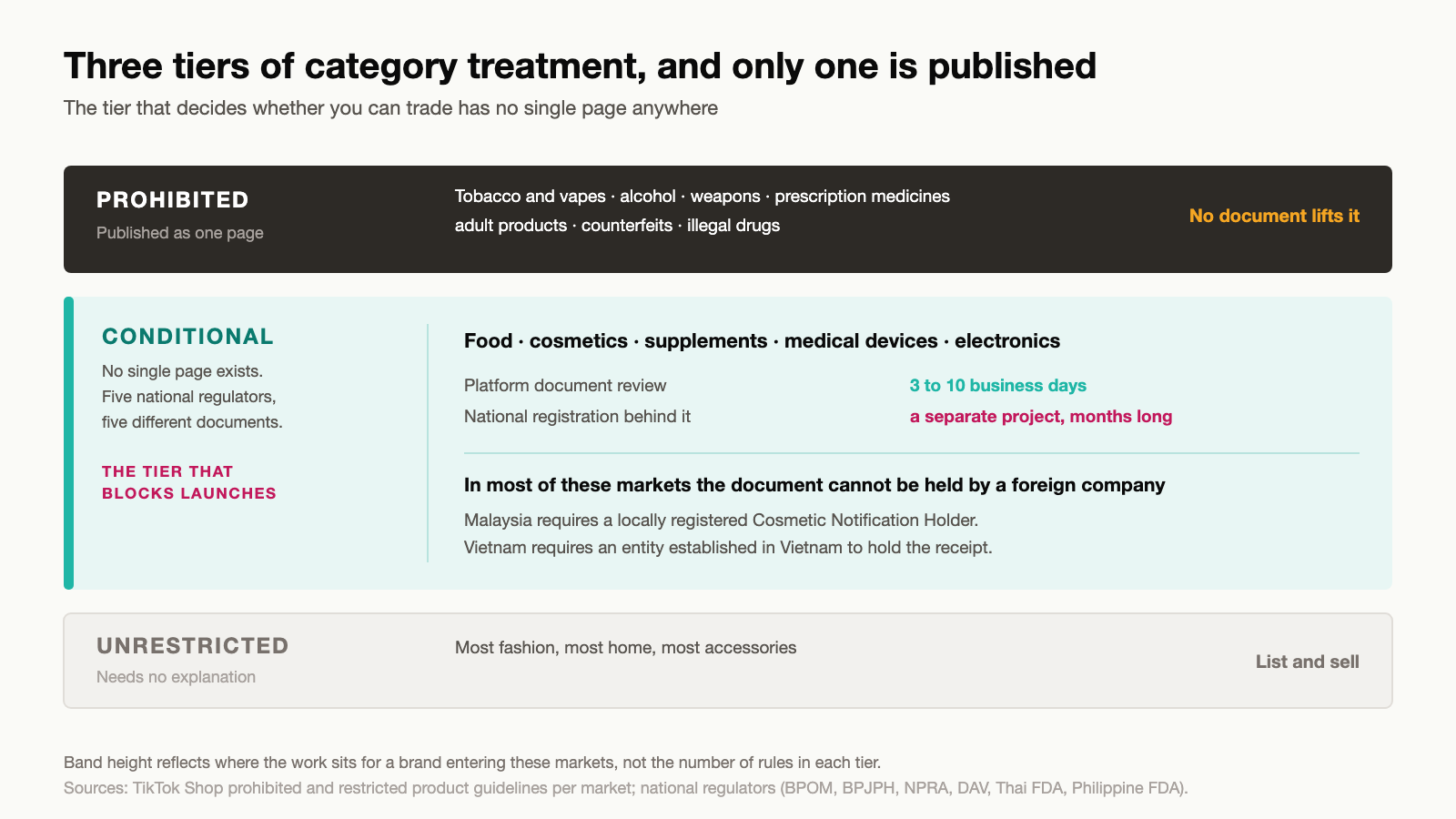
There are two restricted product lists a seller meets on the way into Southeast Asia. The first one is easy. Tobacco and vapes, alcohol, weapons, prescription medicines, adult products, counterfeits, anything with an illegal drug in it. Nobody planning a skincare or supplement launch is troubled by that page, and nearly everybody stops reading at the bottom of it.
The second list is not published as a list. It is spread across five national regulators, it never says no, and it is the one that ends shops. It says yes, once you hold the document. Then it adds a condition almost nobody reads carefully: in most of these markets the document cannot be held by you.
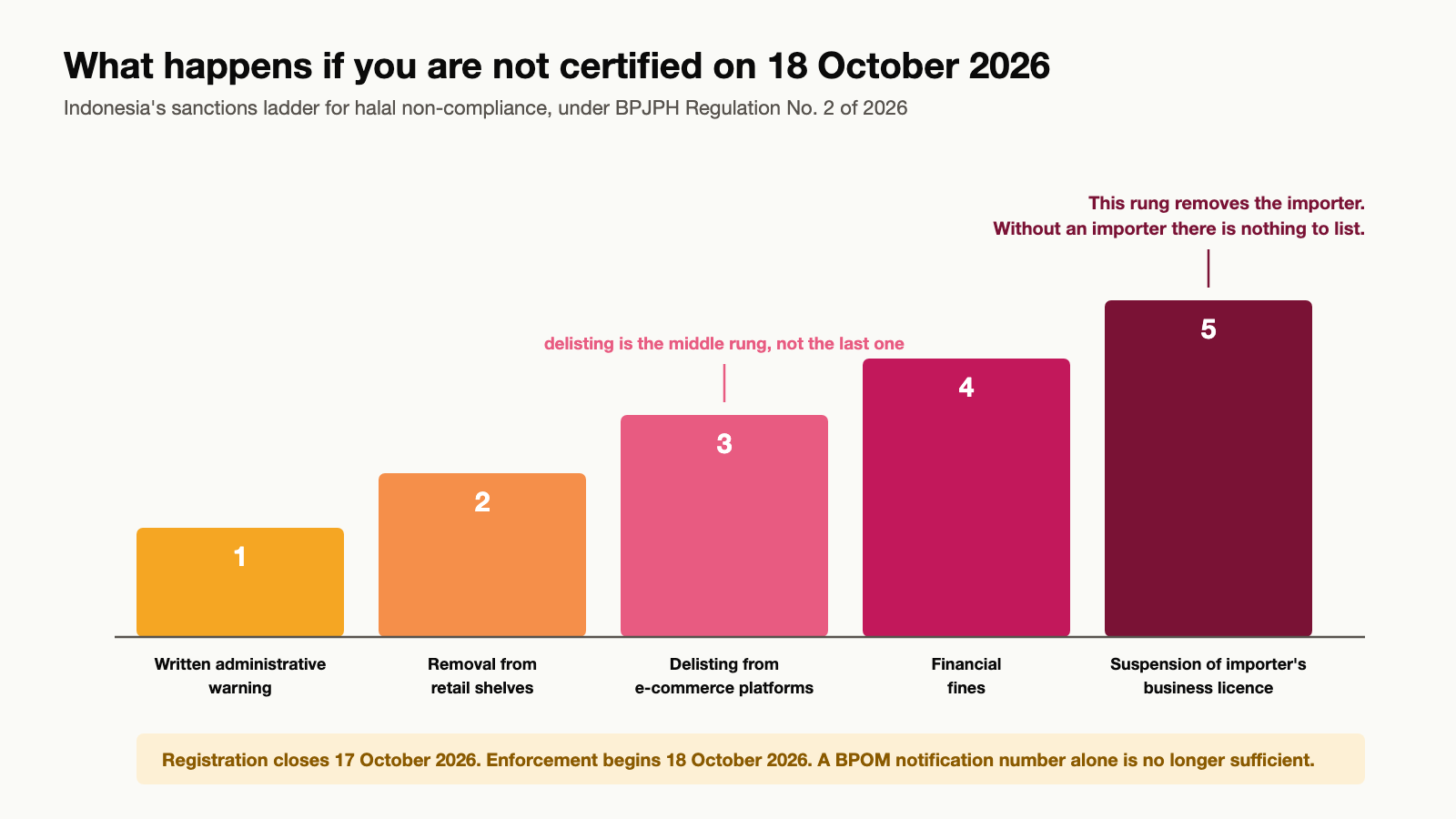
From 18 October 2026, cosmetics sold in Indonesia require a halal certificate issued or recognised by BPJPH. Registration closes on 17 October. A BPOM notification number, which has been the entry document for years, stops being sufficient on its own. Uncertified products face removal from TikTok Shop, Tokopedia, Shopee and Lazada, and seizure by BPOM inspectors.
Three tiers, and only one of them gets published
Category treatment on TikTok Shop sorts into three tiers, not two. The prohibited tier is absolute and global, which is exactly why it can be published as a tidy page. The unrestricted tier needs no explanation. Between them sits the conditional tier, and it is where launch plans quietly die.
A conditional category is one you may sell in, provided you upload a compliance document before listing. Food, cosmetics, medical devices, supplements and electronics all sit here across the region. The platform review itself is quick, typically three to ten business days depending on category and market. That number is reassuring and it is also the least important number in the process, because the platform is only checking that you already hold a national document. Obtaining that document is a separate project with a separate clock, run by a regulator who has never heard of your launch date.
The published list is the small one. The tier that decides whether you can trade is the middle one, and it has no single page anywhere.
One face serum, five markets
Take a single product, a face serum, and walk it across the five Southeast Asian markets TikTok Shop operates in. The product does not change. Everything around it does.
Indonesia. A BPOM notification, and from 18 October 2026 a BPJPH halal certificate as well. The halal audit runs across the whole supply chain, covering raw material sourcing, manufacturing, packaging and storage. The certificate must match the brand, specification and formula of the listed product.
Malaysia. Notification through the NPRA Quest3+ system under the ASEAN Cosmetics Directive, at RM50 per product. The notification note is valid for two years and takes roughly three to four weeks. The applicant must be a Malaysian registered company, so a foreign brand has to appoint a local Cosmetic Notification Holder.
Vietnam. A notification receipt number from the Drug Administration of Vietnam, required before import or sale, valid for five years. The notification must be held by an entity established in Vietnam, which in practice means your importer, your distributor, or a company you set up yourself.
Thailand. Thai FDA registration or notification for the product, plus a second requirement most brands miss entirely: prior approval for supplement advertising, online and offline alike.
Philippines. A Certificate of Product Notification from the Philippine FDA, which is what permits the product to be legally imported and marketed.
Read that list again and the pattern is not the paperwork. It is the holder.
The holder requirement is a commercial term wearing a compliance costume
Malaysia requires a locally registered Cosmetic Notification Holder. Vietnam requires a Vietnam-established entity to hold the notification. Neither rule is about product safety. Both rules decide who controls your access to the market, and the answer, unless you have incorporated locally, is your distributor.
This matters on the day the relationship ends. If your Vietnamese distributor holds your notification receipt and you want to change partners, the notification does not travel with you. You start again. Your competitor does not have to wait for you, and your listings come down while you refile. Distribution agreements in this region are often negotiated as though the only asset in play were shelf space and payment terms. The regulatory holding is usually the larger asset and it is rarely priced.
The same logic runs through the seller entity rules. Thailand and Singapore require a citizen seller rather than merely a company, which is the same structural constraint expressed at the account level instead of the product level. The two rules compound: a local party may end up holding both your shop and your product registration. Anyone weighing which markets to open first should read those constraints together rather than separately, as set out in what a foreign brand can actually register in each market.
The renewal clocks do not line up
Malaysian notifications last two years. Vietnamese ones last five. Indonesian halal certification will run on its own cycle again, and the underlying BPOM notification on another. Nothing synchronises.
For one product in one market this is a calendar reminder. For twenty products in five markets it is a permanent administrative function, and the failure mode is not dramatic. No regulator sends a warning shot. A notification lapses, the listing stops being compliant, and the shop finds out when the product is delisted during a campaign it has already paid to promote. Brands that run this well treat renewal dates as inventory, tracked in the same place as stock cover, because a lapsed certificate and an out-of-stock SKU have exactly the same effect on revenue.
Indonesia's enforcement ladder is now written down
Five rungs, and e-commerce delisting sits in the middle rather than at the end. Losing the listing is not the worst outcome available.
BPJPH Regulation No. 2 of 2026 sets out the sanctions framework for halal non-compliance, and it escalates through written administrative warnings, removal from retail shelves, delisting from e-commerce platforms, financial fines, and in serious cases suspension of the importer's business licence. The detail worth sitting with is the ordering. Delisting is a middle rung. A brand treating this as a marketplace problem has misread which authority it is dealing with, because the last rung takes away the importer, and without an importer there is nothing to list.
There is a second-order effect here that almost nobody is pricing. Indonesian beauty shelves are about to lose every product whose owner did not certify in time. That is a genuine opening. It is also not available to you if you are reading about the deadline for the first time now, because a full supply chain audit does not complete in three weeks. Whoever entered the BPJPH pipeline months ago inherits the gap. The honest read for everyone else is that Indonesian cosmetics is closed until the next cycle, and the right response is to plan for 2027 rather than to attempt a rush that will fail and cost money on the way.
The product can be legal while the claim is banned
A separate trap sits one layer down from category permissions. TikTok Shop prohibits cosmetics claiming to whiten or bleach skin or to reduce melanin, and prohibits supplements associated with body shaming or with dangerous weight loss methods. Nothing there is about the formula. It is about the words.
In Southeast Asia this bites harder than it does anywhere else, because brightening is a mainstream category rather than a fringe one, and the vocabulary that sells it locally is precisely the vocabulary the policy names. So the SKU clears review, the listing goes live, and the videos come down one by one. Sellers read that as inconsistent enforcement. It is not. Product compliance and content compliance are two different reviews with two different rule sets, and passing the first tells you nothing about the second.
Thailand adds the sharpest version of this. Thai FDA requires prior approval for all supplement advertising, online and offline, and it monitors TikTok, Lazada, Shopee, Facebook, Instagram and brand websites. Enforcement targets the registration holder rather than the platform. Read that alongside an affiliate programme where hundreds of creators improvise their own scripts, and the exposure becomes obvious: every unapproved claim a creator makes about your supplement is your regulatory problem, not theirs and not TikTok's. Anyone running an affiliate programme in these markets needs an approved claims list before the first creator sample ships.
What this does to sequencing
Compliance is priced per product, per market, and it is fixed. That single sentence inverts the usual advice to test small and scale what works.
A brand with twenty SKUs entering five markets is looking at up to one hundred separate notification events, each with its own holder, fee, validity period and renewal date. The cost of certifying a product does not fall because you only intend to sell ten units of it. Advertising budgets scale down gracefully and regulatory ones do not, which means a cheap market test is not actually available to you in the conditional categories. You can test demand cheaply. You cannot test compliance cheaply.
Sort your catalogue into prohibited, conditional and unrestricted before you sort it by margin. An unrestricted hero product in a smaller market usually beats a conditional one in a larger market, because it can actually be listed this quarter.
Find out who would hold each registration in each market, and write the answer down next to the product. If the answer is a distributor you have not signed yet, you do not have a launch plan.
Negotiate the holding explicitly. Transfer on termination, cost of refiling, and who pays for it. This belongs in the contract, not in an email.
Build an approved claims list per market before creator sampling, and treat it as the only language the programme is allowed to use.
Track every validity date in the same system you use for stock cover, and set the reminder at the lead time for renewal rather than the expiry date.
Sequence market entry by certification lead time rather than by market size. The largest market with the longest queue should rarely be first.
"The prohibited list tells you what you may not sell. The conditional list tells you who decides whether you may sell at all, and the answer is frequently somebody whose name is on your distribution agreement."
FAQ
What are TikTok Shop's restricted categories in Southeast Asia?
Restricted categories are those you may sell in only after uploading a national compliance document, and across the region they include food, cosmetics, supplements, medical devices and electronics. This is separate from the prohibited list, which covers tobacco and vapes, alcohol, weapons, prescription medicines, adult products and counterfeits and applies everywhere, with no document that lifts it. Platform review of an uploaded document usually takes three to ten business days, but that clock only starts once the national registration already exists.
Do I need halal certification to sell cosmetics on TikTok Shop Indonesia?
From 18 October 2026, yes. Cosmetics distributed in Indonesia must hold halal certification issued or recognised by BPJPH, with registration closing on 17 October 2026. A BPOM notification number on its own is no longer sufficient after that date. Certification involves an audit of the full supply chain, including raw material sourcing, manufacturing, packaging and storage, so it is not a filing that can be completed quickly under deadline pressure.
Can a foreign company hold a cosmetic registration in Malaysia or Vietnam?
Generally not directly. Malaysia requires the notification applicant to be a locally registered company, so an overseas brand must appoint a local Cosmetic Notification Holder. Vietnam requires the notification receipt to be held by an entity established in Vietnam, typically the importer or distributor. The practical consequence is that a third party may control your market access, which is why transfer terms belong in the distribution contract rather than being discovered when the relationship ends.
Who is liable when an affiliate makes an unapproved claim about my product?
In Thailand, the registration holder. Thai FDA requires prior approval for supplement advertising both online and offline, monitors the major platforms including TikTok, and enforces against the holder of the registration rather than against the platform or the individual creator. An affiliate video is advertising for this purpose. The workable control is an approved claims list issued to every creator before sampling, combined with active monitoring of what is actually being said.
Why was my product approved but my videos removed?
Because they are two separate reviews. Category approval checks whether you hold the right national document for the product. Content review checks the claims being made, and it independently prohibits whitening, bleaching and melanin-reduction claims for cosmetics, along with supplement messaging tied to body shaming or dangerous weight loss. A product can be entirely legal to sell while the most commercially effective way of describing it is not permitted on the platform.
The short version
Read the prohibited list once and then stop worrying about it, because almost nobody is caught by it. Spend the time on the conditional tier instead. Work out which national document each product needs in each market, who is legally required to hold it, how long it lasts, and what happens to it when a partner relationship ends. Then sequence your market entry around those lead times rather than around market size. Indonesia has a hard date on it, and 18 October 2026 will separate the brands that treated compliance as a project from the ones that treated it as a form.
Sources: BPJPH Regulation No. 2 of 2026 on administrative sanctions, summarised by REACH24H; Malaysian NPRA notification requirements via REACH24H; Vietnam's amended cosmetic notification process under Circular 34/2025/TT-BYT, via Tilleke and Gibbins.
Share:
Free · 24 pages
Read Chapter 1 of the Playbook
AI Foundation Models — how DeepSeek and Qwen crossed a billion downloads while Western boards were counting Mag7 capex, and which layers of the AI stack the rotation has not reached. No excerpt tricks: it is the full chapter.
You will also get the weekly newsletter. Unsubscribe any time — the link is in every email.
The Book · $99
China Market Entry Playbook 2026
456 pages across 22 industry chapters — AI, semiconductors, EVs, payments, logistics, beauty, F&B, healthcare, pets, toys. Every chapter runs the same five questions: the anchor number, the rotation underneath it, which layers of the global stack it has reached, and what to do about it. English and Simplified Chinese editions included.
Ex-Transsion Global Digital Marketing Director · Effie Awards Greater China jury member · Guest lecturer, Peking University School of Economics · Writes Annie Chan Talk, your insider lens on China.