What Sells on TikTok Shop in Southeast Asia: The Category List Is the Least Useful Part of the Answer
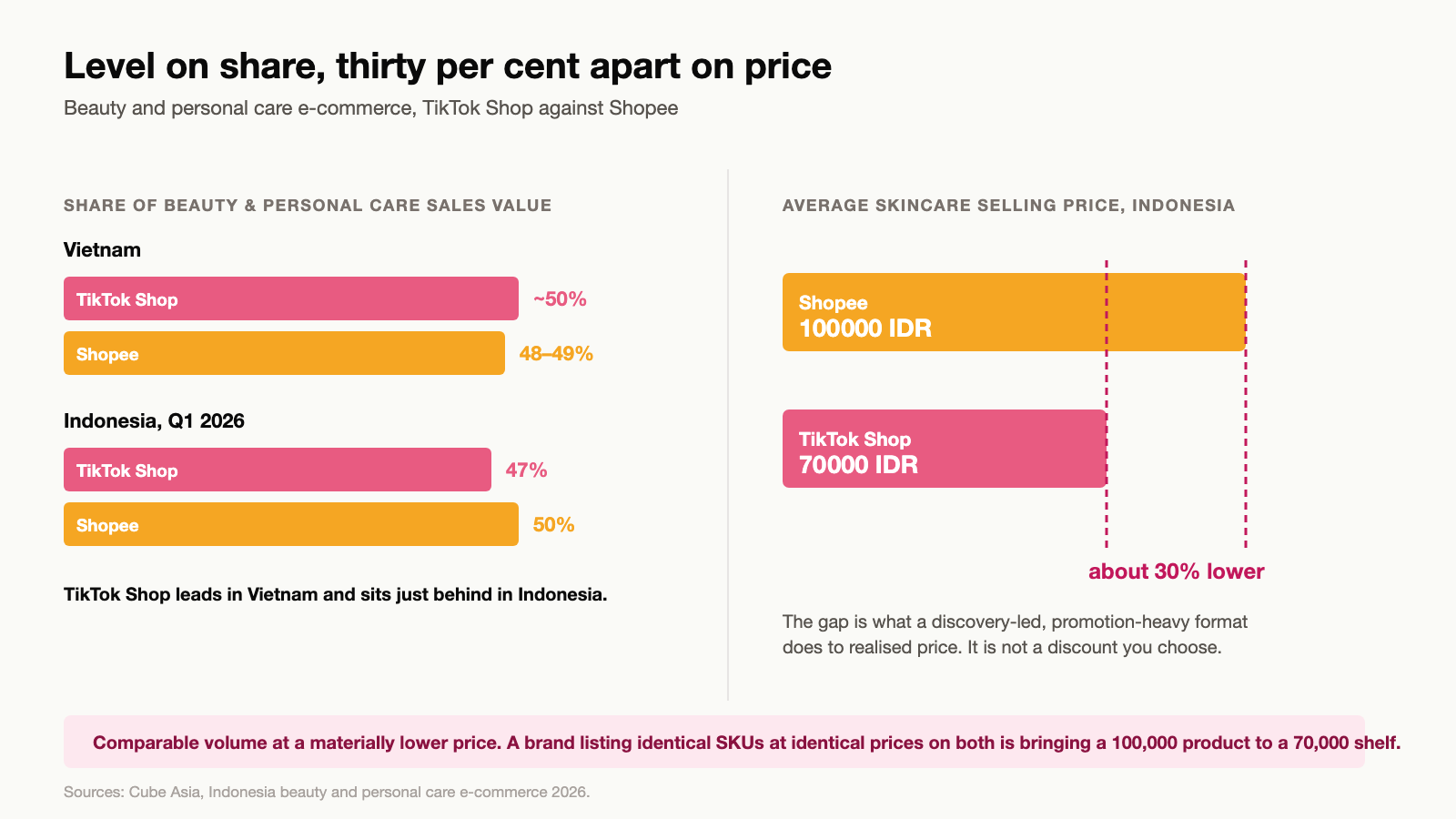
Indonesian skincare sells for around 70,000 rupiah on TikTok Shop and around 100,000 on Shopee. Same category, same country, roughly thirty per cent less. That gap is the format's gravity rather than a discount you choose, and it decides more than the category does.
Annie Chan··12 min read
Ask what sells on TikTok Shop in Southeast Asia and you will be handed a list of categories. Beauty, home, fashion, snacks. The list is accurate, freely available, and it answers a question almost nobody actually has, because a brand does not get to choose its category. It arrives with one.
The useful question is narrower and more uncomfortable. Not whether your category sells here, but whether your price survives here.
Average skincare selling price in Indonesia runs around 70,000 rupiah on TikTok Shop against roughly 100,000 on Shopee. Same category, same country, same shoppers, roughly thirty per cent less. Across Southeast Asian markets generally, average order value sits somewhere between five and twenty US dollars.
That gap is not a promotion you opt into. It is what a discovery-led, promotion-heavy, live-priced format does to realised price, because bundles and live pricing pull the effective number down continuously and the shopper arrives having been shown a deal rather than having searched for a product.
TikTok Shop is not a cheaper Shopee, it is a different shelf
Here is the part that makes the price gap interesting rather than merely discouraging. TikTok Shop is not losing on price. In Vietnam it leads beauty and personal care e-commerce by sales value with around 50 per cent share, narrowly ahead of Shopee at 48 to 49. In Indonesia in the first quarter of 2026 it reached 47 per cent against Shopee's 50 in the same category.
Level on share, thirty per cent apart on price. That combination is the whole strategic problem in one chart.
So the channel moves comparable volume at a materially lower price. A brand that lists identical SKUs at identical prices on both platforms will watch the TikTok listing underperform and conclude the channel does not suit its positioning. What actually happened is simpler. It brought a 100,000 rupiah product to a 70,000 rupiah shelf and then read the result as a verdict on the audience.
The sub-category detail sharpens this further. TikTok Shop over-indexes on skincare and fragrance, while Shopee skews towards makeup. Fragrance selling well on a video platform ought to be surprising, since the one thing video cannot do is let you smell anything, and the explanation says something useful about how the format works. Nobody is evaluating the product. They are responding to a person, a story and a price.
Where the categories actually sit
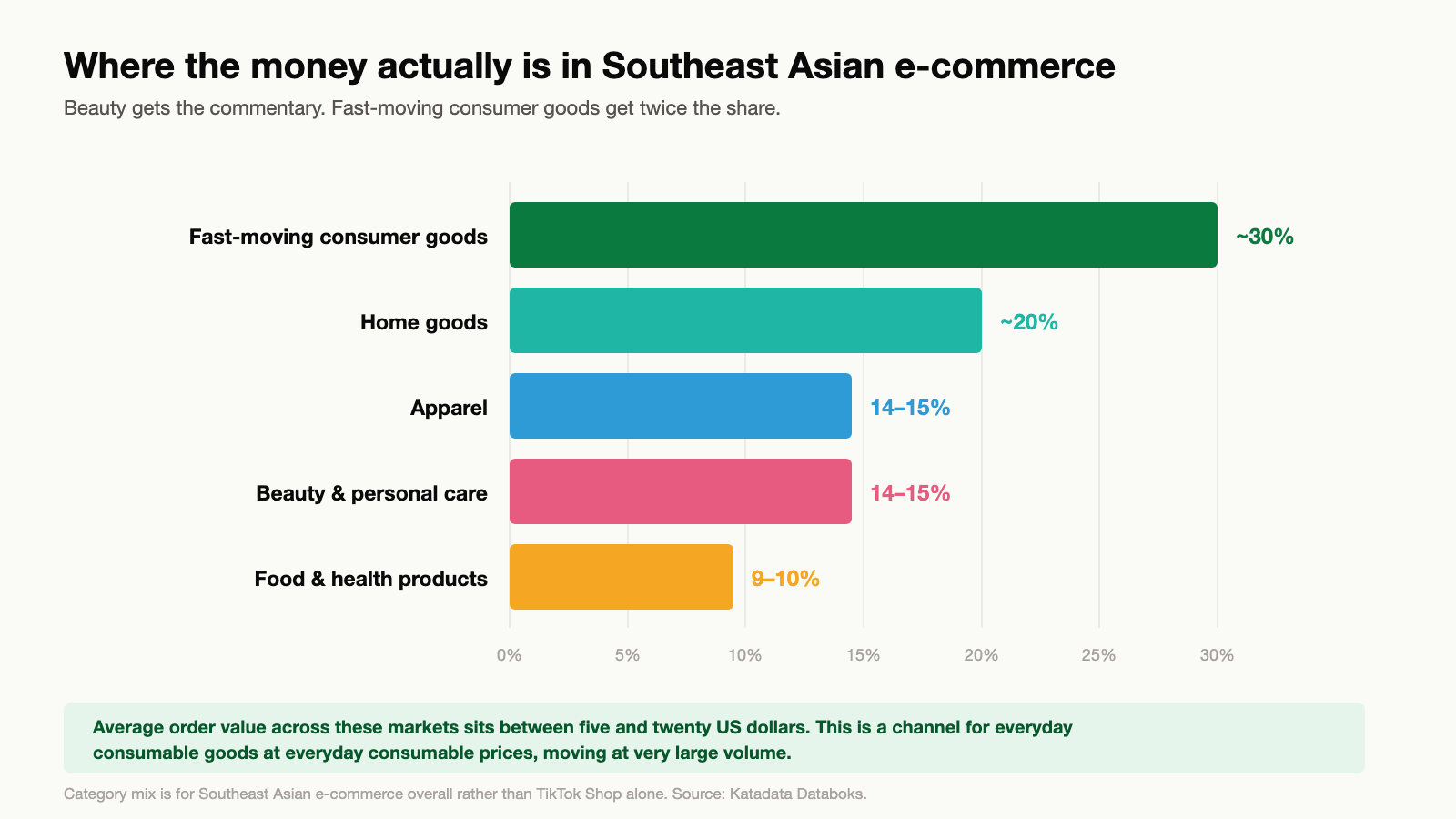
The mix for Southeast Asian e-commerce overall. Beauty gets the attention and fast-moving consumer goods quietly take twice the share.
Fast-moving consumer goods take roughly 30 per cent of Southeast Asian e-commerce, home goods around 20, with apparel and beauty and personal care each at 14 to 15 per cent, and food and health products at 9 to 10. Beauty receives most of the commentary and is not the largest category by some distance.
Read that mix alongside the five to twenty dollar order value band and the shape of the opportunity becomes clearer. This is a channel that moves everyday consumable goods at everyday consumable prices, at very large volume. It is not structurally hostile to premium products, and it does mean a premium product has to work considerably harder here than it does in a search-led marketplace where the shopper arrived already intending to buy a category.
The fragrance puzzle, and what it tells you about everything else
Sit with the fragrance finding for a moment, because it is the most instructive anomaly in the data. A video platform cannot transmit smell. Fragrance is the one major beauty sub-category where the product's entire proposition is inaccessible to the medium, and it is a sub-category where TikTok Shop over-indexes against a marketplace that can at least host detailed notes, reviews and comparison.
If the channel sold products on their attributes, that result would be impossible. It sells something else. The buyer is responding to a person they have decided they like, wearing or describing something they want to be associated with, at a price low enough that being wrong is not expensive. Product information is not what moves the unit. Identification does, and the five to twenty dollar order band is what makes identification sufficient, because at that price a shopper will take the risk on a feeling rather than requiring evidence.
That reframes the whole selection question. A product suits this channel when somebody can be shown wanting it, not when its specification compares well. Categories with a visible transformation work because the transformation is watchable. Categories with no visible mechanism, like fragrance, work when the person carries the demonstration instead of the product. What struggles is the middle: products that require explanation before they can be desired, where the buyer needs to understand a mechanism to want the outcome. Those sell far better in a search-led marketplace where the shopper arrived already curious.
The practical consequence is a test you can apply to your own catalogue before spending anything. Take each product and ask whether a stranger scrolling past could want it within three seconds without being taught anything first. If yes, it belongs here. If it needs a paragraph, it belongs on a marketplace listing where paragraphs get read. How that plays out in the actual video structure, including what to do when there is nothing visible to demonstrate, is set out in TikTok Shop content that converts.
The unit economics test that actually matters
Before deciding whether to enter, run the arithmetic on the realised price rather than on the list price, because the realised price is what the format produces.
Start from a selling price roughly thirty per cent below your marketplace price, not from your recommended retail price. If the model only works at full price, it does not work here.
Subtract the platform take for the specific market, which ranges from around 9 to 11 per cent in Malaysia to roughly 18.5 per cent all-in for a Vietnamese marketplace seller.
Subtract affiliate commission, because creator-led volume is the mechanism and the commission is not optional if you want the mechanism.
Subtract the returns cost for that market, which is a real line rather than a rounding error.
Then check whether the remaining contribution funds a two to four week gap between order and settlement at the volume you are planning.
A product that survives all five of those subtractions belongs on this channel regardless of what category list it appears on. A product that fails at the first one will fail here no matter how well it performs elsewhere, and no amount of creative or creator spend repairs a price that the format will not sustain. The full per-market cost stack is worked through in what selling on TikTok Shop actually costs across the region, and the settlement gap in when TikTok Shop actually pays you.
What to do when your product costs too much for the shelf
The instinct at this point is either to discount the existing catalogue or to walk away. Both are usually wrong, and the second is wrong more often than the first.
Discounting the flagship trains the customer to wait, poisons your marketplace pricing and eventually reaches your home market through comparison sites. Walking away forfeits a channel that is taking around half of beauty and personal care e-commerce in two of the largest markets in the region. The workable third option is to design for the shelf: a channel-specific size, a bundle, a trial format or a sub-brand whose price point starts where the format lives rather than being dragged down to it.
Travel sizes, refill packs, two-for-one bundles and discovery sets all exist for exactly this reason in this region. They are not a downgrade of the brand, they are an entry price into a channel whose shoppers are meeting you for the first time and were not looking for you. The full-price product then has somewhere to send people afterwards, which is a sequence rather than a compromise.
This also decides which single product to concentrate on first, and concentration matters more here than most brands expect, because the learning threshold and the creator quota both operate per product. That mechanism is set out in scaling a TikTok Shop in Southeast Asia.
Choosing between the platforms rather than between categories
The price and sub-category differences point at something that gets framed as a platform loyalty question and is really a portfolio question. Shopee behaves like a search-led marketplace where shoppers arrive with intent, which suits considered purchases, higher price points and makeup. TikTok Shop behaves like a discovery channel where shoppers arrive with attention rather than intent, which suits impulse pricing, strong demonstrations and skincare.
Most brands with a catalogue of any size should be on both, with different products and different prices on each, rather than mirroring one listing set across two platforms and wondering why the numbers differ. The comparison across the three major regional platforms is worked through in Shopee, TikTok Shop or Lazada.
"The category list tells you the room is full of people who buy things like yours. The price tier tells you whether they will buy yours, and only one of those is a decision you can act on."
FAQ
What are the best-selling categories on TikTok Shop in Southeast Asia?
Across Southeast Asian e-commerce overall, fast-moving consumer goods take roughly 30 per cent of sales, home goods around 20, apparel and beauty and personal care each 14 to 15, and food and health products 9 to 10. Beauty attracts most of the commentary despite being well behind fast-moving consumer goods by share. Within beauty, TikTok Shop over-indexes on skincare and fragrance while Shopee skews towards makeup.
Why are prices lower on TikTok Shop than on Shopee?
Because the format produces a lower realised price rather than because sellers choose to discount. Average skincare selling price in Indonesia runs around 70,000 rupiah on TikTok Shop against roughly 100,000 on Shopee, a gap of about thirty per cent. The channel is promotion-heavy and discovery-led, so bundles and live pricing continuously pull the effective price down, and the shopper arrives having been shown an offer rather than having searched for a product.
What is a typical order value on TikTok Shop in Southeast Asia?
Average order value across Southeast Asian markets typically sits between five and twenty US dollars. That band should be the starting point for any unit economics model rather than a domestic recommended retail price, because a product whose margin only works at full Western pricing will not survive the combination of a lower realised price, platform take of roughly 9 to 18 per cent depending on market, and affiliate commission.
Can a premium brand succeed on TikTok Shop in Southeast Asia?
Yes, though rarely by listing the flagship at its usual price. The more reliable approach is to design for the channel's price tier with a travel size, refill pack, bundle or discovery set that starts where the format lives, rather than discounting the main product, which trains customers to wait and eventually damages pricing elsewhere. The entry product then has somewhere to send buyers afterwards.
Should I sell on both TikTok Shop and Shopee?
For most catalogues, yes, with different products and different prices on each. Shopee behaves like a search-led marketplace where shoppers arrive intending to buy, which suits considered purchases and higher price points. TikTok Shop behaves like a discovery channel where shoppers arrive with attention rather than intent, which suits impulse pricing and strong demonstrations. Mirroring one identical listing set across both is what produces the disappointing comparison most brands report.
The short version
Stop asking whether your category sells here, because almost every category does at some volume. Ask whether your price does. Model from a realised price around thirty per cent below your marketplace pricing, subtract the market's platform take, the affiliate commission and the returns cost, then check that what remains still funds a month of working capital. If it does, the category question answers itself. If it does not, design something that starts at the channel's price tier instead of dragging the flagship down to it, because the shelf is not going to move and there is no version of this channel where it does.
Sources: Indonesian beauty and personal care share and average selling price data via Cube Asia; regional category mix via Katadata Databoks.
Share:
Free · 24 pages
Read Chapter 1 of the Playbook
AI Foundation Models — how DeepSeek and Qwen crossed a billion downloads while Western boards were counting Mag7 capex, and which layers of the AI stack the rotation has not reached. No excerpt tricks: it is the full chapter.
You will also get the weekly newsletter. Unsubscribe any time — the link is in every email.
The Book · $99
China Market Entry Playbook 2026
456 pages across 22 industry chapters — AI, semiconductors, EVs, payments, logistics, beauty, F&B, healthcare, pets, toys. Every chapter runs the same five questions: the anchor number, the rotation underneath it, which layers of the global stack it has reached, and what to do about it. English and Simplified Chinese editions included.
Ex-Transsion Global Digital Marketing Director · Effie Awards Greater China jury member · Guest lecturer, Peking University School of Economics · Writes Annie Chan Talk, your insider lens on China.