The Xiaohongshu Blue Tick Is a Permissions Key, Not a Trust Badge
Agencies sell blue tick verification on credibility, which is the least valuable thing it does. It costs 600 RMB a year, and without it you cannot advertise, cannot attach a link, cannot open a shop and cannot see your own data.
Annie Chan··12 min read
Ask an agency whether your brand needs the Xiaohongshu blue tick and you will get an answer about trust: verified accounts look legitimate, consumers are wary of unverified sellers, the badge signals commitment to the market. All of this is broadly true and none of it is the reason to do it.
The blue tick — 蓝V, formally the business professional account — costs 600 RMB for the first year. At that price, a debate about whether the credibility benefit justifies the cost is not a real debate. Something else is going on, and it becomes obvious once you look at what the badge actually switches on.
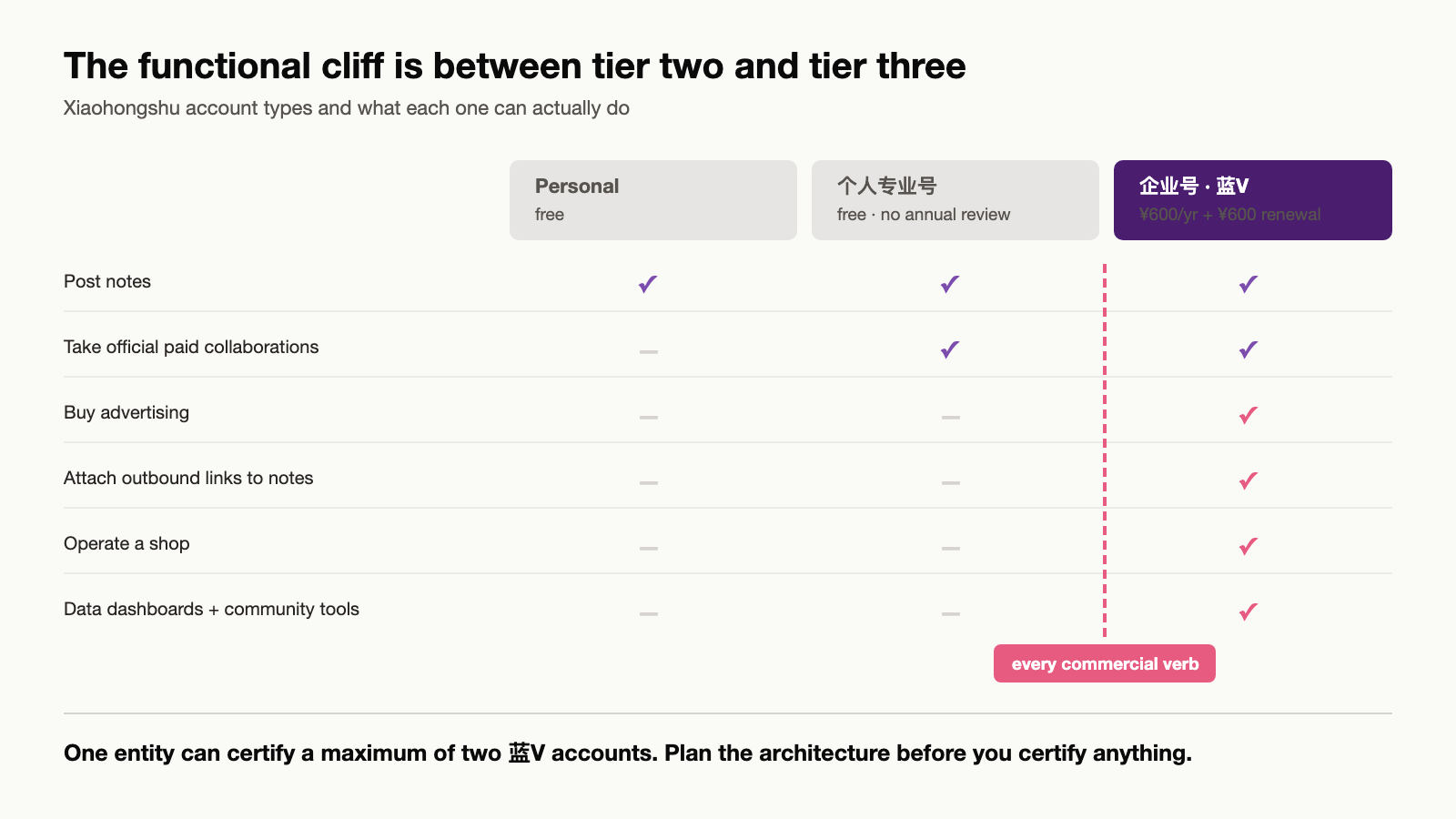
Verification is not a trust signal that happens to carry features. It is a permissions gate that happens to display a badge. Without it you cannot buy advertising, cannot attach an outbound link to a note, cannot operate a shop, and cannot see the analytics on your own content. The tick is what the platform draws on the outside of the door.
The three account types, and what separates them
The functional cliff is between personal professional and business professional. Everything commercial sits on the far side of it.
Personal account
The default. You can post, you can accumulate followers, and you have essentially no commercial capability. A personal account promoting products without commercial registration risks reach suppression or removal, and enforcement here is more aggressive than most Western platforms.
Personal professional account (个人专业号)
Free, with no annual review. This is the creator tier: better analytics than a personal account, eligibility to take paid collaborations through the official platform, and some content tooling. It is the right choice for an individual building an audience. It is not a brand account and carries none of the brand capabilities.
Business professional account (企业号 / 蓝V)
600 RMB for the initial certification, valid one year, with a 600 RMB annual review fee thereafter initiated before expiry through the professional account platform (Anasmiden, 2026). This is the tier that carries commercial rights. Reported verification costs for international entities have been quoted considerably higher — figures around 300 US dollars circulate — which almost certainly reflects agency handling and document preparation rather than a different platform fee.
Any commercial entity with valid business registration can apply, and the ceiling worth knowing about is that a single business entity can certify a maximum of two accounts (Alluatech, 2026).
What the tick actually switches on
Four capability groups, in descending order of how badly you need them.
Advertising rights
You cannot buy inventory on the advertising platform without a verified business account. This alone settles the question for any brand intending to spend money on distribution, and it means verification is not an optimisation to schedule later — it is a precondition sitting on the critical path.
Shop and commerce operation
Selling on the platform requires the commercial tier. If your model is discovery-to-external-checkout this matters less, though the link permissions below still bite.
Link attachment and conversion plumbing
The ability to attach outbound links to notes is a verified-account capability. Without it, a note can describe your product beautifully and offer the reader no route anywhere, which turns a content programme into a branding exercise whether or not that was the intention.
Data dashboards and community management tools
Analytics on your own content, plus the tooling to manage comments and community interaction at volume. Comment management is not cosmetic on this platform — comment engagement is a signal the algorithm rewards, and doing it manually across a growing note corpus stops being feasible quickly.
"Ask what you can do without it rather than what it gets you. The honest answer is: post, and wait. Every commercial verb sits behind the gate."
The distribution question, and how to hold it
Verified accounts are widely reported to receive prioritised recommendation and stronger organic visibility in platform search. Every agency page says so. No audited figure exists for how much, because the platform does not publish ranking mechanics.
The claim is plausible on first principles — a verified commercial entity is a lower-risk object for a platform to surface than an unverified one — and it is also exactly the sort of claim an interested party would make whether or not it were true. Treat it as directionally likely and quantitatively unknown, and do not let it into a business case as a number.
What is worth more attention is the invitation layer. Verified accounts are reported to be invited into platform events and marketing programmes, which is the kind of access that compounds and does not appear in any feature comparison table.
The two-account ceiling is a strategy constraint
One business entity, two certified accounts. This gets almost no attention in English-language coverage and it shapes structure more than anything else on this page.
A group with four brands cannot run four verified brand accounts from one registered entity. A brand that wants a corporate account plus a product-line account has used its allocation and has nothing left for a market-specific or campaign account. The workaround is entity structure, which means the decision belongs to whoever handles your corporate registrations, not to the marketing team, and it needs to be made before the first certification rather than after.
Decide the account architecture before you certify anything. Which entity certifies which accounts is a corporate structuring question with a hard ceiling, and it is considerably easier to plan than to unwind.
The annual review is a trap for exactly one reason
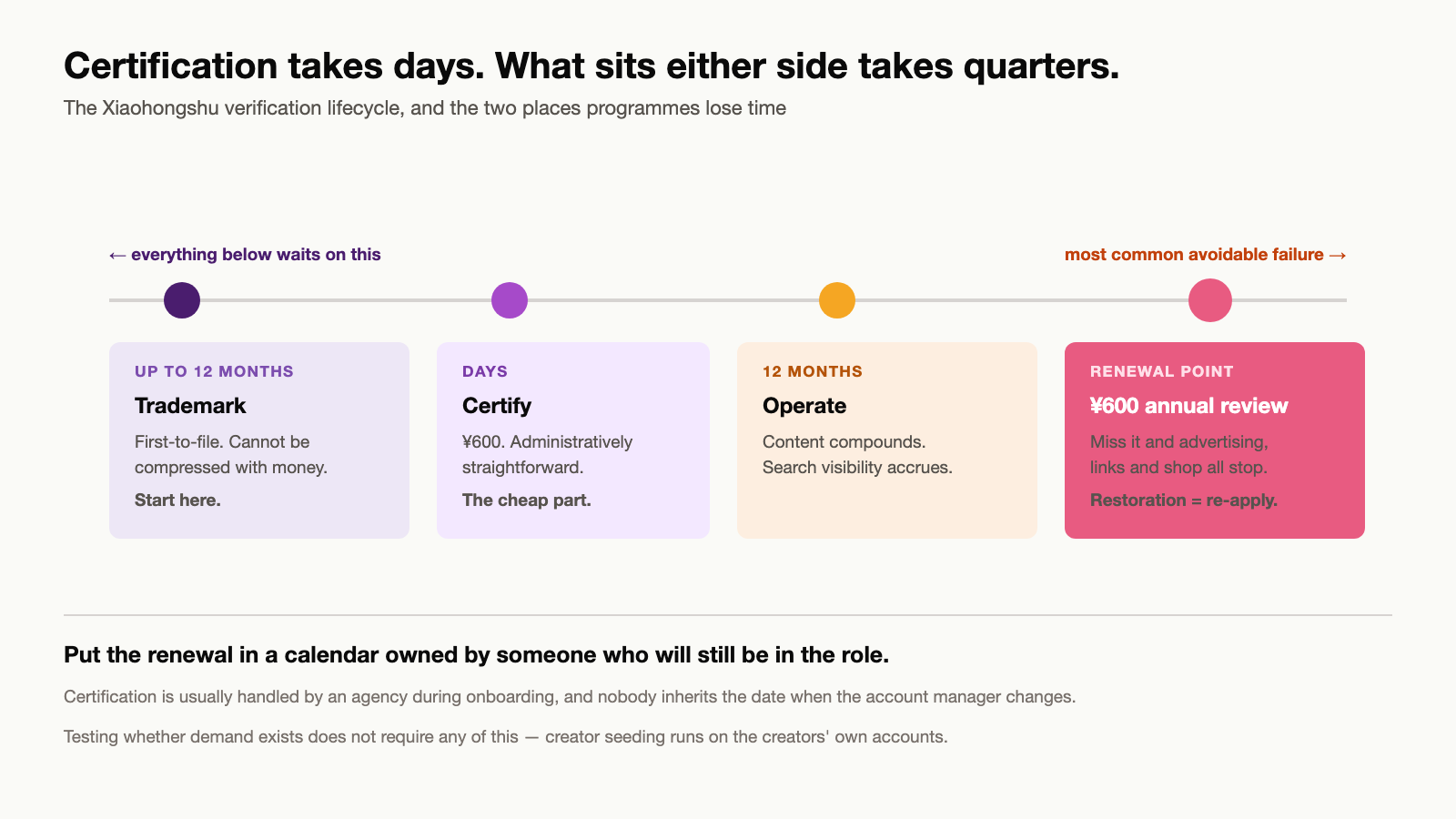
The certification itself takes days. What sits either side of it is where programmes lose quarters.
Certification lasts one year and the review has to be initiated before expiry. That is a simple administrative fact and it becomes expensive for a structural reason: the permissions lapse with it.
A lapsed certification does not merely remove a badge. It removes advertising rights, link attachment and shop operation from an account that by then holds a year of accumulated content and search visibility. Campaigns stop mid-flight. Notes that were converting become notes that go nowhere. And the restoration is a re-application rather than a click, which means the gap is measured in weeks rather than hours.
Put the renewal in a calendar owned by someone who will still be in the role. This sounds trivial and it is the most common avoidable failure on this entire page, because certification is normally handled by an agency during onboarding and nobody inherits the date when the account manager changes.
The alternative nobody proposes: do not certify at all
For a small brand testing whether the market exists, there is a legitimate route that skips all of this, and agencies rarely mention it because there is no fee attached.
You can run a pure seeding programme through creators on their own accounts, with no brand account of your own. Creators hold their own professional accounts, take paid collaborations through the official platform, and publish notes that mention your product. Your brand appears in the index without you operating anything.
What this cannot do is convert. No link attachment, no shop, no retargetable audience, no data of your own. What it can do is answer the only question that matters at the testing stage: does anyone search for this category, and does the content get engagement when it appears. That is a real answer, obtainable for the cost of the creator fees alone, and it is available before the trademark work completes.
"Certification is required to harvest demand. It is not required to find out whether the demand exists. Those are different questions and they can be sequenced."
Where verification fails for foreign brands
The fee is trivial and the application is administratively straightforward. The failures happen upstream, and they are the same failures that block advertising access generally.
Trademark position. China operates first-to-file, registration is slow, and someone else may already hold your mark. This is the item with a twelve-month lead time and no way to compress it.
Trademark class coverage. A mark registered in the wrong class does not support certification for the categories you actually sell.
Category certification. Cosmetics, food, supplements and medical-adjacent products carry their own regimes, and the requirement is per product rather than per industry.
Document form. Home-jurisdiction business registration needs certified translation where it is in neither Chinese nor English, which is a scheduling problem rather than a substantive one but derails timelines routinely.
Entity eligibility. Overseas entities without a Chinese subsidiary generally need an authorised partner in the loop, and that relationship has to exist before the application rather than being arranged during it.
What the badge does not do
Worth stating plainly, because the credibility framing implies more than it delivers. The tick does not make your notes rank. It does not exempt you from the platform's content rules, and verified accounts are held to them more visibly rather than less. It does not shorten the trademark timeline, and it does not confer any protection if a competitor is already using your name on the platform.
It also does not transfer. Certification attaches to the entity that applied, so an account certified under an agency's arrangement may not follow you when the relationship ends. That question belongs in the agency contract, and it is worth asking before certification rather than after.
The sequencing that avoids the common trap
The trap is producing content first. A brand that commissions a quarter of notes and then discovers it cannot certify has bought inventory it cannot attach links to, cannot amplify and cannot measure properly.
Confirm trademark position and class coverage in China. If this fails, the entire programme changes shape and you want to know now.
Decide the entity-to-account map against the two-account ceiling, with whoever owns corporate structure in the room.
Confirm category eligibility in writing for your specific products.
Certify, and complete the annual review reminder as a calendar item rather than a hope — lapsed certification takes the commercial permissions with it.
Then commission content, with link attachment and measurement available from the first note rather than retrofitted to a corpus that was published without them.
Frequently asked questions
How much does Xiaohongshu blue tick verification cost?
The business professional account certification is 600 RMB for the first year, with a 600 RMB annual review fee thereafter. Higher figures quoted to international brands, around 300 US dollars, generally reflect agency handling and document preparation rather than a different platform fee.
What are the benefits of the Xiaohongshu blue tick?
Advertising rights, shop operation, outbound link attachment on notes, data dashboards and community management tooling. Verified accounts are also widely reported to receive prioritised search and recommendation exposure, though no audited figure exists for how much.
Can a foreign company get a Xiaohongshu blue tick?
Yes. Any commercial entity with valid business registration can apply, but overseas entities without a Chinese subsidiary generally need an authorised partner in the loop, plus a registered Chinese trademark covering the relevant product categories.
How many accounts can one company verify on Xiaohongshu?
A single business entity can certify a maximum of two accounts. Groups with multiple brands need to plan entity structure against that ceiling before certifying anything, because it is considerably easier to plan than to unwind afterwards.
Do I need verification if I only want organic reach?
You can post without it, but you cannot attach outbound links, see proper analytics or manage comments at volume. A purely organic programme without verification produces content that readers cannot act on, which is usually not the intention.
The summary judgement
The 600 RMB is not the decision. The decision is the trademark work sitting in front of it, the entity structure sitting around it, and the recognition that certification is a critical-path item rather than an administrative one. Brands that treat it as paperwork schedule it last and then find their content calendar waiting on a trademark filing.
"Certification is cheap and its prerequisites are not. Start from the trademark and work forward, not from the content calendar and work back."
AI Foundation Models — how DeepSeek and Qwen crossed a billion downloads while Western boards were counting Mag7 capex, and which layers of the AI stack the rotation has not reached. No excerpt tricks: it is the full chapter.
You will also get the weekly newsletter. Unsubscribe any time — the link is in every email.
The Book · $99
China Market Entry Playbook 2026
456 pages across 22 industry chapters — AI, semiconductors, EVs, payments, logistics, beauty, F&B, healthcare, pets, toys. Every chapter runs the same five questions: the anchor number, the rotation underneath it, which layers of the global stack it has reached, and what to do about it. English and Simplified Chinese editions included.
Ex-Transsion Global Digital Marketing Director · Effie Awards Greater China jury member · Guest lecturer, Peking University School of Economics · Writes Annie Chan Talk, your insider lens on China.