Affiliate Commission Is a Second Platform Fee, and in Vietnam the Two Together Take 38%
Guides discuss affiliate commission as a marketing cost. It is not. It stacks directly on platform take, and in three Southeast Asian markets the combined number is larger than the gross margin most brands are working with.
Annie Chan··12 min read
Almost every guide to the TikTok Shop affiliate programme is written for creators. What follower count do I need, how do I get approved, how much can I earn. That audience is enormous and the content serving it is adequate.
A brand is asking a different question, and it is one those guides never reach: what does this actually cost me, on top of everything else the platform already takes?
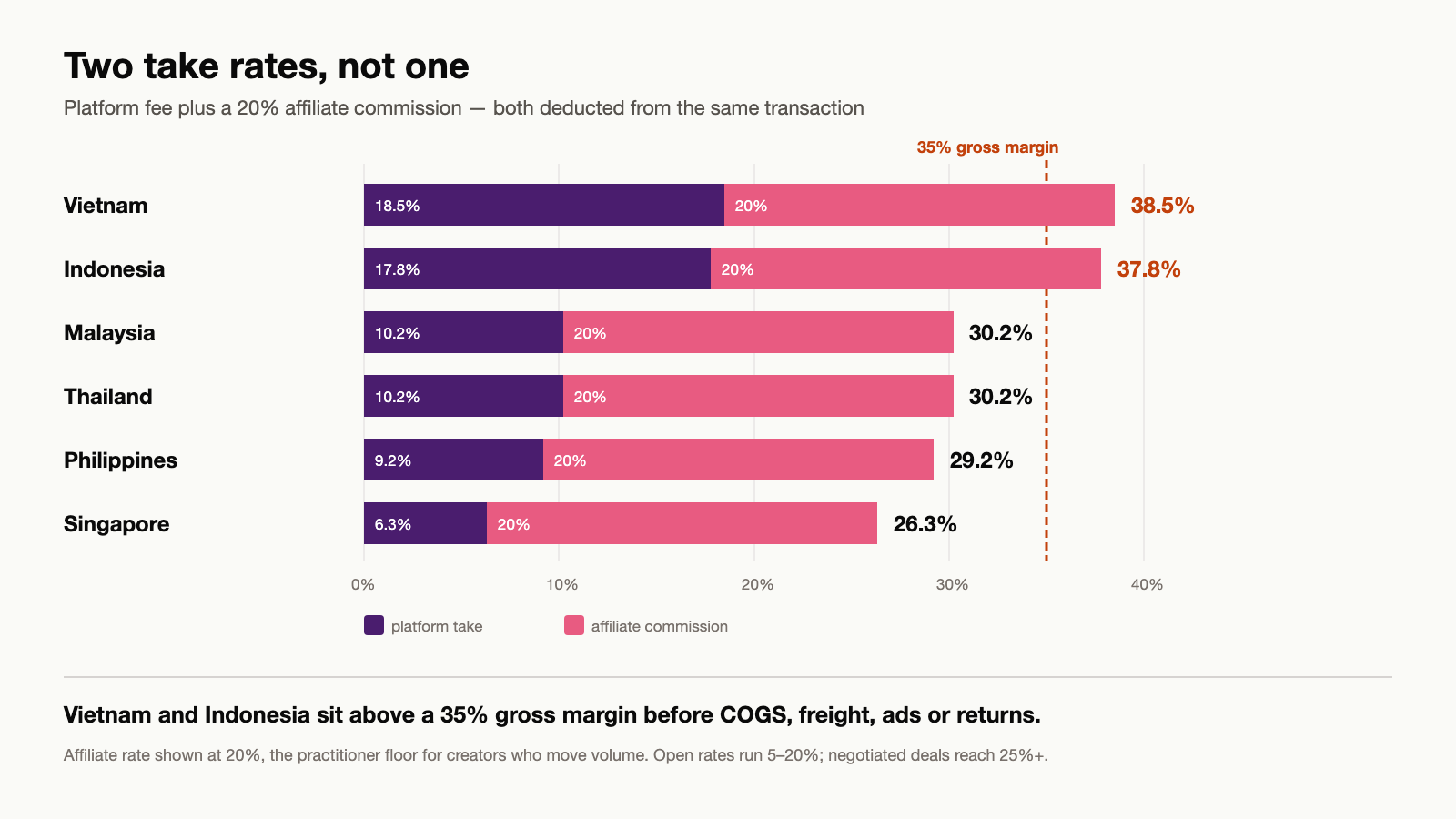
Affiliate commission is not a marketing line item. It is a second platform fee, deducted from the same transaction, and it is roughly twice the size of the first one. In Vietnam, platform take of around 18.5 percent plus a competitive affiliate rate of 20 percent removes 38.5 percent of revenue before you have paid for the product, the advertising or the shipping.
That number is not a warning against the channel. Creator-driven selling is how TikTok Shop works, and a brand that refuses to pay for it will simply not sell. It is an argument for doing the arithmetic before the negotiation rather than after it.
What the commission actually runs
Open rates — the commission any creator can claim without negotiation — sit in the 5 to 20 percent band across the region. That is the number brands see first and the number that makes the channel look affordable.
Targeted recruitment is where the real economics live. Negotiated rates for creators a brand actually wants typically run 18 to 25 percent, and top-tier creators with a proven sales record command considerably more — 50 percent is not unheard of for a launch collaboration (, 2026). Practitioner consensus in 2026 puts roughly 20 percent as the floor for attracting creators who move volume rather than creators who accept whatever is offered.
"The open rate is what you pay creators who were going to post anyway. The negotiated rate is what you pay creators who would otherwise post for a competitor. Only the second one is a growth strategy, and it costs about double."
The stacked number, market by market
Platform take plus a competitive affiliate rate. Everything below the line still has to cover product, advertising, fulfilment and returns.
Taking 20 percent as a working affiliate rate and stacking it on the all-in platform take for each market gives the number a margin model actually needs.
Vietnam: roughly 18.5 percent platform plus 20 percent affiliate — about 38.5 percent of revenue.
Indonesia: roughly 17.8 percent including VAT, plus 20 percent — about 37.8 percent.
Malaysia: roughly 10.2 percent plus 20 percent — about 30.2 percent.
Thailand: similar to Malaysia on published figures, around 30 percent, with the caveat that the Thai schedule circulating in English appears to be copied from Malaysia's.
Philippines: roughly 9.2 percent plus 20 percent — about 29.2 percent, though the category spread is wide enough that food categories land considerably higher.
Singapore: roughly 6.3 percent plus 20 percent — about 26.3 percent, the lowest combined take in the region.
On a product carrying 35 percent gross margin, Vietnam at 38.5 percent combined take is underwater before COGS. That is not a reason to avoid Vietnam — it is a reason to know, before launch, that Vietnamese unit economics require either a higher price point, a lower affiliate rate, or a category with more room in it.
Where creator eligibility differs, and why it matters to you
Brands rarely think about creator-side entry requirements, but they determine the size of the pool you are recruiting from.
Across Singapore, the Philippines and Indonesia, eligibility generally begins around 600 to 1,000 followers depending on the permission type. Malaysia operates a link-sharing path with no follower minimum for basic sharing, which makes the Malaysian creator pool structurally larger and cheaper at the bottom end.
That has a direct commercial consequence. A market with a low eligibility floor gives you a deep pool of micro-creators to test with at low individual cost. A market with a higher floor pushes you toward fewer, larger creators and therefore toward negotiated rates sooner. Malaysia's combination of a large accessible creator pool and the region's second-lowest platform take is the most underrated fact in Southeast Asian TikTok Shop planning.
Setting the rate: the mistake almost everyone makes
The default approach is a single catalogue-wide commission rate, chosen by looking at what competitors appear to offer. It is simple, it is defensible in a meeting, and it systematically overpays on some products while failing to attract anyone on others.
Commission should be set by product, not by brand, because the thing being funded differs by product. A high-margin hero SKU can carry 25 percent and still work. A volume driver at 15 points of margin cannot carry 20, and offering it anyway means paying creators to sell the thing that makes you the least money.
Set a tiered structure rather than a flat rate: a headline rate on products that can absorb it, a lower open rate on the rest, and negotiated rates reserved for named creators.
Price the rate against the specific product's margin after platform take, not against gross margin before it. Those are different numbers and only one of them is real.
Reserve your highest rates for launch windows rather than making them permanent. A rate is easy to raise and very hard to lower without losing the creators it attracted.
Track creator-attributed revenue net of both fees. Attributed revenue at 38.5 percent combined take is a different business from attributed revenue at 26 percent, and a single regional dashboard hides that.
"A flat catalogue commission is a decision not to think about which products you want sold. Creators will resolve that question for you, and they will resolve it toward whatever is easiest to sell rather than whatever you needed to move."
The margin that is left, and what still has to come out of it
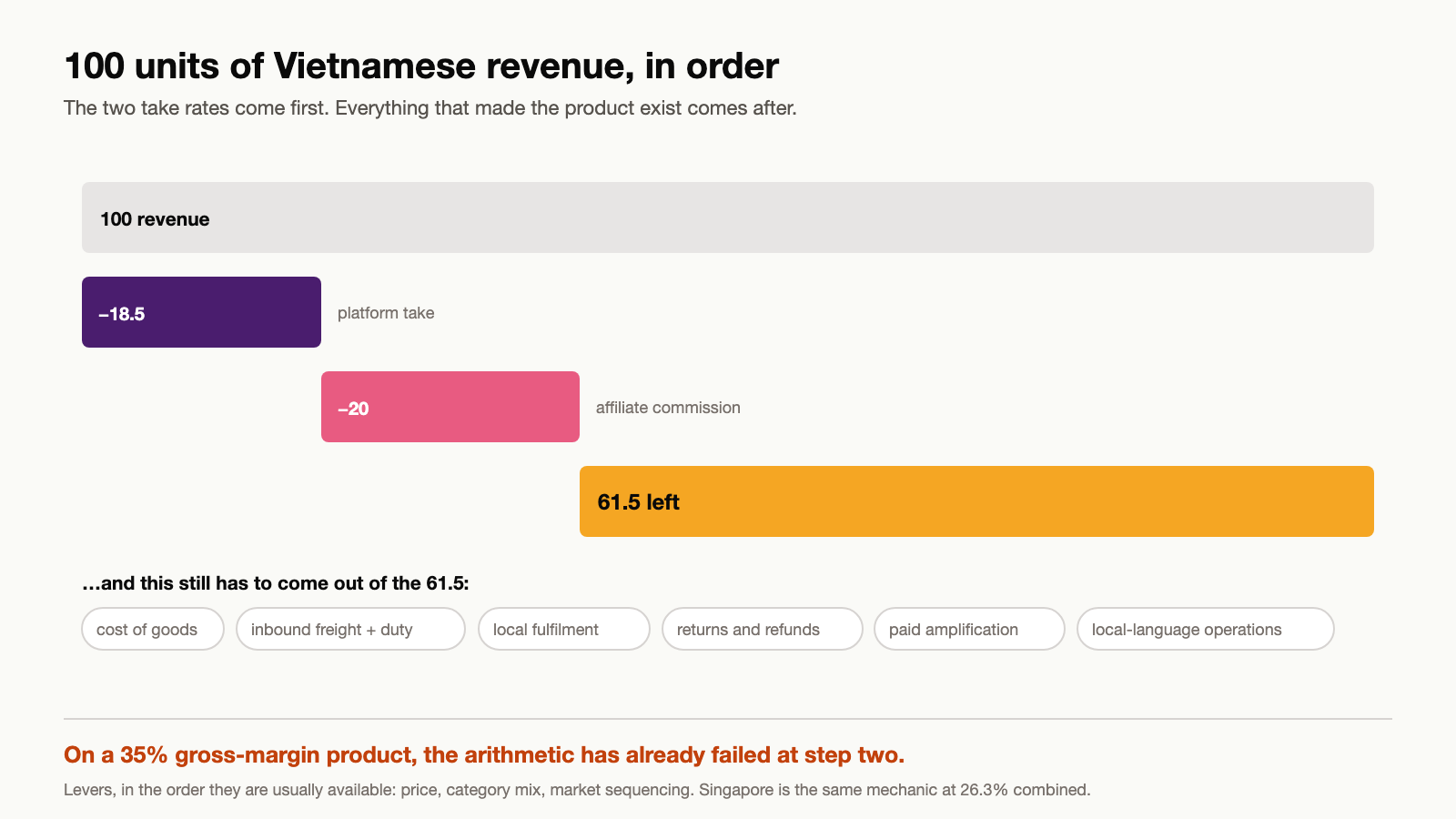
Vietnam, 20 percent affiliate rate. The two take rates are the first two deductions, and everything that makes the product exist comes after them.
Run 100 units of Vietnamese revenue through in order. Platform take removes 18.5. Affiliate commission removes 20. You are at 61.5 before anything that produced the product has been paid for.
Out of that 61.5 still come: cost of goods, inbound freight and duty, local fulfilment, returns and the refunds attached to them, any paid advertising used to amplify creator content, and the local-language operations that keep the shop compliant. On a product with 35 percent gross margin, the arithmetic has already failed.
Which points at the three levers, in the order they are usually available.
Price. The most reliable and the most resisted. A product priced for a 10 percent take-rate market is mispriced in a 38 percent one, and regional price parity is a policy choice rather than a law.
Category. The Philippine spread runs roughly 2 percent on electronics to 12 percent on food. Which of your SKUs leads the market entry changes the combined number by ten points before you negotiate anything.
Market sequencing. Singapore at roughly 26 percent combined and Vietnam at 38.5 are the same platform, the same programme and the same creator mechanic. Entering the cheaper one first buys you the operating experience without the margin exposure.
Recruiting creators without overpaying at the start
The economics above determine what you can afford. Recruitment determines whether you get anything for it, and the common failure is spending the whole budget on the wrong tier.
Start with breadth, not with names
The instinct is to identify the largest creator in the category and negotiate. That is the most expensive possible first move, and it produces a single data point. Twenty micro-creators at open rates produce twenty data points about which product, which angle and which format actually converts — and that intelligence is what makes the eventual negotiated deal worth signing.
Judge on sell-through, not on followers
Follower count predicts reach and almost nothing about conversion. A creator with 40,000 followers who reliably shifts units in your category is worth more than one with 400,000 who has never sold anything similar, and the second one costs an order of magnitude more. The metric worth asking for is units moved on comparable products, and creators who have it will supply it without being pushed. Reluctance to share sell-through, from someone whose whole business is selling, is itself the answer.
Treat the first quarter as sampling cost
Product seeding at volume is how the creator pool discovers you, and a meaningful share of the product you send generates nothing. Budget it as a research line rather than a marketing one, because that is what it is, and because calling it marketing invites someone to demand attribution for every unit. A workable rule: assume two thirds of seeded units produce no measurable sale, and judge the programme on what the remaining third taught you about which angle converts. That framing survives a quarterly review; per-unit attribution does not.
What the channel is actually worth
The costs above are only half the calculation. Southeast Asia's creator-commerce ecosystem has been estimated above 55 billion dollars, against global TikTok Shop GMV projected to exceed 112 billion in 2026 (Hashmeta, 2026). The region is not a test market for this channel; it is the channel's centre of gravity.
The practical implication is that affiliate is not an optional layer on top of a TikTok Shop programme. It is the distribution mechanism. Brands that treat it as a bolt-on and budget for it late end up choosing between paying creators properly and hitting the margin they promised, at exactly the moment when neither option is available cheaply.
Budget the affiliate rate into the launch model at the same time as the platform fee, because they are the same kind of cost and they arrive together. A model that includes one and not the other is not conservative — it is wrong by roughly twenty points.
Frequently asked questions
How much commission does TikTok Shop affiliate cost a brand?
Open rates run 5 to 20 percent, but targeted recruitment of creators who actually move volume typically requires 18 to 25 percent, with 20 percent widely treated as the practical floor in 2026. Top-tier creators with proven sales records negotiate considerably higher for launch collaborations.
Does affiliate commission come out of the platform fee or on top of it?
On top. They are separate deductions from the same transaction. In Vietnam, platform take of roughly 18.5 percent plus a 20 percent affiliate rate removes about 38.5 percent of revenue before product cost, advertising or fulfilment.
What are the follower requirements for TikTok Shop affiliates in Southeast Asia?
Generally around 600 to 1,000 followers in Singapore, the Philippines and Indonesia depending on permission type. Malaysia operates a link-sharing path with no follower minimum for basic sharing, which gives it a structurally larger and cheaper micro-creator pool.
Should a brand set one affiliate commission rate for its whole catalogue?
No. A flat rate overpays on some products and fails to attract creators on others, and it lets creators decide which of your products get sold. Set tiered rates by product margin after platform take, and reserve the highest rates for named creators and launch windows.
Which Southeast Asian market has the best affiliate economics?
Singapore on combined take at roughly 26.3 percent, but Malaysia is arguably better overall: the second-lowest platform take in the region combined with a link-sharing path that has no follower minimum, which makes the creator pool both large and inexpensive to test with.
The summary judgement
The affiliate programme is described everywhere as a way to get creators selling for you, which is accurate and incomplete. Structurally it is a second take rate — set by you rather than by the platform, and in every Southeast Asian market it is the larger of the two.
"Model platform take and affiliate commission as one number, per product, per market. Anything else produces a margin that looks acceptable in the deck and does not survive the first invoice."
AI Foundation Models — how DeepSeek and Qwen crossed a billion downloads while Western boards were counting Mag7 capex, and which layers of the AI stack the rotation has not reached. No excerpt tricks: it is the full chapter.
You will also get the weekly newsletter. Unsubscribe any time — the link is in every email.
The Book · $99
China Market Entry Playbook 2026
456 pages across 22 industry chapters — AI, semiconductors, EVs, payments, logistics, beauty, F&B, healthcare, pets, toys. Every chapter runs the same five questions: the anchor number, the rotation underneath it, which layers of the global stack it has reached, and what to do about it. English and Simplified Chinese editions included.
Ex-Transsion Global Digital Marketing Director · Effie Awards Greater China jury member · Guest lecturer, Peking University School of Economics · Writes Annie Chan Talk, your insider lens on China.