New Sellers Wait 31 Days After Delivery, and the Fast Tier Is Performance-Gated
Settlement speed is tiered by Shop Performance Score, and every new shop starts on the slowest tier. Add transit, the payout cadence and bank transfer, and a cross-border order can take two months to become cash.
Annie Chan··12 min read
Marketplace launch models are built on margin. Revenue, platform take, affiliate commission, cost of goods, and whatever is left is the answer. The model is usually correct and it is not the thing that kills the programme.
What kills it is that the margin arrives roughly two months after the money goes out, and almost nobody builds the second model.
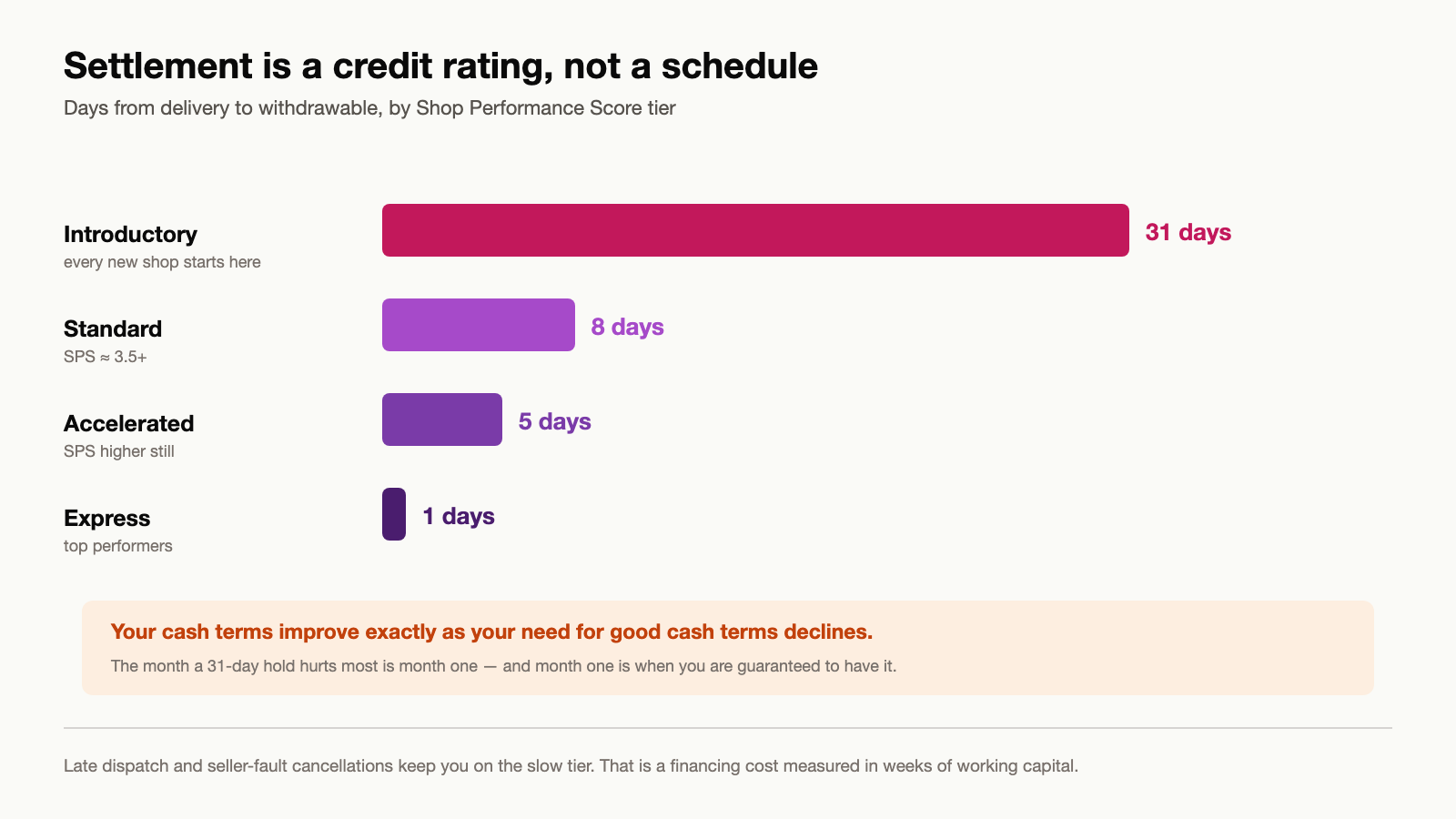
Settlement on TikTok Shop is tiered by Shop Performance Score: roughly 31, 8, 5 and 1 days after delivery for the Introductory, Standard, Accelerated and Express tiers. Every new shop starts on Introductory. The fast tiers require a performance record you cannot have yet, which means the worst cash terms apply exactly when working capital is tightest.
The full cycle, end to end
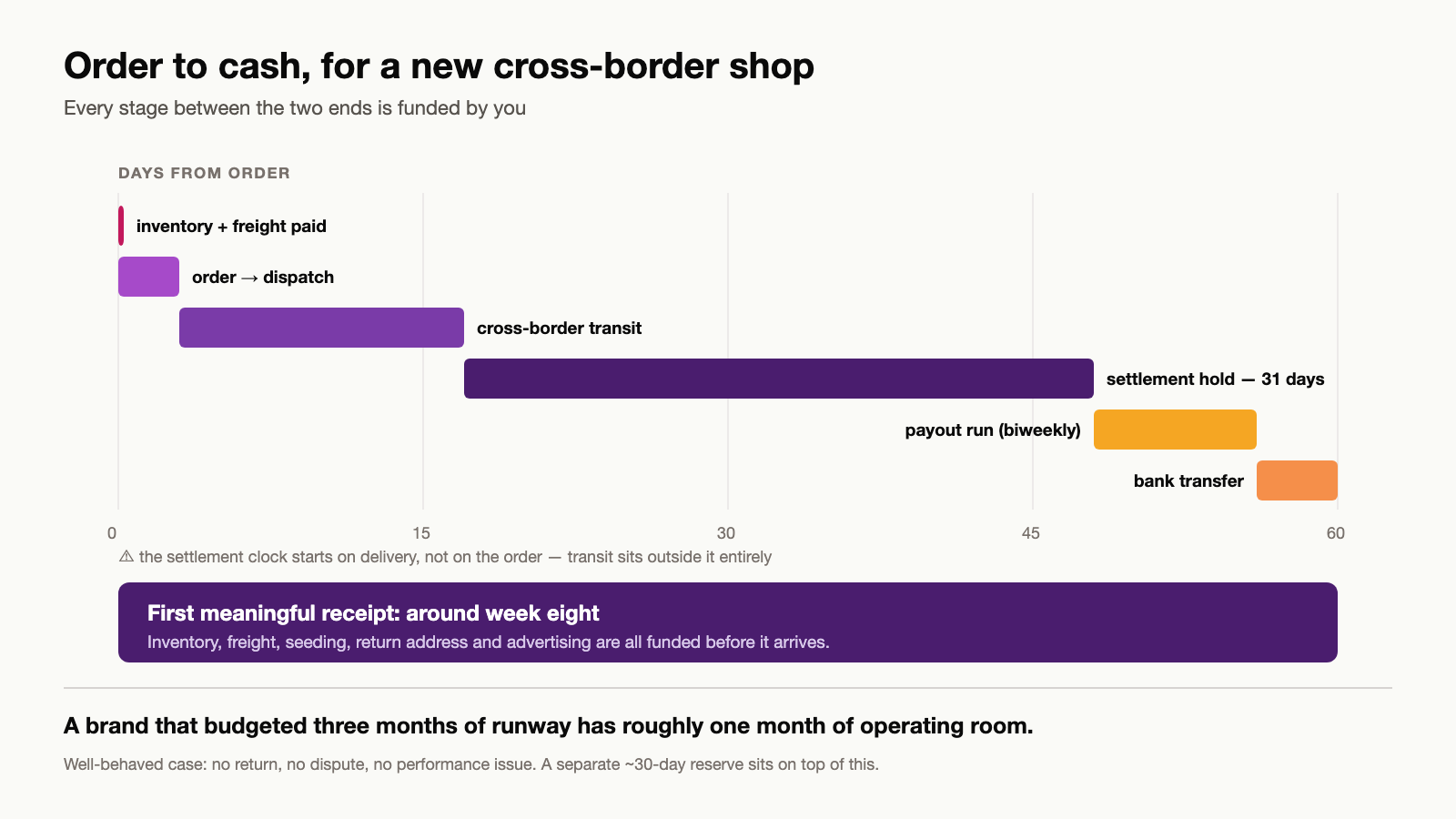
Cash leaves at the left and arrives at the right. Every stage in between is funded by you, and the settlement hold is the largest of them.
Take a new cross-border seller with an order placed today. The stages, in order.
Inventory and inbound freight were paid weeks earlier, before any of this started. That cash is already out.
Order placed and dispatched. Cross-border transit into Southeast Asia commonly runs one to two weeks.
Delivered. The settlement clock starts here, not at the order — a distinction that quietly adds the whole transit time to the cycle.
Settlement hold of roughly 31 days on the Introductory tier, covering the customer return window.
The balance becomes withdrawable and joins the next payout run, which operates on a roughly biweekly cadence.
Bank transfer lands one to seven days later depending on method.
Add those and a cross-border order placed at the start of the month is realistically cash in the second half of the following month, and that is the well-behaved version with no return, no dispute and no performance issue.
"The settlement clock starts on delivery. For a cross-border seller that means the transit time is a free loan you are making to the platform, and nobody puts it in the model because the platform's own documentation starts counting later."
The tier ladder, and why it is backwards for new sellers
Four tiers, thirty days apart at the extremes. The gate is a performance score, which a new shop by definition does not have.
Settlement speed is not a fixed platform term. It is a performance reward, with the faster tiers requiring Shop Performance Scores at roughly 3.5 and above, and the fastest higher still (TT Calculator, 2026).
The logic from the platform's side is sound. A shop with a proven fulfilment record represents less refund risk, so holding its money for a month serves no purpose. A brand new shop is an unknown, and the hold is insurance.
The consequence for a brand is uncomfortable and rarely stated: your cash terms improve exactly as your need for good cash terms declines. The month where a thirty-day hold hurts most is month one, and month one is when you are guaranteed to have it.
Which reframes what the performance score is for. It is usually presented as a quality metric, and it is, but operationally it is a credit rating. Late dispatch and seller-fault cancellations do not only risk enforcement — they keep you on the slow tier, and that is a financing cost measured in weeks of working capital.
The reserve, which is a separate hold
Alongside settlement there is a reserve: funds held back for around 30 days against potential returns and refunds, released if unused (TikTok Seller Center, 2026).
This is not the same thing as the settlement hold and it is easy to conflate them. Settlement delays when the money becomes yours. The reserve withholds a proportion of what has already settled, against risk that has not yet materialised. A shop can be on a fast settlement tier and still find that a slice of every payout is sitting in reserve.
For a category with a meaningful return rate, the reserve is effectively a permanent balance you never see — it refills as fast as it releases. Model it as a fixed asset tied up in the channel rather than as a temporary delay, because functionally that is what it is.
Where this interacts with everything else
The cash cycle is not an isolated finance detail. It compounds with the other constraints in a way that catches brands specifically in the first quarter.
With the new-shop order caps
New shops face daily order ceilings — around 50 in the US, around 100 in Southeast Asian markets. So the first month produces limited revenue and holds it for 31 days. Low volume and slow settlement arrive together, which is the worst possible combination for a launch budget.
With affiliate commission
Creator commission is deducted from the settled amount rather than invoiced separately, so it does not create a payables timing problem. Product seeding does. Units sent to creators are paid for immediately and generate revenue weeks later, if at all.
With Refund Without Return
A refund inside the settlement window simply reduces what settles. A refund after settlement claws back cash you have already received and possibly spent. Under Refund Without Return there is no unit coming back either, so the claw-back is against nothing.
"Margin models answer whether the business works. Cash models answer whether you survive long enough to find out. Southeast Asian marketplace entry needs both, and the second one is almost never built."
A worked cash model for the first quarter
Numbers make this concrete in a way the timeline does not. Take a brand launching cross-border into Malaysia with a 30 dollar product, 12 dollars landed, and a plan to reach 30 orders a day by the end of quarter one.
What goes out before anything comes back
Opening inventory. 1,500 units at 12 dollars is 18,000, paid to the factory before the shop opens.
Inbound freight and duty into the market. Varies enormously by category and lane; assume 2,000 for planning.
Product seeding. 200 units to creators at 12 dollars landed is 2,400, and a large share of those generate nothing.
Local return address and operations for the quarter. Modest as a line item, real as a commitment.
Call it somewhere north of 22,000 committed before the first order settles — and note that none of it is recoverable if the category turns out not to work, because inventory in a foreign market is the hardest asset there is to liquidate.
What comes back, and when
Week one produces orders. Those orders are in transit for one to two weeks, delivered around week three, and then held 31 days on the Introductory tier — so week seven or eight. They then wait for the next biweekly payout run and one to seven days of bank transfer.
Net of Malaysian platform take at roughly 10.2 percent and affiliate commission at 20 percent, a 30 dollar order settles around 21. Against a 12 dollar landed cost that is around 9 of contribution, before freight, seeding and operations are recovered.
The first meaningful receipt lands around week eight. Everything spent before that — inventory, freight, seeding, the return address, whatever advertising ran — is funded entirely from your own balance sheet. A brand that budgeted three months of runway has budgeted roughly one month of actual operating room.
The trap in scaling into it
The instinct on seeing early traction is to reorder inventory. That is correct commercially and dangerous financially, because the second inventory purchase lands before the first settlement does. Growth consumes cash faster than a slow-settling channel returns it, which is the ordinary mechanism by which a profitable business runs out of money.
The mitigation is unglamorous: stage the inventory commitment, accept that you will stock out on a winner, and treat the stock-out as the price of not being insolvent. Brands that refuse this trade tend to discover the arithmetic at the point where the factory wants a deposit and the platform has not paid yet.
What to actually do
Build a cash model beside the margin model, starting from when inventory is paid for rather than from when the order is placed. The gap is where launches die.
Fund the first quarter as though nothing settles. On Introductory tier with a biweekly cadence, the first meaningful receipt arrives around week seven, and planning for anything earlier is planning for a number you cannot bank.
Treat the performance score as a financing term, not a quality badge. Every point of late dispatch keeps you on a slower tier, and the interest on that is paid in working capital.
Model the reserve as permanently tied up rather than temporarily delayed. In a category with normal returns it refills as fast as it releases.
Sequence markets by cash terms as well as by margin. Domestic seller status shortens transit and therefore the whole cycle, which is worth more in the first year than most of the margin differences between markets.
If the cash gap is the binding constraint
Some brands read the arithmetic above and conclude they cannot afford the channel. Occasionally that is correct. More often the constraint is fixable by changing the shape of the entry rather than abandoning it.
Reducing the opening inventory commitment is the largest single lever, because inventory is the biggest cash outflow and the one furthest from any receipt. A narrow assortment ordered in smaller quantities costs more per unit and vastly less in total exposure, and the per-unit penalty is trivial against the risk of holding fifteen hundred units of something the market did not want.
Entering as a domestic seller where you can shortens transit, which shortens the whole cycle by one to two weeks at no cost. Choosing a market with a lower take rate leaves more in each settlement. Neither of those requires additional funding; both require making the decision before launch rather than after.
The one thing not to do is treat the settlement delay as a temporary inconvenience that ends once the shop matures. It does end — but reaching Standard tier requires a performance record built over the exact period when the delay is hurting, and no amount of intent accelerates it.
Frequently asked questions
How long does TikTok Shop take to pay sellers?
Settlement is tiered by Shop Performance Score at roughly 31, 8, 5 and 1 days after delivery for the Introductory, Standard, Accelerated and Express tiers. New shops start on Introductory. Add the payout cadence and bank transfer of one to seven days.
When does the TikTok Shop settlement clock start?
On delivery, not on the order. For a cross-border seller with one to two weeks of transit, that transit sits outside the settlement window entirely and adds to the total cash cycle without appearing in the platform's own timeline.
What is the TikTok Shop reserve?
A separate hold of around 30 days against potential returns and refunds, released if unused. It is distinct from the settlement delay — a shop can be on a fast settlement tier and still have a proportion of each payout sitting in reserve.
How do I get faster TikTok Shop settlement?
By raising the Shop Performance Score, with faster tiers gated at roughly 3.5 and above. Practically that means on-time dispatch with valid tracking, low seller-fault cancellations and fast customer response — the same behaviours that protect the Account Health Rating.
How much working capital does a TikTok Shop launch need?
Enough to fund inventory, freight, seeding and operations for roughly the first seven weeks without receipts, because on the Introductory tier with a biweekly payout cadence that is when the first meaningful settlement lands.
The summary judgement
Every number in this article is published. None of them are hidden, and the platform documents each stage clearly. What is missing is the addition — nobody sums transit, settlement, cadence and transfer into a single figure, because each is owned by a different page.
"Do the addition before the launch. A programme with acceptable margin and unacceptable cash timing fails the same way as one with bad margin, only faster and with more inventory left over."
AI Foundation Models — how DeepSeek and Qwen crossed a billion downloads while Western boards were counting Mag7 capex, and which layers of the AI stack the rotation has not reached. No excerpt tricks: it is the full chapter.
You will also get the weekly newsletter. Unsubscribe any time — the link is in every email.
The Book · $99
China Market Entry Playbook 2026
456 pages across 22 industry chapters — AI, semiconductors, EVs, payments, logistics, beauty, F&B, healthcare, pets, toys. Every chapter runs the same five questions: the anchor number, the rotation underneath it, which layers of the global stack it has reached, and what to do about it. English and Simplified Chinese editions included.
Ex-Transsion Global Digital Marketing Director · Effie Awards Greater China jury member · Guest lecturer, Peking University School of Economics · Writes Annie Chan Talk, your insider lens on China.