Refund Without Return Means the Buyer Keeps It — and From March 2026 Cross-Border Sellers Need a Local Address
Two policy changes have quietly rewritten the economics of selling into Southeast Asia from outside it. One lets buyers keep the product and the money. The other removes the main reason cross-border looked cheap.
Annie Chan··12 min read
Return policy is the part of a marketplace plan that gets written last, by whoever has least context, in a paragraph that says returns will be handled in line with platform policy. On TikTok Shop in Southeast Asia that sentence now hides two changes that move unit economics by more than most pricing decisions do.
The first is Refund Without Return, live across the region since January 2025. The second lands in March 2026 and removes the structural reason cross-border selling looked like the cheap way in.
Refund Without Return means exactly what it says: the buyer is refunded and keeps the product. It covers quality complaints, description mismatches and — the part brands miss — change of mind. For a cross-border seller each instance is a total loss rather than a recoverable one, because there was never any prospect of getting the unit back economically.
What Refund Without Return actually does to a P&L
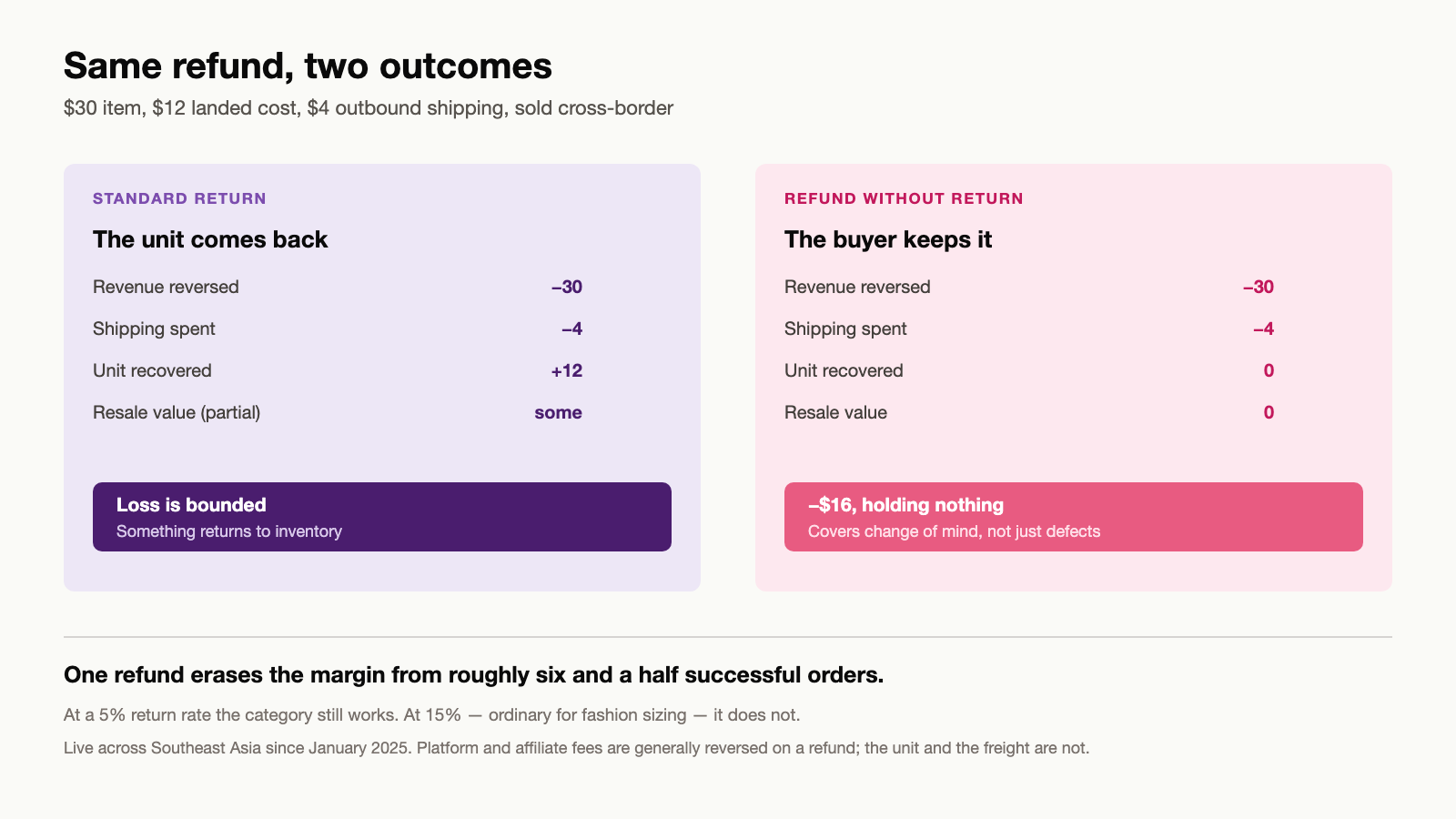
Under an ordinary return, a refunded order costs you the margin, the outbound shipping and the handling. You get the unit back, and depending on category and condition some fraction of it is resaleable. The loss is real and bounded.
Under Refund Without Return there is no unit coming back. The loss is the full landed cost plus the outbound shipping, with no recovery, on an order that also consumed platform take and affiliate commission on the way out.
Same refunded order, two outcomes. The difference is whether anything comes back, and for a cross-border seller the answer was already usually no.
The policy is not unreasonable from the platform's side. Cross-border return logistics for a low-value item cost more than the item, so returning it destroys value for everyone. Refund Without Return simply stops pretending otherwise and books the loss where it always sat.
"The policy did not create the loss. It made the loss visible and immediate rather than notional and deferred. Models that assumed a recoverable return were already wrong; now they are wrong on the invoice."
Two practical consequences. Low-value, high-return-rate categories — fashion sizing, anything cosmetic where expectation and reality diverge — carry a materially worse cost structure than the same category in a domestic market. And the decision SLA is short: sellers in Southeast Asia generally have two business days to approve or reject a return request, which is not enough time for a team in another timezone to investigate anything.
The March 2026 change nobody has priced
From early March 2026, TikTok Shop is requiring merchants selling cross-border into Southeast Asian markets to establish local return addresses (Forest Shipping, 2026).
Read that against the usual argument for cross-border, which is that it reaches a market without standing anything up in it. A mandatory local return address is standing something up in it. Not an entity, not a warehouse necessarily, but a physical presence with an operator behind it — and once you are paying for that, the gap between cross-border and local selling narrows on exactly the dimension that justified cross-border.
This does not make cross-border pointless. It remains the only route into Thailand and Singapore for a foreign brand without local participation, and it still avoids incorporation. What it does is remove the assumption that cross-border carries no fixed in-market cost, and that assumption is load-bearing in most first-year models.
There is a partial offset arriving alongside it. A Shipping Fee Reimbursement Programme is scheduled for April 2026, intended to help sellers absorb some of these costs. Treat it as a discount on a cost you now have rather than as a reason the cost does not exist.
The policy sequence, and why it reads as one decision
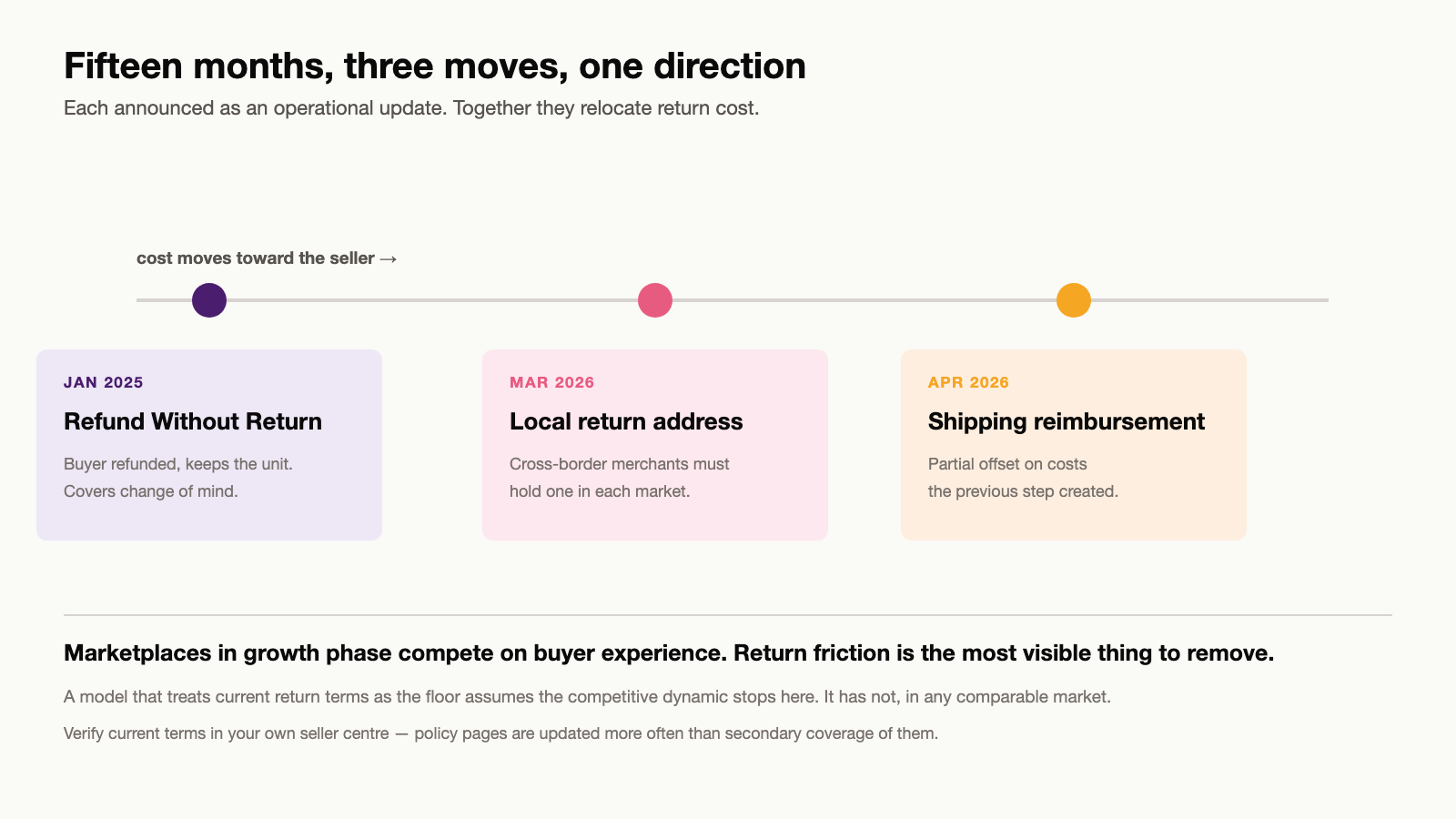
Three moves over fifteen months. Read separately they look like housekeeping; read together they describe a platform pushing return cost onto sellers and then partially subsidising it back.
January 2025 introduced Refund Without Return across the region. March 2026 requires cross-border merchants to hold local return addresses. April 2026 brings a shipping fee reimbursement programme.
Each was announced as an operational update. Together they describe a coherent direction: the platform is moving return handling closer to the buyer, which improves buyer experience and conversion, and the cost of doing that lands on the seller — with a partial rebate arriving one month later to soften the transition.
The strategic read for a brand is that this direction will continue. Marketplaces in growth phase compete on buyer experience, and return friction is the most visible thing to remove. Any model that assumes current return terms are the floor is assuming the competitive dynamic stops here, which it has not done in any comparable market.
One order, worked through
Take a 30 dollar item sold cross-border into Vietnam, landed cost 12 dollars, outbound shipping 4 dollars, sold through an affiliate at 20 percent.
The order that sticks
Revenue 30. Platform take at 18.5 percent removes 5.55. Affiliate commission removes 6. Landed cost 12 and shipping 4 leave you at 2.45 before local operations, advertising or the return address you now maintain. Thin, but positive.
The order that gets refunded without return
Revenue 30 comes back out. The 12 of landed cost is gone with the unit. The 4 of shipping is spent. Platform and affiliate fees on a refunded order are generally reversed, which helps, but you are down roughly 16 dollars and holding nothing.
One refund erases the margin from roughly six and a half successful orders. At a 5 percent return rate the category still works. At 15 percent — ordinary for fashion sizing — it does not, and no amount of operational excellence closes a gap that arithmetic wide.
This is why category selection outranks almost every other decision when entering cross-border. The margin structure is thin enough that return rate, not conversion rate, decides whether the programme is viable. Brands habitually optimise the second and inherit the first.
What differs by market
Return windows and category carve-outs are set per market and per category, and the published figures should be verified in your own seller centre rather than taken from any secondary source, this one included.
The Philippines runs a 15-day window from delivery for most purchases, with variation by category and by seller — some extend it during sale events, some shorten it for perishables and fast-moving goods. Other markets in the region operate on comparable but not identical terms.
The number that actually matters is not the window length. It is your return rate in that category in that market, and you cannot know it before you sell. Which is an argument for entering with a small, deliberately chosen assortment rather than a full catalogue: you are buying information about return behaviour, and a narrow test buys it cheaply.
Creator content is a return-rate variable, and nobody treats it as one
On a marketplace where discovery is search, the buyer arrives having decided what they want. On TikTok Shop the buyer arrives having watched forty seconds of someone else enjoying it, which is a different mental state and produces a different return profile.
Impulse purchases return at higher rates than considered ones. That is not a TikTok-specific finding; it is what impulse means. The platform-specific part is that the content driving the impulse is made by someone who does not carry the return cost.
A creator is compensated on sales, not on sales that stick. Every incentive points toward the most persuasive possible framing, and the gap between that framing and the product in the buyer's hand is exactly where Refund Without Return gets triggered — including under change of mind, where no one did anything wrong.
This is manageable and almost never managed. The brief given to creators is normally about tone and mandatory claims. It rarely specifies the things that prevent returns: showing the product at true scale, stating fit honestly, demonstrating the failure case as well as the success case.
Brands that track return rate by creator find the spread is wide, and that the highest-converting creator is frequently not the most profitable one once returns are netted off. That analysis takes one spreadsheet and almost nobody runs it, because attribution stops at the sale and the dashboard was built by someone measuring revenue.
How returns interact with the ratings that end shops
Returns are not only a cost line. Seller Fault Cancellation Rate carries a threshold around 2.5 percent under the 2026 service levels, and cancellations attributed to the seller feed the Account Health Rating that replaced Violation Points in July 2026.
The trap is that both are ratios. A shop doing twelve orders a day breaches a 2.5 percent threshold on roughly one bad order per fortnight, which is well inside normal variance. The same absolute number of incidents at two hundred orders a day is invisible.
"Low volume does not protect you from performance thresholds. It exposes you to them, because the denominator is too small to absorb an ordinary bad week."
The implication runs against instinct: during the ramp, when volume is lowest, return and cancellation discipline matters most. That is also when a brand is most tempted to accept marginal orders to build the numbers.
What to do about it
Model returns as unrecoverable in cross-border, not as a percentage of margin. Assume the unit does not come back, because under Refund Without Return it frequently will not.
Price the local return address into the cross-border case from the start. It is now a fixed in-market cost, and pretending otherwise makes cross-border look cheaper than local selling by an amount that no longer exists.
Enter with a narrow assortment. You are buying information about return behaviour in an unfamiliar market, and a wide catalogue buys the same information at several times the price.
Staff the two-business-day decision window in local hours. A queue reviewed once a week auto-approves by default and hands the outcome to the platform.
Choose the launch category for return behaviour, not only for margin. A high-margin product with a 30 percent return rate is worse than a moderate-margin product at 5 percent, and the gap widens when nothing comes back.
Frequently asked questions
What is Refund Without Return on TikTok Shop?
A policy live across Southeast Asia since January 2025 under which a buyer is refunded and keeps the product. It applies to quality issues, mismatches with the description and change of mind, which means it is not limited to cases where the seller did something wrong.
Do cross-border sellers need a local return address in Southeast Asia?
From early March 2026, yes. TikTok Shop requires merchants selling cross-border into Southeast Asian markets to establish local return addresses, which removes the assumption that cross-border carries no fixed in-market cost.
How long does a seller have to approve a return?
Around two business days in Southeast Asia to approve or reject a request. That window is short enough that a team operating in another timezone will default to auto-approval unless the queue is staffed in local hours.
What is the TikTok Shop return window in the Philippines?
Generally 15 days from delivery for most purchases, varying by category and seller. Some sellers extend it during sale events and shorten it for perishables. Confirm the current terms for your category in the seller centre rather than relying on secondary sources.
Do returns affect my Account Health Rating?
Cancellations attributed to the seller do, through a Seller Fault Cancellation Rate threshold around 2.5 percent. Because it is a ratio, a low-volume shop breaches it on far fewer absolute incidents than a high-volume one — the ramp is when this matters most.
The summary judgement
Two changes, both easy to miss because they arrive as policy notices rather than as pricing decisions. Together they mean a refunded cross-border order now costs the full landed value with no recovery, and that cross-border selling carries a fixed in-market cost it did not carry a year ago.
"Neither change makes Southeast Asia a worse market. Both make the cheap version of entering it more expensive than the spreadsheet from last year says."
AI Foundation Models — how DeepSeek and Qwen crossed a billion downloads while Western boards were counting Mag7 capex, and which layers of the AI stack the rotation has not reached. No excerpt tricks: it is the full chapter.
You will also get the weekly newsletter. Unsubscribe any time — the link is in every email.
The Book · $99
China Market Entry Playbook 2026
456 pages across 22 industry chapters — AI, semiconductors, EVs, payments, logistics, beauty, F&B, healthcare, pets, toys. Every chapter runs the same five questions: the anchor number, the rotation underneath it, which layers of the global stack it has reached, and what to do about it. English and Simplified Chinese editions included.
Ex-Transsion Global Digital Marketing Director · Effie Awards Greater China jury member · Guest lecturer, Peking University School of Economics · Writes Annie Chan Talk, your insider lens on China.