Shopee, TikTok Shop, Lazada: You Are Not Choosing an Audience, Because They Overlap
In Thailand, platform penetration runs 75, 67 and 51 percent. Those add to well over one hundred, which means the same shoppers are on all three. The platform decision is not about who you reach — it is about which demand mechanic your product can survive.
Annie Chan··13 min read
The platform question arrives in every Southeast Asian entry deck in the same shape. Shopee has the largest user base, Lazada has brand trust through LazMall, TikTok Shop has the growth. Pick one, or sequence them, and the deck moves on.
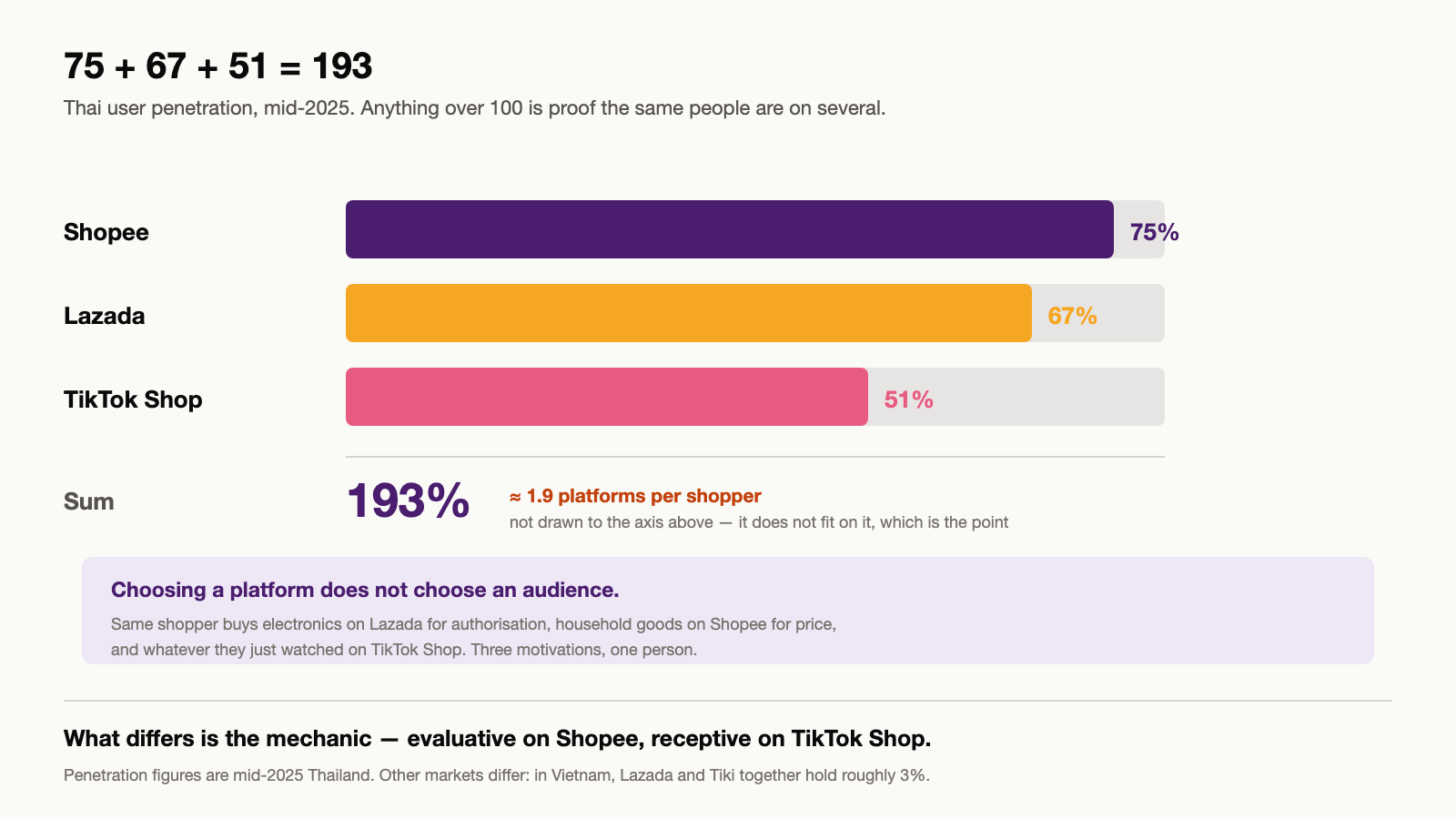
The framing assumes the three platforms hold different audiences. In mid-2025 Thailand, user penetration was roughly 75 percent for Shopee, 67 percent for Lazada and 51 percent for TikTok Shop. Those figures sum to 193.
The same Thai shoppers are on all three. Choosing a platform does not choose an audience, because there is one audience and it is already everywhere. What differs is the mechanic by which a person arrives at your product — and that determines which of your products can be sold at all.
What the market structure actually looks like
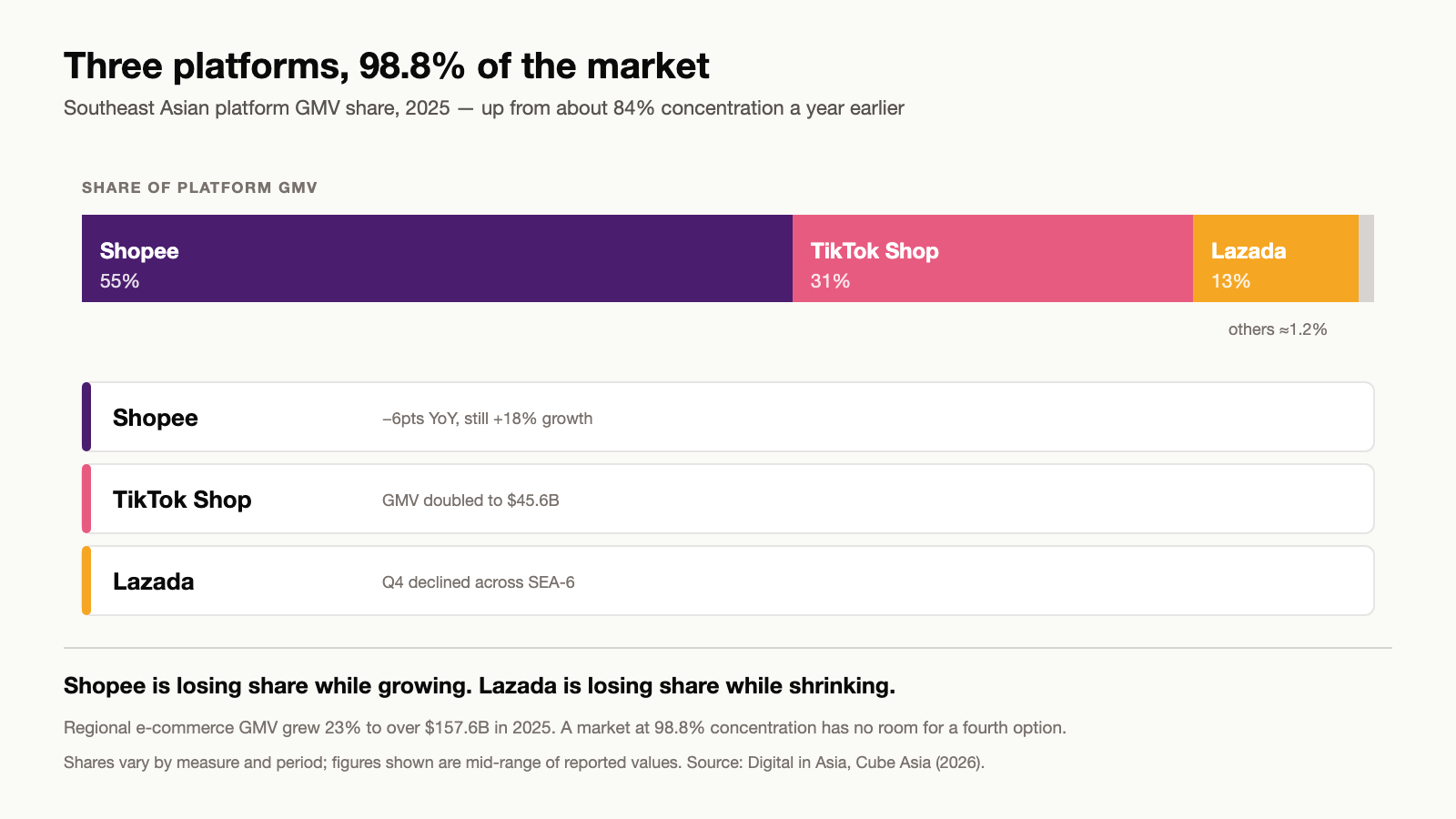
Three platforms now take 98.8% of regional platform GMV, up from 84% a year earlier. The interesting number is not the leader's share — it is how fast the third place is emptying.
Southeast Asian e-commerce GMV grew 23 percent to over 157.6 billion dollars in 2025. Within that, Shopee, TikTok Shop including Tokopedia, and Lazada together took 98.8 percent of platform GMV, up from about 84 percent a year earlier (Digital in Asia, 2026).
That consolidation figure matters more than the individual shares. A market where three platforms hold 84 percent has room for a fourth option and for specialist niches. A market at 98.8 percent does not. Whatever channel strategy you write, it is a strategy about these three.
Within the three: Shopee holds roughly 53 to 59 percent depending on the measure and period, growing around 18 percent year on year but with share sliding from about 61 percent a year earlier. TikTok Shop sits near 31 percent with GMV that doubled to 45.6 billion. Lazada is around 15 percent, and its Q4 declined across the SEA-6 during a period when both competitors grew.
"Shopee is losing share while growing. Lazada is losing share while shrinking. Those are different situations and only one of them is a strategy problem for you."
The Lazada question, stated plainly
Most comparison content treats the three as peers. In several markets that is no longer accurate, and pretending otherwise wastes a launch slot.
In Vietnam, Shopee holds more than 56 percent and TikTok Shop has expanded past 41 percent. Lazada and Tiki combined have fallen to roughly 3 percent. That is not a smaller third option; it is a rounding error, and a Vietnamese launch that allocates resource to Lazada is allocating it to almost nothing.
Thailand is different — Lazada penetration at 67 percent is genuinely high, and LazMall carries real brand-authorisation weight in categories where counterfeit risk shapes purchase behaviour. The lesson is not that Lazada is finished. It is that its position varies enough by market that a regional platform strategy is incoherent by construction.
There is no regional platform decision. There is a Vietnamese platform decision, a Thai one and an Indonesian one, and in at least one of them the answer is a two-horse race that most decks still draw as three.
What you are actually choosing between
If the audiences overlap, the differentiator is the demand mechanic — how a person comes to be looking at your product in the first place.
Shopee and Lazada: the buyer already decided
A shopper opens Shopee with an intention. They search, they compare, they filter by price and rating. Your listing competes against every similar listing on specification and cost, and the buyer's mental state is evaluative.
That rewards products that win a comparison: better specification at the price, better reviews, clearer differentiation on a measurable attribute. It punishes products whose value is hard to see in a grid — anything where the appeal is experiential, or where the buyer needs to be told why they want it.
TikTok Shop: the buyer had not thought about it
Nobody opens TikTok to buy your product. They arrive at it mid-scroll, in an entertainment context, through content someone else made. The mental state is receptive rather than evaluative, and the purchase is closer to impulse than to comparison.
That inverts what works. Products that demonstrate well in fifteen seconds succeed regardless of whether they would survive a spec comparison. Products whose advantage is legible only through specification struggle, because nobody is reading specifications.
"The question is not which platform has your customer. It is whether your product can be understood by someone who was not looking for it. If the answer is no, TikTok Shop is a hard channel regardless of its growth rate."
The overlap, in one number
Three penetration figures that sum to 193%. Any number above 100 is proof of overlap, and this one is nearly double.
Mid-2025 Thai penetration: Shopee 75 percent, Lazada 67 percent, TikTok Shop 51 percent. A market cannot have 193 percent of its shoppers unless most of them are counted more than once.
This is worth sitting with, because it dismantles the most common way the platform decision gets made. If you are choosing Shopee to reach Shopee shoppers, you have chosen nothing — three quarters of the market is on Shopee, two thirds is on Lazada, and half is on TikTok Shop, and they are substantially the same people.
What the overlap does not tell you is where those shoppers buy which categories. A Thai consumer might buy electronics on Lazada for the authorisation guarantee, household goods on Shopee for price, and whatever they saw in a video on TikTok Shop. Same person, three platforms, three different purchase motivations — which is exactly why the mechanic matters more than the reach.
How the three sit in each major market
Vietnam — effectively a duopoly
Shopee above 56 percent, TikTok Shop past 41 percent, Lazada and Tiki together near 3 percent. Two platforms hold 97 percent of the market between them. Vietnam is also the highest-take TikTok Shop market in the region at roughly 18.5 percent all-in, so the platform strength and the margin cost point in opposite directions.
Thailand — the most genuinely three-way
The penetration figures above, with LazMall carrying real weight in categories where authenticity matters. Thailand is the market where a three-platform comparison is still an honest exercise rather than a legacy habit.
Indonesia — the largest, and structurally different
TikTok Shop operates alongside Tokopedia following their combination, which makes the competitive picture different in kind from the other markets rather than just different in degree. It is also the largest market in the region, which means everyone has already arrived.
A regional platform strategy has to be wrong in at least one of these markets, because the correct answer differs between them. Writing one anyway is how a plan gets approved regionally and fails locally.
The headroom argument, and its limit
As of early 2026, TikTok Shop is described as the only one of the three with single-digit penetration headroom across major Southeast Asian markets — reaching buyers who have not adopted traditional e-commerce at all.
That is a genuine structural advantage and it is the strongest argument for the platform. It is also frequently over-read. Headroom describes the platform's growth, not yours. A brand entering a category that is already saturated on TikTok Shop inherits the competition, not the headroom, and the growth accrues to whoever is already ranking.
The useful version of the headroom argument is narrower: in categories where the platform's buyer base is genuinely new to e-commerce, first-mover positioning is available in a way it is not on Shopee, where every category has been contested for a decade.
Fee structure has stopped being a differentiator
The historical argument for TikTok Shop was that it was cheaper. In 2026 that has largely closed.
Shopee added a 5 percent technical support fee in February 2026 across Singapore, Malaysia, Thailand and Vietnam, on top of commission around 2 to 6 percent and a transaction fee near 2.18 percent, putting its all-in take roughly between 12 and 22 percent. Lazada sits at 4 to 6 percent commission with transaction and processing adding around ten points. TikTok Shop ranges from about 6.3 percent in Singapore to 18.5 percent in Vietnam.
All three now land in the low-to-high teens once everything stacks. If a proposal recommends a platform primarily on take rate, it is optimising a variable that no longer separates them — and it is probably comparing headline commission rather than all-in take, which separates them even less.
Why multi-platform costs more than twice as much
The assumption behind launching on two platforms at once is that the assets transfer. They do not, and the reason is the mechanic.
A Shopee listing needs comparison-grade assets: specification detail, dimensional photography, review volume, competitive pricing displayed against a grid of alternatives. A TikTok Shop presence needs continuous demonstrative video produced by creators who have to be recruited, briefed, seeded and paid. Neither set substitutes for the other, and the second one never finishes because content decays.
Two platforms is not two listings. It is two production pipelines with different skills, different vendors and different cadences. A budget that funds one properly will fund neither adequately when split. The visible symptom is a thin presence on both that under-converts, and the usual conclusion drawn from it is that the market rejected the product rather than that the budget was halved.
How to actually decide
Decide per market, not regionally. Lazada is a serious option in Thailand and a rounding error in Vietnam, and no single regional answer survives that spread.
Test whether your product demonstrates. Film fifteen seconds of it doing the thing it does. If the appeal is obvious without narration, TikTok Shop is viable. If it needs a specification table, start on Shopee.
Check category saturation before believing the headroom argument. Platform growth and category opportunity are different variables, and only the second one is yours.
Run one platform properly before adding a second. Multi-platform from launch splits a small content budget across two different content requirements and usually produces two underfunded presences.
If counterfeit risk shapes your category, weight LazMall's authorisation position more heavily than share figures suggest. Brand trust is worth more in some categories than reach is.
Frequently asked questions
Which is bigger in Southeast Asia, Shopee or TikTok Shop?
Shopee, by a substantial margin — roughly 53 to 59 percent of platform GMV depending on measure, against about 31 percent for TikTok Shop. But Shopee's share is falling from around 61 percent a year earlier while TikTok Shop's GMV doubled to 45.6 billion dollars.
Is Lazada still worth selling on?
It depends entirely on the market. Thai penetration is around 67 percent and LazMall carries genuine brand-authorisation weight. In Vietnam, Lazada and Tiki combined have fallen to roughly 3 percent, where the answer is effectively no.
Which platform is cheapest for sellers?
None meaningfully, in 2026. All three land in the low-to-high teens once commission, transaction fees, service fees and tax stack. Shopee added a 5 percent technical support fee in February 2026 across four markets, which closed most of the remaining gap.
Can I sell on all three at once?
Technically yes, practically it is usually a mistake at launch. The content requirements differ — comparison-grade listings versus demonstrative video — and a budget split across both typically funds neither adequately.
Do Shopee and TikTok Shop reach different customers?
Largely the same ones. Thai penetration of roughly 75, 67 and 51 percent across the three platforms sums to 193, which is only possible if shoppers use several. What differs is the mental state they arrive in — evaluative on Shopee, receptive on TikTok Shop.
The summary judgement
Platform comparison content is organised around audience because audience is easy to describe and easy to put on a slide. In a region where the same shoppers hold accounts on all three, that organising principle produces a decision made on the wrong variable.
"Choose the mechanic your product survives, in the specific market you are entering. The audience question answers itself, because the answer is everyone."
AI Foundation Models — how DeepSeek and Qwen crossed a billion downloads while Western boards were counting Mag7 capex, and which layers of the AI stack the rotation has not reached. No excerpt tricks: it is the full chapter.
You will also get the weekly newsletter. Unsubscribe any time — the link is in every email.
The Book · $99
China Market Entry Playbook 2026
456 pages across 22 industry chapters — AI, semiconductors, EVs, payments, logistics, beauty, F&B, healthcare, pets, toys. Every chapter runs the same five questions: the anchor number, the rotation underneath it, which layers of the global stack it has reached, and what to do about it. English and Simplified Chinese editions included.
Ex-Transsion Global Digital Marketing Director · Effie Awards Greater China jury member · Guest lecturer, Peking University School of Economics · Writes Annie Chan Talk, your insider lens on China.