TikTok Live Selling in Southeast Asia: The Conversion Rate Is Real and It Is the Wrong Number to Plan With
Live converts at roughly 7.8 per cent against 2.1 per cent for feed ads, which is why brands try it, and hours are the unit it actually consumes, which is why most of them stop within a quarter. The rate is free to admire. The hours are not.
Annie Chan··12 min read
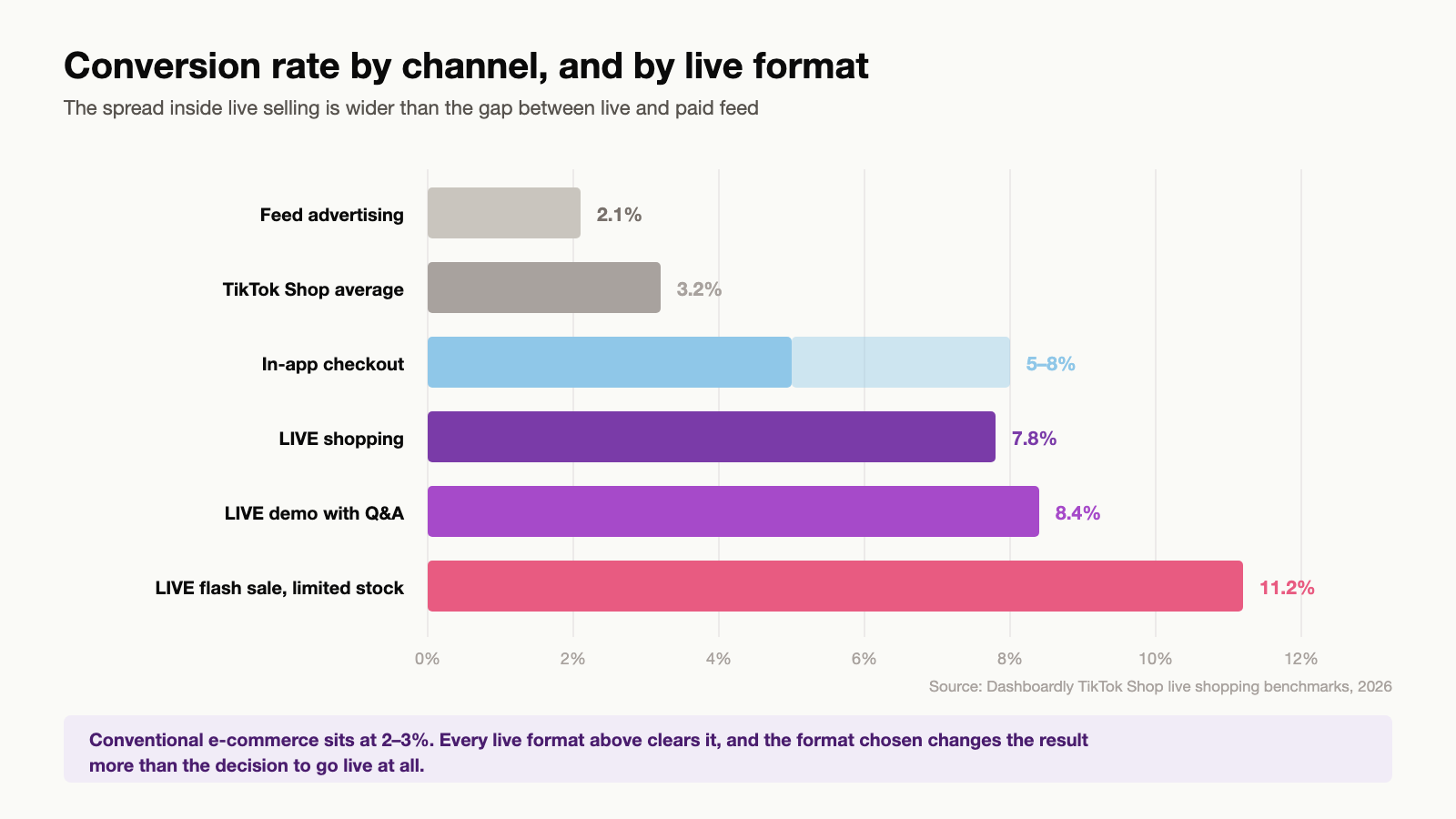
The case for live selling is usually made with one statistic, and it is a good one. TikTok LIVE shopping converts at roughly 7.8 per cent, against about 2.1 per cent for feed ads and 2 to 3 per cent for a conventional e-commerce site. Nearly four times the paid social benchmark. Every brand that sees that number tries live selling, and most of them have stopped within a quarter.
The number is not wrong. It is simply denominated in the wrong unit for planning. Conversion rate is a ratio, and ratios are free. What live selling actually consumes is hours, and hours are the most expensive input a commerce team has.
Sellers who make live work in Southeast Asia run 15 to 25 hours a week, and the usual path to a middle-tier result is five or more streams a week sustained for four to six months. That is not a campaign. It is a shift pattern, and it needs a host, an assistant and an operator behind it.
Why the region rewards this more than any other
Southeast Asia now accounts for about 71 per cent of TikTok Shop's global GMV, on roughly 45.6 billion US dollars of regional volume in 2025, and video commerce takes around 20 per cent of all Southeast Asian e-commerce GMV. Momentum Works puts the region's content commerce on track for 77.9 billion dollars in 2026.
Those figures get quoted as a reason to enter. They are more useful read as a description of consumer habit. In Indonesia and Thailand, viewers sit through hours-long sessions hunting for deals. Live is not a launch tactic in those markets, it is a shopping channel with an audience that arrives expecting one. A Western brand running a polished forty-minute brand film as a live stream has misunderstood what the audience showed up for.
Format matters more than channel. A flash sale with visible scarcity converts at better than five times feed advertising, and a brand film does not.
Look at the spread inside live itself. Product demonstrations with live questions and answers run around 8.4 per cent. Flash sales with limited stock run about 11.2 per cent. The gap between a good live format and a weak one is larger than the gap between live and feed advertising, which tells you where the effort belongs.
GMV per streaming hour is the number that runs the business
Revenue per stream in this channel ranges from roughly 800 US dollars for a small seller to 48,000 for the largest operators. That is a sixty-fold spread on the same platform, the same conversion mechanics and frequently the same product categories. Conversion rate does not explain it. Audience size and cadence do.
A 7.8 per cent conversion rate against forty concurrent viewers is three orders. The rate is excellent and the business is not. So the planning metric is GMV per streaming hour, because that is the only figure that prices the input you are actually spending. Work it out before you commit: if a stream needs three people for four hours including setup and teardown, and it produces 600 dollars of GMV at a 40 per cent contribution margin, the channel is losing money and the conversion rate is still 7.8 per cent.
This is also where live collides with working capital, because live drives volume into exactly the same settlement queue as everything else. Streaming harder does not accelerate payment, it enlarges the gap between money out and money in, which is worked through in when TikTok Shop actually pays you.
The 30 to 60 minute curve, and why copying it blindly hurts
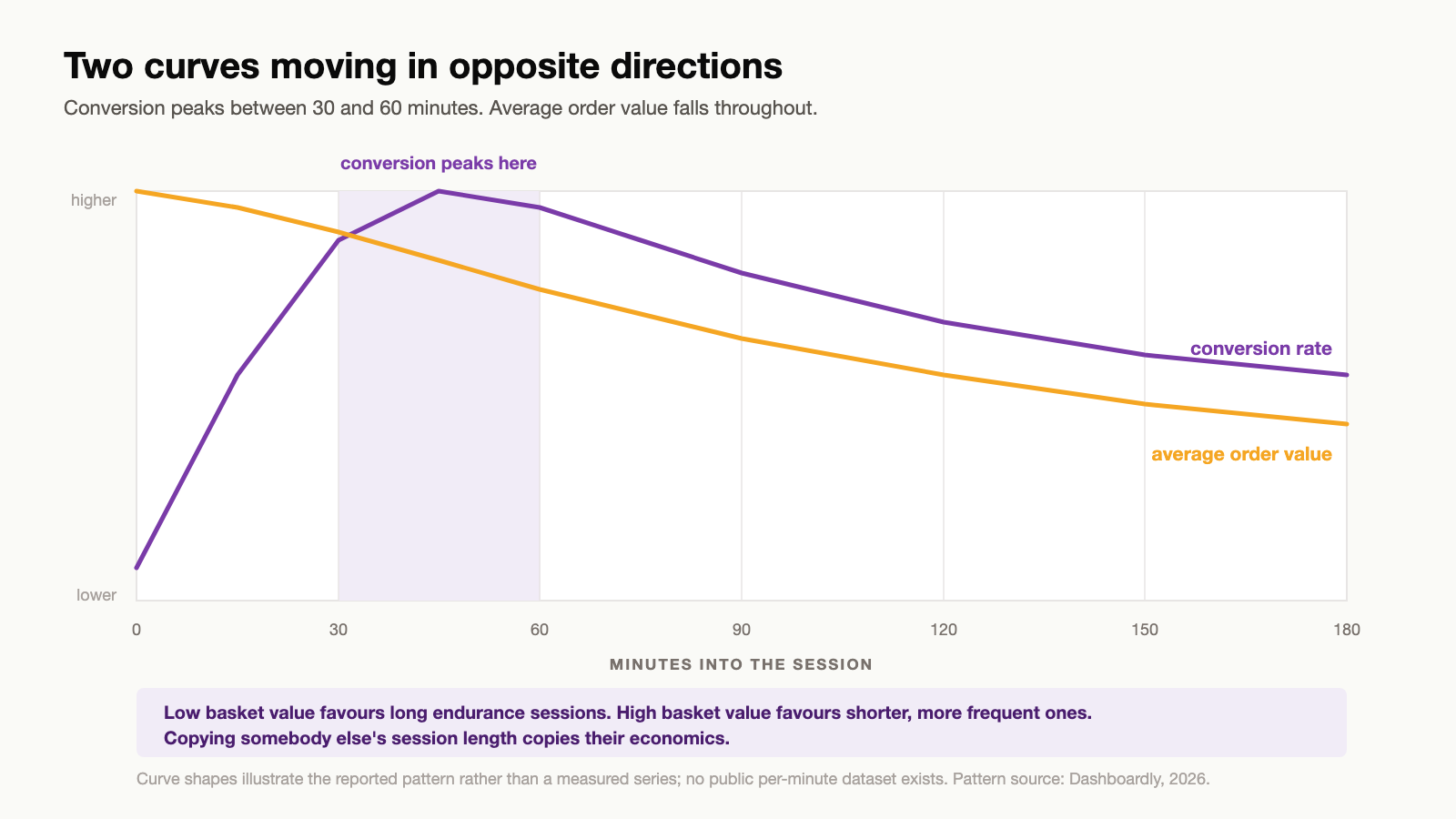
Conversion on a live session tends to peak somewhere around the thirty to sixty minute mark, as viewers who have stayed build enough trust to buy. Average order value moves the other way. Later buyers tend to be impulse-stacking smaller items, so the basket shrinks as the session lengthens.
Two curves moving in opposite directions. Where you stop the session should depend on which one carries your economics.
Most operators read the first half of that finding and ignore the second. They extend sessions to reach the conversion peak and then keep going, because the conversion number keeps looking healthy. For a low-priced impulse catalogue that is correct behaviour. For a brand selling a single higher-value item it is close to backwards, because the buyers arriving in hour three are not the buyers who justify the stream.
The practical rule is that session length should follow basket economics, not the published curve. High average order value favours shorter, tighter, more frequent sessions. Low average order value favours long-form endurance streaming of the kind Indonesian and Thai sellers already run extremely well. Choosing the wrong one costs you the channel while every dashboard says the channel is working.
The labour market is already organised, and you are not in it
There are more than 21,000 creator networks worldwide supporting somewhere near 4.7 million TikTok LIVE creators. Southeast Asia holds roughly a quarter of those networks and about a third of network-affiliated creators globally. This is an industry with agencies, training, shift rosters and talent contracts, and it existed before your brand arrived.
The creators driving the most GMV in the region are increasingly Key Opinion Sellers rather than Key Opinion Leaders. A KOS is a commerce-first performer whose entire output points at immediate conversion. They are not brand ambassadors and they should not be briefed as though they were. Hiring an aspirational lifestyle creator to run a selling stream is a common and expensive category error, and it is a different skill from the one that makes a feed video travel.
So the honest decision is build or buy. Buying means going through a network, accepting their rates and their roster, and getting hours immediately. Building means hiring hosts in-market, which is a headcount decision with a payroll attached rather than a marketing budget line. Both are defensible. What does not work is the middle path most brands try first, where an existing marketing employee streams twice a week between other duties. Against sellers running twenty-five hours weekly, that is not a smaller version of the same strategy. It is a different and losing one. The broader creator economics, including how affiliate commission interacts with all of this, sit in running a TikTok Shop affiliate programme in Southeast Asia.
What compliance looks like when it is live
Everything said on a live stream is a product claim, made in real time, by a person who is being paid on commission and is under pressure to close. Pre-approved scripts do not survive contact with an hour of improvisation, and in Thailand the regulator enforces against the holder of the product registration rather than against the platform or the creator.
This is the single largest unpriced risk in live selling for regulated categories, and it grows with exactly the thing you are trying to grow. More hours means more claims. Brands in beauty and supplements need a written approved-claims list, a banned-words list, and somebody actually watching the stream, because the alternative is discovering the problem when the listing comes down. The market-by-market version of that constraint is set out in TikTok Shop restricted categories in Southeast Asia.
A first ninety days that does not waste the budget
Pick one market, not the region. Live is operationally local, the host speaks one language, and the audience habits differ enough that a shared plan helps nobody. Market choice framework applies here more than anywhere.
Decide build or buy in week one and commit. The middle path consumes a quarter and produces no readable data.
Set the target as GMV per streaming hour, with a break-even figure written down before the first stream. Conversion rate goes on the dashboard as a diagnostic, not as the goal.
Run five sessions a week minimum. Below that, the algorithm does not learn your stream and your audience never forms a habit, so the test is not really a test.
Test format before you test product. Flash sale with visible stock limits against demonstration with questions and answers, same catalogue, same slot, four weeks.
Match session length to basket size rather than to the published conversion curve, and re-check it once you have your own data.
Write the approved claims list before the first stream, and have a second person watching live with the authority to cut.
Give it four to six months before judging the channel. The people you are competing with have been doing it for years.
"A 7.8 per cent conversion rate on a stream nobody watches is a very good ratio and no business at all. Hours are the input, audience is the multiplier, and the rate is merely what happens in between."
FAQ
What is a good conversion rate for TikTok live shopping?
Live shopping on TikTok converts at roughly 7.8 per cent on average, with a typical working range of 5 to 12 per cent. For comparison, feed advertising runs near 2.1 per cent, the average TikTok Shop conversion rate overall is about 3.2 per cent, and conventional e-commerce sits at 2 to 3 per cent. Format drives most of the variation within live: demonstrations with live questions and answers run around 8.4 per cent, and flash sales with limited stock around 11.2 per cent.
How many hours a week do you need to stream to make it work?
Sellers who succeed with live in Southeast Asia generally run 15 to 25 hours a week, and reaching a middle-tier result usually takes five or more streams a week sustained over four to six months. Consistency matters more than variety of product. This is the reason live is better understood as a staffing decision than a marketing campaign, because it needs a host, support and an operator on a repeating schedule.
How long should a live selling session be?
It depends on your average order value rather than on a universal number. Conversion tends to peak between thirty and sixty minutes as viewer trust builds, while average order value declines later in a session because remaining buyers add smaller impulse items. A low-priced catalogue benefits from long endurance sessions. A higher-value catalogue usually does better with shorter, more frequent streams, because the late-session buyer does not carry the economics.
Should a brand use a creator network or hire its own hosts?
Either can work, and the failing option is doing neither properly. A network gives immediate access to trained hosts and existing shift capacity at the cost of margin and control. Hiring in-market gives control and a compounding asset at the cost of payroll and management attention. Southeast Asia holds around a quarter of the world's creator networks and about a third of network-affiliated live creators, so the buy option is genuinely available here in a way it is not in most markets.
What is the difference between a KOS and a KOL for live selling?
A Key Opinion Leader builds audience and brand affinity, while a Key Opinion Seller is a commerce-first performer whose output is built entirely around immediate conversion. Key Opinion Sellers are increasingly the largest GMV drivers on TikTok Shop in Southeast Asia. The two require different briefs, different pay structures and different success measures, and using a KOL for a selling stream is one of the more expensive mistakes available.
The short version
Live selling deserves the attention it gets, and the conversion statistic that attracts brands to it is accurate. It is also the wrong number to build a plan on, because it prices nothing. Budget the hours first, decide build or buy before you start, measure GMV per streaming hour against a break-even you wrote down in advance, and match session length to your basket rather than to somebody else's curve. Then give it two quarters, because the operators you are competing against in Jakarta and Bangkok have been running this as a full-time job for years, and they are very good at it. Which market to attempt this in first is its own question, worked through in choosing a Southeast Asian market to open first.
Sources: live shopping conversion and revenue benchmarks via Dashboardly; regional content commerce and GMV figures from Momentum Works, reported by TNGlobal.
Share:
Free · 24 pages
Read Chapter 1 of the Playbook
AI Foundation Models — how DeepSeek and Qwen crossed a billion downloads while Western boards were counting Mag7 capex, and which layers of the AI stack the rotation has not reached. No excerpt tricks: it is the full chapter.
You will also get the weekly newsletter. Unsubscribe any time — the link is in every email.
The Book · $99
China Market Entry Playbook 2026
456 pages across 22 industry chapters — AI, semiconductors, EVs, payments, logistics, beauty, F&B, healthcare, pets, toys. Every chapter runs the same five questions: the anchor number, the rotation underneath it, which layers of the global stack it has reached, and what to do about it. English and Simplified Chinese editions included.
Ex-Transsion Global Digital Marketing Director · Effie Awards Greater China jury member · Guest lecturer, Peking University School of Economics · Writes Annie Chan Talk, your insider lens on China.