Cross-Border or Local Warehouse: Southeast Asia Quietly Removed the Reason to Choose Cross-Border
The standard advice is to test a market with cross-border shipping and localise the winners. That advice was written for a tax regime that no longer exists. Thailand removed its de minimis exemption on 1 January 2026, Vietnam removed its in February 2025, and Indonesia's has been three US dollars for years.
Annie Chan··12 min read
Almost every guide to entering Southeast Asia gives the same sequencing advice. Start cross-border, because it is cheap and needs no inventory commitment. Find out what sells. Move the winners into a local warehouse once the volume justifies it. Test small, then localise.
It is sensible advice and it is now several years out of date, because the thing that made cross-border cheap has been dismantled market by market while the guides kept being republished.
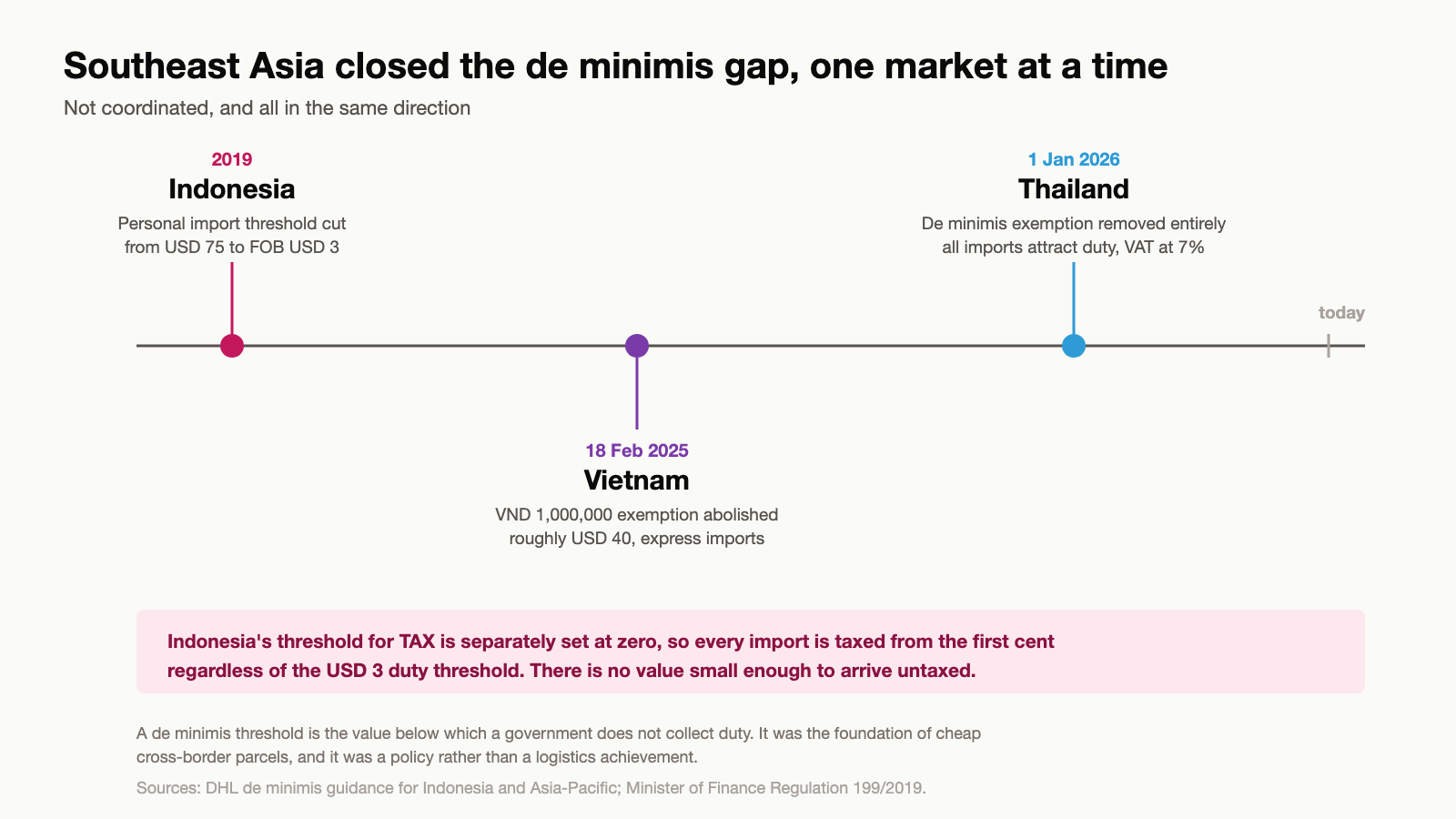
Thailand removed its de minimis exemption entirely on 1 January 2026, so all imports attract duty regardless of value. Vietnam abolished its VND 1,000,000 low-value exemption for express imports on 18 February 2025. Indonesia's de minimis has been FOB USD 3 since Minister of Finance Regulation 199/2019, and its threshold for tax is zero, meaning every import is taxed from the first cent.
What de minimis was actually paying for
A de minimis threshold is the value below which a government does not bother collecting duty. For a decade it was the quiet foundation of cross-border e-commerce, because it let a low-priced parcel cross a border as if no border existed. Sellers experienced this as cheap shipping. It was not cheap shipping. It was a tax exemption that happened to be attached to small parcels.
Indonesia moved first and hardest, cutting the personal import threshold from 75 US dollars to 3. Read that as the policy statement it was. At three dollars almost nothing qualifies, and because the tax threshold is separately set at zero, the exemption does not exist at all in practice. Vietnam followed in February 2025. Thailand closed the last significant gap on the first day of this year.
Three separate governments, three separate decisions, one direction. The cross-border cost advantage was a policy, and the policy was withdrawn.
This was not coordinated and it does not need to be. Every one of these governments watched the same thing happen: domestic sellers paying tax while imported parcels arrived beside them paying none. The correction was predictable and it is not going to be reversed.
The second force, which arrived from the opposite direction
While the tax advantage was disappearing, the platform was moving the goalposts on speed. During 2025 TikTok Shop extended next-day delivery across all six of its regional markets, and it did so by building a certified warehousing system rather than its own courier network, leaning primarily on J&T Express. The benchmark it was working against was T plus four. It is now considerably faster than that.
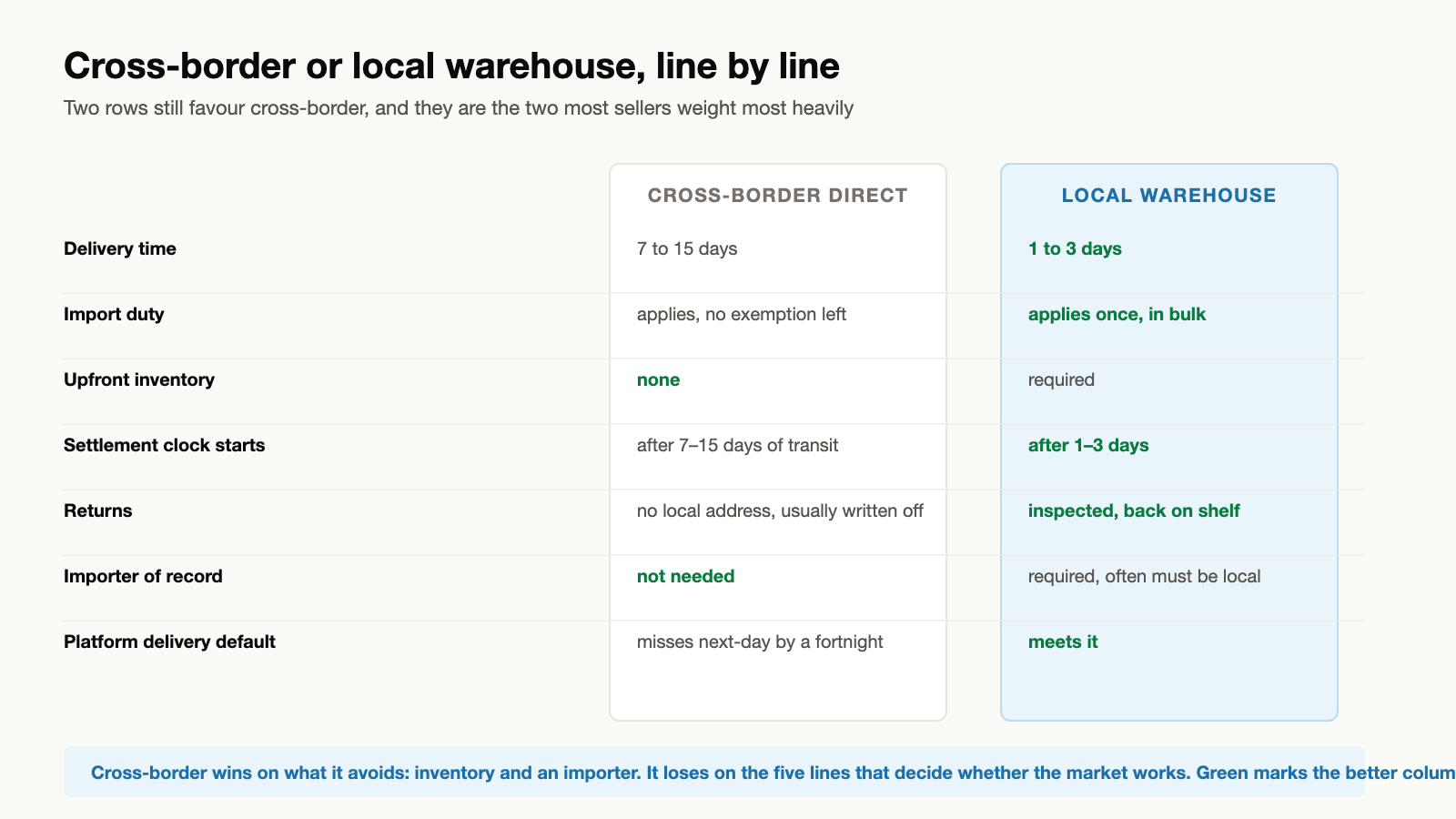
Cross-border direct shipping from China runs 7 to 15 days. Local warehouse fulfilment runs 1 to 3. When the platform sets the default customer expectation at next-day, a fortnight is not a slower version of the same service. It is a different and visibly worse product sitting next to it on the same page, and shoppers are choosing between them in the same scroll.
So the two forces hit from opposite sides. Tax policy removed the cost advantage. Platform logistics removed the tolerance for slowness. Neither of them cares that the other happened, and a seller feels the combination as a route that is no longer cheap and never was fast.
The third cost, which nobody puts in the model
There is a further penalty that does not appear on any freight quotation. Settlement on TikTok Shop starts counting from delivery, not from order. A parcel spending 12 days in transit is 12 days of your own money sitting inside somebody else's network before the payment clock even begins.
Put that next to a local warehouse delivering in two days and the difference is not the ten days of customer waiting. It is ten extra days of working capital, on every single order, permanently. For a business doing a hundred orders a day that is a standing loan you are making to the platform at zero per cent, and it scales precisely with your success. The full shape of that cycle is set out in when TikTok Shop actually pays you.
Cross-border wins on the two lines about what it avoids, and those are exactly the two a seller weights most heavily when starting out.
What cross-border is still genuinely good for
None of this makes the route worthless. It makes it a specific tool with a narrower job than it used to have.
Validating demand for a product you have never sold in that market, where being slow matters less than finding out at all. Accept that your conversion rate will read low and do not treat that reading as the product's verdict.
High-margin, low-weight goods where a duty line does not break the unit economics. The tax still applies; it simply matters less.
Markets where you cannot yet hold the local registrations, because an importer of record is a prerequisite for warehousing and you may not have one. That constraint is a legal one rather than a commercial one, and it is set out in TikTok Shop restricted categories in Southeast Asia.
Long-tail SKUs that will never justify shelf space in a local warehouse but should stay purchasable.
What it is no longer good for is the thing everybody uses it for, which is being the cheap way to run a market for the first year.
Returns are where the arithmetic turns actively hostile
Cross-border comparisons almost always model the outbound leg and stop there. Returns are what happens on the way back, and on a cross-border lane there frequently is no way back worth taking.
A single returned item sitting in Jakarta is not going to be shipped to a warehouse in Guangdong, because the freight costs more than the product is worth and the customs paperwork costs more than the freight. So the real options narrow to three: refund without requiring the return, arrange local disposal, or maintain a local return address, which is the one thing a pure cross-border operation does not have. Most sellers discover this on their first refund request rather than in the business case, and then absorb it as a cost of sale they never modelled.
A local warehouse changes the shape of this completely, because the item comes back to a place you control, gets inspected, and where saleable goes back onto the shelf. The difference between writing off a returned unit and reselling it is the entire margin on that unit, twice. Return rates and the mechanics behind them differ sharply by market, which is worked through in how returns actually work on TikTok Shop in Southeast Asia.
What a certified warehouse means if you do not want to own inventory
There is a middle option, and it is worth understanding precisely because TikTok Shop built it deliberately. Rather than constructing its own courier network, the platform certified a warehousing ecosystem and leaned primarily on J&T Express. A seller therefore does not choose between owning a warehouse and shipping from China. They choose a certified partner and place stock with it.
That lowers the capital requirement, and it introduces a dependency worth naming. Your delivery performance now belongs to a third party you selected, and the platform grades it as though it were entirely yours. Late dispatch, damaged goods and failed deliveries land on your account metrics regardless of whose hands the parcel was in. Given that those metrics gate capacity and settlement speed, the partner choice is an operational decision with consequences well beyond warehousing, as set out in probation and the Account Health Rating.
Rebuilding the sequencing advice
If cross-border is now a validation instrument rather than an operating model, the entry plan changes shape. The old plan was a gradual slope: start cheap, get proof, invest later. The real plan is a step, and the step happens earlier than anyone would like.
Model landed cost with duty and tax included from the first spreadsheet, for every market, before choosing which one to open. A route that looks viable at zero duty and fails at full duty was never viable, and you will find this out faster on paper than in a warehouse.
Run cross-border deliberately as a test, with a fixed end date and a decision attached to it. Eight to twelve weeks is usually enough to learn which SKUs have demand.
Read cross-border conversion as a floor rather than as a measurement. The same product in a local warehouse will convert better, so a SKU that works despite a fortnight of transit is a strong signal.
Budget the warehouse move as part of market entry rather than as a later upgrade, because the platform's delivery defaults mean you will need it sooner than the volume appears to justify.
Confirm who can act as importer of record before committing to a market, since local fulfilment is gated on it and in several of these markets it cannot be you.
Include the settlement-clock difference in the business case. The working capital released by faster delivery is real money and it is routinely left out of the comparison entirely.
"Cross-border shipping was never cheap. It was untaxed, which felt identical right up until the moment three governments noticed."
FAQ
Is there still a de minimis threshold for shipping into Southeast Asia?
Not in the largest markets. Thailand removed its exemption entirely on 1 January 2026, so all imports attract duty regardless of value. Vietnam abolished its VND 1,000,000 exemption for low-value express imports on 18 February 2025. Indonesia's threshold has been FOB USD 3 since 2019, and because its de minimis for tax is separately set at zero, every import is taxed no matter how small. Planning a landed cost on the assumption of a duty-free allowance will produce a number that is wrong in all three.
How much slower is cross-border shipping than a local warehouse?
Cross-border direct shipping from China typically takes 7 to 15 days, while local warehouse fulfilment runs 1 to 3 days. The gap matters more than the raw difference suggests, because TikTok Shop extended next-day delivery across all six of its Southeast Asian markets during 2025. Your delivery estimate is displayed beside sellers offering next-day, which turns a transit time into a competitive disadvantage at the point of purchase.
Does slow shipping affect when I get paid?
Yes, and this is the cost most often left out of the comparison. The settlement clock on TikTok Shop starts at delivery rather than at order, so every day in transit is a day before the payment countdown even begins. A twelve-day transit against a two-day local delivery means ten additional days of working capital tied up on every order, which compounds as volume grows rather than diminishing.
When should a seller move from cross-border to a local warehouse?
Earlier than volume alone would suggest. The traditional trigger was order volume justifying inventory risk, but with duty applying either way and platform delivery expectations set at next-day, the commercial case arrives before the volume case does. A practical approach is to treat cross-border as a fixed-length validation exercise of roughly eight to twelve weeks, with the warehouse decision already budgeted as part of entry rather than deferred as an upgrade.
Can any seller use a local warehouse in these markets?
Not automatically. Local fulfilment requires an importer of record, and in several Southeast Asian markets that entity must be locally established, which means a foreign brand without a local company or a willing distributor cannot simply rent warehouse space and begin. This is the same structural constraint that governs product registrations and seller accounts in the region, and it is worth resolving before committing to a market rather than after.
The short version
Cross-border direct shipping is no longer the cheap option. It is the slow option that also pays duty and gets paid last, and it kept its reputation for cheapness for several years after the policy that created that cheapness was withdrawn. Use it to find out what sells, with a date in the diary for stopping. Budget the local warehouse as part of entering the market rather than as a reward for succeeding in it. And build the landed cost with duty included from the very first model, because in Thailand, Vietnam and Indonesia there is no longer a threshold underneath which the sums quietly work.
Sources: regional de minimis thresholds and the Indonesian FOB USD 3 figure via DHL; TikTok Shop's certified warehousing rollout and regional next-day delivery reported in China Digital Retail Report.
Share:
Free · 24 pages
Read Chapter 1 of the Playbook
AI Foundation Models — how DeepSeek and Qwen crossed a billion downloads while Western boards were counting Mag7 capex, and which layers of the AI stack the rotation has not reached. No excerpt tricks: it is the full chapter.
You will also get the weekly newsletter. Unsubscribe any time — the link is in every email.
The Book · $99
China Market Entry Playbook 2026
456 pages across 22 industry chapters — AI, semiconductors, EVs, payments, logistics, beauty, F&B, healthcare, pets, toys. Every chapter runs the same five questions: the anchor number, the rotation underneath it, which layers of the global stack it has reached, and what to do about it. English and Simplified Chinese editions included.
Ex-Transsion Global Digital Marketing Director · Effie Awards Greater China jury member · Guest lecturer, Peking University School of Economics · Writes Annie Chan Talk, your insider lens on China.