Scaling a TikTok Shop: Almost Everything You Need Is Gated on Something You Do Not Have Yet
How many creators you may contact is rationed by your trailing 30-day GMV. Settlement speed is rationed by a performance score. The algorithm will not optimise until roughly 40 conversions have happened. The first phase is not growth, it is unlocking, and the order matters.
Annie Chan··12 min read
A shop opens, the first orders arrive, and the instinct is to push harder. Brief more creators, add more products, raise the budget. The thinking is that the channel responded, so more input should produce more output.
Then the pushing does not work, and it does not work in a way that feels arbitrary rather than commercial. The creator outreach runs out partway through the week. Campaigns spend without settling into anything. Payouts arrive slowly enough to constrain the reorder. Each of these has an explanation, and the explanations share a shape.
Creator outreach is rationed by a tiered quota based on your shop's trailing 30-day GMV, refreshing weekly on Sundays. A new shop with low GMV cannot brute-force its way to scale, because the input it needs most is issued in proportion to the output it does not have yet.
That is a bootstrap problem rather than an effort problem, and it is one of the least discussed constraints in this channel. No amount of willingness to work changes the quota. It is a number the platform issues on a Sunday.
The three gates, and what opens each one
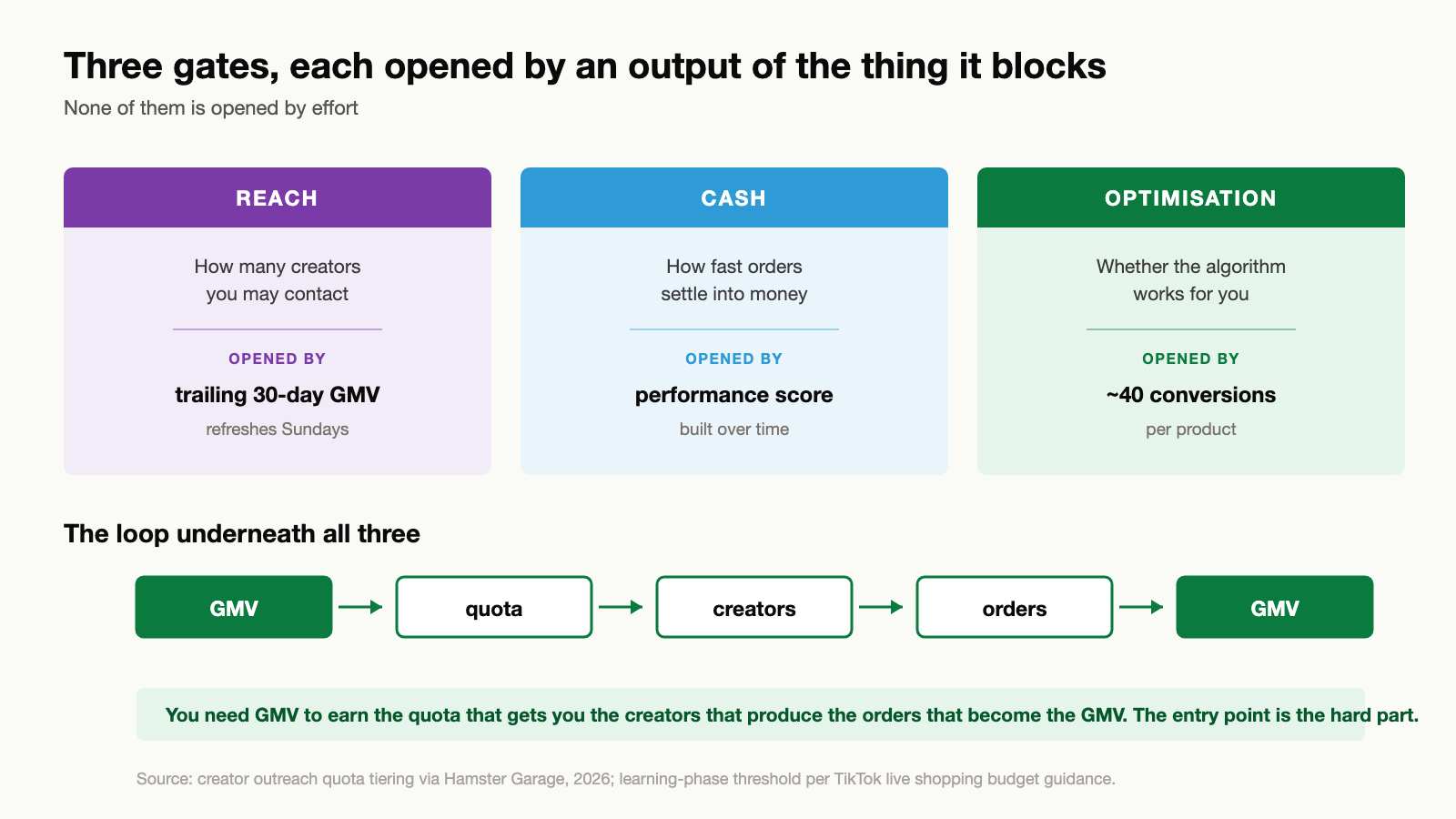
Each gate is opened by an output of the system it constrains. That is why the first months feel like pushing on something that pushes back.
The first gate is reach. How many creators you may approach is set by trailing GMV, so a shop doing very little may contact very few, which keeps it doing very little.
The second is cash. Settlement speed is tiered by performance score, and the fast tiers require a trading record a new shop has not had time to build. Around a fortnight between delivery and payout is normal early on, which means two to four weeks of working capital sitting between an order and the money for it. That constraint tightens exactly when you want to reorder, and its full shape is set out in when TikTok Shop actually pays you.
The third is the algorithm. Roughly 40 conversions are needed before a shop exits the learning phase and optimisation becomes useful. Below that threshold the system is guessing, your cost per acquisition is noisy, and the numbers you are reading are not yet describing anything stable.
Notice that all three are the same kind of constraint. Reach is gated on revenue. Cash speed is gated on record. Optimisation is gated on volume. None of them is gated on how much you want it.
Which is why concentration is arithmetic, not modesty
The standard advice to launch with one hero product rather than a catalogue usually gets explained in terms of focus and storytelling. There is a harder reason underneath it.
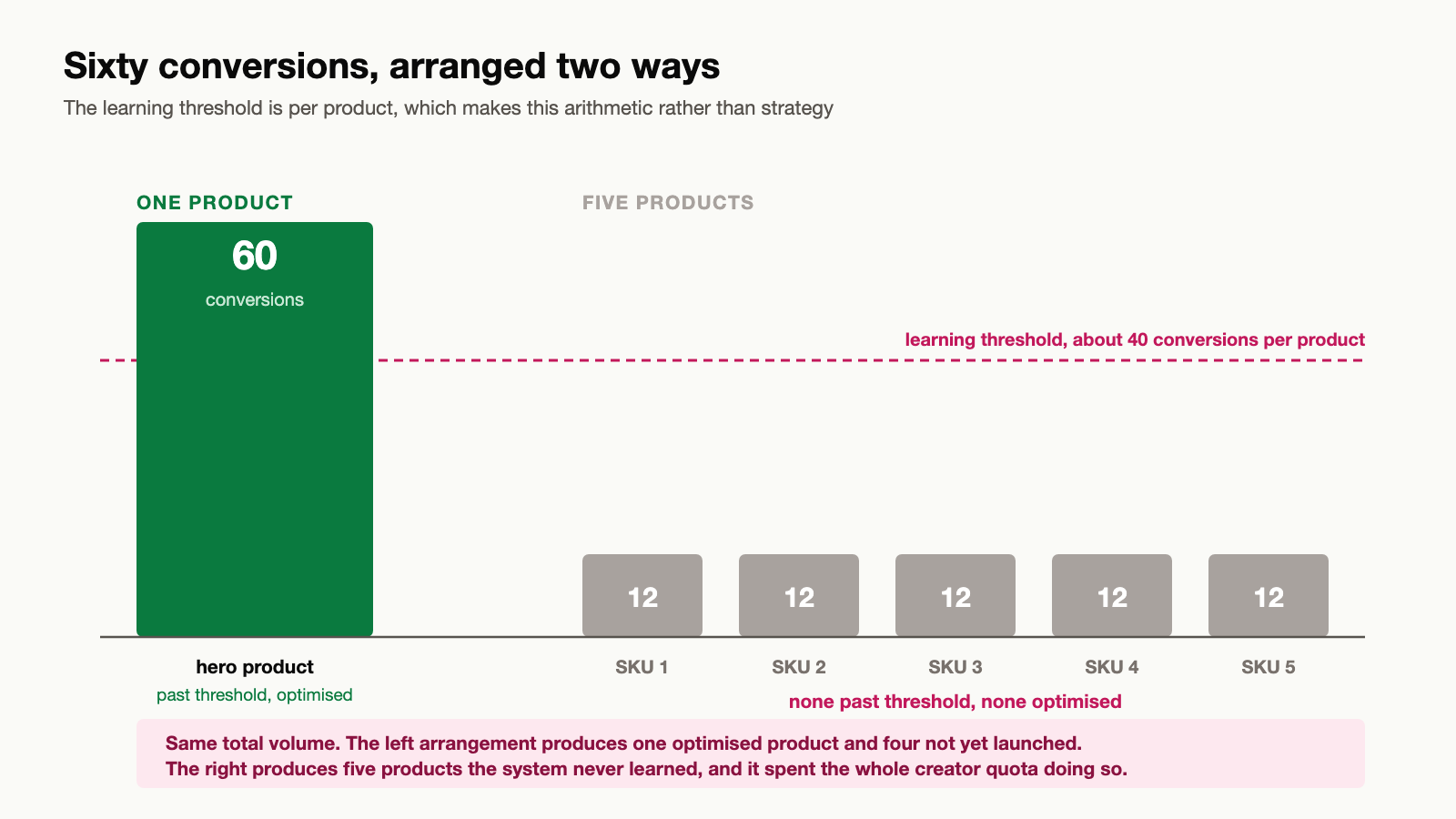
Identical total volume. One arrangement produces an optimised product and four unlaunched ones; the other produces five products the system never learned.
If the learning threshold is around 40 conversions per product and your shop can realistically generate 60 conversions in a month, then one product crosses the line and starts being optimised. Spread the same 60 across five products and every one of them sits at 12, which is to say none of them crosses. You have not launched five products. You have failed to launch one, five times, and you spent your creator quota doing it.
The quota point compounds this. Outreach is rationed, so every creator approached about a product that will never reach threshold is a slot that cannot be used on the product that might. Concentration is not a cautious strategy for people with small budgets. It is the only arrangement in which the gates open at all.
What the operational load actually is
The other reason shops stall is that the work is consistently underestimated, and not by a small margin. A programme of 25 creators runs roughly 20 to 30 hours a week once you count sourcing, briefing, sample logistics, content review and performance tracking.
That is most of a full-time role for the creator programme alone, before anyone has done live selling, customer service, listing maintenance or reconciliation. Live is a separate 15 to 25 hours a week for the sellers who make it work, as set out in live selling in Southeast Asia. A brand assigning all of this to one marketing manager alongside their existing duties has not resourced a channel, it has scheduled a disappointment.
There is a useful planning question hiding in that arithmetic. Rather than asking how much budget the channel needs, ask how many staffed hours a week the plan assumes and who is providing them. The answer is frequently nobody, and the plan usually does not say so anywhere.
The metrics that gate everything else
Two numbers sit underneath all of this and deserve to be watched more closely than revenue in the early months, because they control access rather than describing results.
Shop health, where above 80 and in the green band is the working target. This is the score that keeps you trading and influences the treatment your listings receive.
Violation points, where under 12 is the operational threshold. These accumulate quietly from listing and content issues, and they do not feel urgent until they are.
Performance score, which determines your settlement tier and therefore how much working capital the business needs to hold. Moving up a tier is worth more to a cash-constrained shop than a comparable increase in revenue.
Dispatch timeliness, which is the input most within your control and the one that moves the others fastest.
The relationship between these and the early trading restrictions that new shops face is covered in probation and the Account Health Rating. The short version is that the adjustment period resolves on schedule for anyone who ships on time, and the rating that follows it is the one worth protecting.
Opening five markets divides the quota rather than multiplying the reach
There is a harsher version of the bootstrap problem waiting for anyone treating Southeast Asia as one expansion. These are separate shops. A shop in Indonesia and a shop in Vietnam each carry their own trailing GMV, their own quota, their own performance score and their own learning phase, and none of that record travels between them.
So launching five markets at once does not give you five times the reach. It gives you five shops with very little GMV each, which means five small quotas, five separate learning phases that each need their own 40 conversions, and five slow settlement tiers holding working capital. The same total effort concentrated in one market produces one shop with real GMV, a quota that has grown, a product past threshold and a faster settlement tier. That shop is then in a position to fund the second market, which the five parallel launches never were.
This is worth saying plainly because regional expansion plans are almost always written in parallel. Five markets, one timeline, one budget divided by five. The structure of the gates punishes that arrangement specifically, and the punishment arrives four months in, disguised as the channel simply not working. Which market to concentrate on first therefore carries more weight than it appears to, and the variables that decide it are set out in choosing a Southeast Asian market to open first.
One qualification keeps this honest. Direct outreach is quota-limited, but creators can also find your products themselves through the open affiliate marketplace, and that route is not rationed the same way. A quota-starved shop should therefore make its commission terms and sample policy as easy to say yes to as possible, so that inbound creator interest does some of the work the quota will not permit. How those terms behave commercially is worked through in running a TikTok Shop affiliate programme in Southeast Asia.
A sequence that respects the gates
Pick one hero product per market and resist adding a second until the first has cleared the learning threshold. The catalogue can wait; the threshold cannot be negotiated.
Spend the full creator quota every week on that one product. Unused quota does not roll over, and a slot spent on a product that will not reach threshold is worse than an unused one.
Treat dispatch timeliness as the highest-priority operational metric in the first quarter, because it is the fastest lever on performance score and therefore on settlement speed.
Hold enough working capital for two to four weeks between order and payout, and model the reorder against settlement dates rather than against order dates.
Resource the creator programme as roughly 20 to 30 hours a week for 25 creators, and write down who is providing those hours before launch rather than discovering the gap in month two.
Only add the second product once the first is past threshold, settling on a faster tier and no longer consuming the whole quota. Then repeat the same concentration on the second.
Re-check the quota tier monthly, since it moves with trailing 30-day GMV and a good month genuinely buys you more reach the following one.
This sequence looks slow next to a launch plan with twenty listings and a regional creator brief, and it reaches meaningful volume considerably sooner, because it is the only version where the gates open in an order that compounds. The creative side of making that hero product work is a separate discipline with its own structure, covered in TikTok Shop content that converts.
"You cannot work harder than a quota. The first months are not about pushing the channel, they are about opening it in the right order, and the order is decided by which gate is currently closed."
FAQ
Why can I only contact a limited number of creators on TikTok Shop?
Because outreach is rationed by a tiered quota based on your shop's trailing 30-day GMV, and the quota refreshes weekly on Sundays. A newer shop with low GMV receives a small allowance, which is one of the least discussed constraints in the channel. It also means a new seller cannot force scale through effort alone, since the resource most needed is issued in proportion to the revenue not yet earned.
How many sales does a TikTok Shop product need before the algorithm optimises?
Roughly 40 conversions are needed to exit the learning phase. Below that threshold the system is still exploring, acquisition costs read as noisy, and performance figures do not yet describe a stable pattern. This threshold is per product rather than per shop, which is the main reason spreading early volume across a catalogue tends to leave every product stranded below the line.
Should I launch with one product or my whole catalogue?
One, in almost every case, and for arithmetic rather than stylistic reasons. If a new shop can generate around 60 conversions in its first month, concentrating them on a single product carries it past the 40-conversion learning threshold, while spreading them across five products leaves each at about 12 and none optimised. The rationed creator quota compounds the effect, since outreach spent on products that will not reach threshold cannot be reused.
How much working capital does a new TikTok Shop need?
Enough to cover two to four weeks between an order being placed and the money arriving, since settlement runs roughly a fortnight from delivery and new shops sit on the slower settlement tiers. The practical consequence is that reorder decisions should be modelled against settlement dates rather than order dates, because a shop can be profitable on paper and unable to restock in the same week.
How many hours a week does a creator programme take to run?
A programme of about 25 creators runs roughly 20 to 30 hours a week once sourcing, briefing, sample logistics, content review and performance tracking are all counted. That is close to a full-time role before live selling, customer service or reconciliation are considered. Plans that assign this work to an existing marketing manager alongside their current responsibilities tend to stall for reasons that get misread as channel weakness.
The short version
Scaling here is less about pressure and more about sequence. Reach is rationed by revenue, cash speed by record, and optimisation by volume, so the early work is opening gates rather than pushing through them. Concentrate everything on one product per market until it clears the learning threshold, spend the whole weekly quota on it, protect dispatch timeliness above all other operational metrics, and staff the creator programme honestly at something close to a full-time role. Then add the second product, and only then. It is a slower-looking plan that arrives earlier.
Sources: creator outreach quota tiering and weekly refresh via Hamster Garage; shop health, violation point and settlement tier thresholds via Shortform Nation.
Share:
Free · 24 pages
Read Chapter 1 of the Playbook
AI Foundation Models — how DeepSeek and Qwen crossed a billion downloads while Western boards were counting Mag7 capex, and which layers of the AI stack the rotation has not reached. No excerpt tricks: it is the full chapter.
You will also get the weekly newsletter. Unsubscribe any time — the link is in every email.
The Book · $99
China Market Entry Playbook 2026
456 pages across 22 industry chapters — AI, semiconductors, EVs, payments, logistics, beauty, F&B, healthcare, pets, toys. Every chapter runs the same five questions: the anchor number, the rotation underneath it, which layers of the global stack it has reached, and what to do about it. English and Simplified Chinese editions included.
Ex-Transsion Global Digital Marketing Director · Effie Awards Greater China jury member · Guest lecturer, Peking University School of Economics · Writes Annie Chan Talk, your insider lens on China.